


from The Conversation
— this post authored by Wijnand Van Tilburg, University of Essex
We all respond to boredom in different ways. Some may find a new hobby or interest, others may instead rip open a bag of crisps and binge watch a new Netflix show. Boredom may seem to you an everyday – perhaps even trivial – experience. Surprisingly, however, boredom has undergone quite a metamorphosis over the past couple of centuries.

Please share this article – Go to very top of page, right hand side, for social media buttons.
Well before the word “boredom” cropped up in the English language, one of the earliest mentions of boredom is in a Latin poem by Lucretius (99 – 55BC), who writes of the boring life of a rich Roman who flees to his country house … only to be find himself equally bored there.
The first recorded mention of the word “boredom” in the English language seems to be in the British newspaper The Albion in 1829, in the (frankly impenetrable) sentence:
“Neither will I follow another precedental mode of boredom, and indulge in a laudatory apostrophe to the destinies which presided over my fashioning.”
But the term was popularised by Charles Dickens, who famously used the term in Bleak House (1853) where the aristocrat Lady Dedlock says she has been “bored to death” by, variously, the trying weather, unremarkable musical and theatrical entertainment, and familiar scenery.

‘God, I’m just so bored.’ JeniFoto via Shutterstock
In fact, boredom became a popular theme in English Victorian writing, especially in describing the life of the upper class, whose boredom may reflect a privileged social standing. Dickens’ character James Harthouse (Hard Times, 1854), for example, seems to cherish perpetual boredom as indicative of his high breeding, declaring nothing but boredom during his life as military dragoon and on his many travels.
The existentialists’ boredom
In the second part of the 19th century and during the early 20th century, boredom gained notoriety among existentialist writers. Their view of boredom was often less than flattering, and one that confronted all of humanity, not just the upper class with its presumably empty existence.
The early existentialist Danish philosopher Søren Kierkegaard, for example, wrote:
“The gods were bored; therefore they created human beings.”
This was, according to him, only the beginning of the trouble with boredom. It would eventually lead Adam and Eve to commit their original sin.
Unsurprisingly, Kierkegaard declared boredom to be the root of all evil. Several other existentialists shared this unfavourable view. Jean-Paul Sartre called boredom a “leprosy of the soul”, and Friedrich Nietzsche, agreeing with Kierkegaard, remarked that:
“The boredom of God on the seventh day of creation would be a subject for a great poet.”
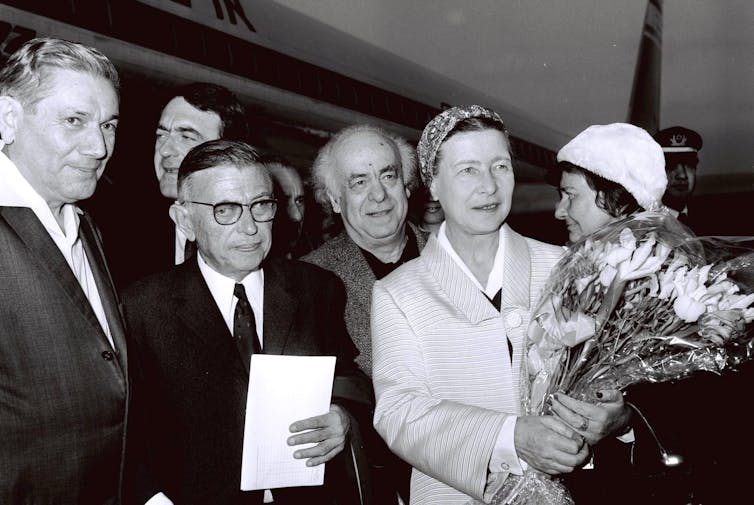
Jean-Paul Sartre and Simone de Beauvoir: often bored, but never boring. National Photo Collection of Israel
Arthur Schopenhauer took the cake when it came to being gloomy about boredom. According to him, the human capacity for boredom was nothing less than direct evidence for life’s ultimate lack of meaning. In his fittingly titled essay, Studies on Pessimism, he wrote:
The truth of this will be sufficiently obvious if we only remember that man is a compound of needs and necessities hard to satisfy, and that even when they are satisfied, all he obtains is a state of painlessness, where nothing remains to him but abandonment to boredom.
A world of boredom, the existentialists seemed to warn, is a world without purpose.
The science of boredom
The 20th century witnessed the emergence of psychology as a scientific discipline. While our understanding of many emotions slowly increased, boredom was surprisingly left alone. What little psychological work on boredom existed was rather speculative, and more often than not excluded empirical data.
These accounts hardly painted a more positive picture of boredom than the existentialists. As recently as 1972, psychoanalyst Erich Fromm blatantly denounced boredom as “perhaps the most important source of aggression and destructiveness today“.
During the past few decades, however, the image of boredom has changed once more, and with it has come an appreciation of the hitherto discredited emotion. Development of better measurement tools allowed psychologists to examine boredom with greater accuracy, and experimental methods allowed researchers to induce boredom and examine its actual, rather than presumed, behavioural consequences.
This work reveals that boredom can indeed be problematic, as the existentialists assured us. Those who bore easily are more likely to be depressed and anxious, have a tendency to be aggressive, and perceive life as less meaningfull.
Yet, psychology uncovered also a much brighter side of boredom. Researchers found that boredom encourages a search for meaning in life, propels exploration, and inspires novelty seeking. It shows that boredom is not only a common but also a functional emotion that makes people reconsider what they are currently doing in favour of more rewarding alternatives, for example increasing creativity and prosocial tendencies.
In doing so, it seems that boredom helps to regulate our behaviour and prevents us from getting stuck in unrewarding situations for too long. Rather than merely a malady among the upper classes or an existential peril, boredom seems, instead, to be an important part of the psychological arsenal available to people in the pursuit a fulfilling life.
Wijnand Van Tilburg, Lecturer, Department of Psychology, University of Essex
This article is republished from The Conversation under a Creative Commons license. Read the original article.


