


from The Conversation
— this post authored by Atif Kubursi, McMaster University
It’s hard to believe that the price of any commodity, let alone oil, can dip into negative territory. But that’s just what’s happened to oil prices.

Please share this article – Go to very top of page, right hand side, for social media buttons.
COVID-19 has prompted lockdowns, shuttered factories and stopped people from travelling. The global economy is contracting.
The pandemic has also reduced global demand for oil by about 29 million barrels a day from about 100 million a year ago. OPEC and other producers agreed to cut production by 9.7 million barrels a day, far less than the decrease in demand, leaving a huge surplus of oil on the market and no buyers.
Storage capacity on land has filled up quickly. Many oil-importing countries have stored large quantities of oil, taking advantage of cheap prices that may not last.
Some oil producers, hoping to maintain their market share, have taken to storing their excess oil at sea, leasing tankers at high costs. Some are believed to be paying in excess of US$100,000 per day for each tanker.
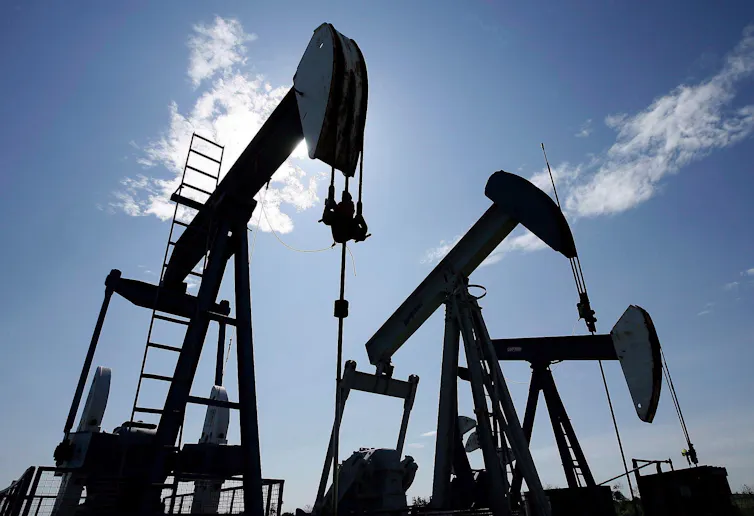
Pumpjacks pump crude oil near Halkirk, Alta., more than a decade ago. Oil prices have plunged into negative territory due to the glut created by the COVID-19 global economic shutdown. THE CANADIAN PRESS/Larry MacDougall
Oil prices will come back up
So how have Alberta oil prices and even future prices for West Texas Intermediate (WTI) slipped into negative territory?
It starts with the futures’ contracts for WTI – oil to be delivered in a few months at today’s price. It lost US$6 a barrel on Monday, fetching US$11.66, but ended the day at -US$37 as holders of future contracts tried to dump their contracts before oil is actually delivered with nowhere to store it.
But Alberta oil, primarily derived from oilsands (referred to as Western Select), typically sells at US$10 to US$15 below the price of WTI, because it has to be extracted from deep rocky terrain. That makes it harder to refine, and it also has to be transported thousands of kilometres to American refineries.
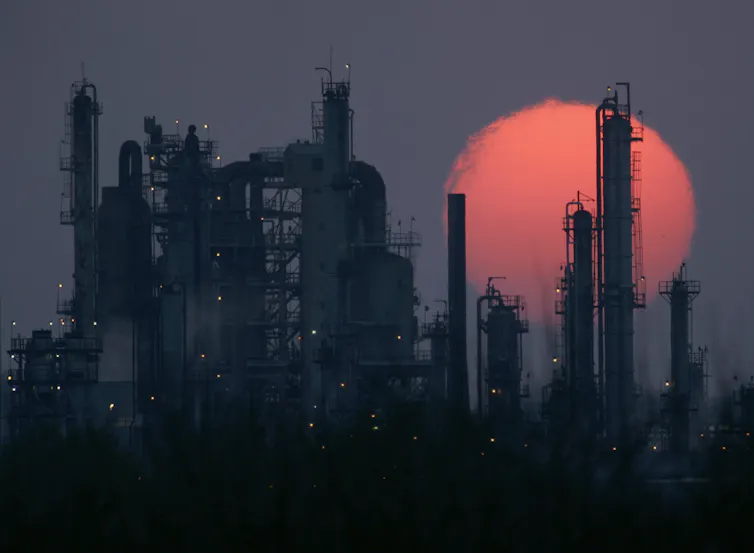
An oil refinery is seen in Kansas. Oil from Alberta’s oilsands is processed at American refineries. THE CANADIAN PRESS/AP, Charlie Riedel
And so Alberta oil prices have become negative in the sense that the benchmark price is now lower than the cost of production, transport and storage.
This state of affairs cannot be expected to last for long. Producers, in the short term, may accept prices below their variable cost as long as they are able to pay some of the costs they will incur even if oil production shuts down.
As time passes, more and more rigs will stop operating (technically, a few will be kept operational in order to avoid being compromised) and a new balance between supply and demand will be established at prices that exceed total average cost. But this doesn’t bode well for either Alberta or the United States.
Collateral damage
Alberta oil is now the collateral damage of the oil war between Russia and Saudi Arabia, with COVID-19 launching an additional attack. Either of these two factors could have disrupted Alberta’s oil production. But the Saudi-Russia hostilities combined with the global pandemic have proven to be catastrophic for Canada, and could have a similar outcome for the U.S. energy industry.
Russia and Saudi Arabia depend heavily on their oil revenues to sustain their economies. Of course, Saudi Arabia’s economy is less diversified than the Russian economy, but both share a similar distortion, where oil revenues represent a very high share of their GDPs (Saudi Arabia about 50 per cent, Russia 38.9 per cent), budgets (Saudi Arabia 87 per cent and Russia 68 per cent) and exports (Saudi Arabia 90 per cent and Russia 59 per cent. It’s difficult to believe that either country can do with such low prices.
Russia needs a price of US$60 a barrel to balance its government budget and even a higher price to balance its current account, meaning exports of goods and services minus imports of goods and services, plus net short-term capital transfers.
Saudis also need a much higher oil price
Saudi Arabia, which remains the lowest-cost oil producer in the world, can make money when the price per barrel exceeds US$20, and Russia can at a price of US$40.

Prince Abdulaziz bin Salman Al-Saud, Saudi Arabia’s energy minister, leads a recent virtual summit of the G20 energy ministers at his office in Riyadh, Saudi Arabia. (Saudi Energy Ministry via AP)
But making a profit when prices are higher than cost is not sufficient. Saudi Arabia needs an US$80-per-barrel price to balance its budget, realize its plans to diversify its economy and sustain a heavily subsidized economy. In the balance is the stability of both the Russian and Saudi Arabian political systems and current regimes.
The longer the COVID-19 pandemic lasts, the greater the damage oil producers will endure. It’s hard to tell now how high oil prices will rise once the pandemic subsides. They will likely go higher as marginal producers are eliminated, but not for long. Using oil and other fossil fuels is no longer consistent with avoiding the expected disasters of climate change. Oil is increasingly becoming a stranded asset.
Atif Kubursi, Professor Emeritus of Economics, McMaster University
This article is republished from The Conversation under a Creative Commons license. Read the original article.
.


