


Written by John Lounsbury
Prof. Nir Shaviv maintains that the role of solar activity variation in changes in the earth’s climate has been significantly underestimated. This week we have a 09 April 2018 lecture in which he reviews the data on historical changes in global climate and the correlation with changes in solar activity. He then discusses how the importance of solar activity is insufficiently included in the climate change models used by most scientists.

Please share this article – Go to very top of page, right hand side, for social media buttons.
The conclusions that Prof Shaviv has drawn include the indication that the science summarized by the IPCC work (Intergovernmental Panel on Climate Change) has overestimated the anthropogenic causes of climate change and underestimated the input of solar activity.
From Wikipedia:
Nir Joseph Shaviv (Hebrew: ניר יוסף שביב, born July 6, 1972) is an Israeli‐American physics professor. He is professor at the Racah Institute of Physics of the Hebrew University of Jerusalem,[1] of which he is now its chairman.
He is a climate change denialist known for his solar and cosmic-ray hypothesis of climate change. In 2002, Shaviv hypothesised that passages through the Milky Way’s spiral arms appear to have been the cause behind the major ice-ages over the past billion years. In his later work, co-authored by Jan Veizer, a low upper limit was placed on the climatic effect of CO2.[2]
Shaviv disagrees with the scientific consensus on human-caused climate change.[19] He claims that solar activity changes have contributed between half to two thirds of the warming over the 20th century,[20] and that climate sensitivity should be on the low side ΔTx2=1.3±0.4 °C compared with IPCC’s range of ΔTx2=1.5 to 4.5 °C per CO2 doubling.[21]
We are entering a most auspicious time for Prof. Shaviv’s theories to be tested. It is expected that we are entering a period of reduced solar activity and the earth’s temperature should therefore be decreasing (or increases should be slowing) if solar activity has a larger effect on global temperature than CO2. If this solar cycle is completed through an activity minumum in the coming decade or two, the observed temperature changes for the planet should be changed accordingly.
The coming decades may resolve the questions raised in this lecture. See Wikepedia for a summary and literature references for the solar cycle.


But the test of the solar activity effects vs. CO2 may not come to pass if new work from India is born out. From EarthSky.org:
On December 6, 2018, the Center of Excellence in Space Sciences India (CESSI) reported that two of its scientists have made a prediction for the upcoming sunspot cycle. Solar physicist Dibyendu Nandi and his Ph.D .student Prantika Bhowmik devised a new prediction technique, which simulates conditions both in the sun’s interior, where sunspots are created, and on the solar surface, where sunspots are destroyed.
Earlier predictions (like this one) have suggested the coming sunspot cycle 25 will be weaker than the current cycle 24. But, based on their model, Nandi and Bhowmik believe cycle 25 might be similar to or even stronger than 24. They expect the next cycle to start rising about a year from now and to peak in 2024. Their work was published December 6, 2018, in the peer-reviewed journal Nature Communications.
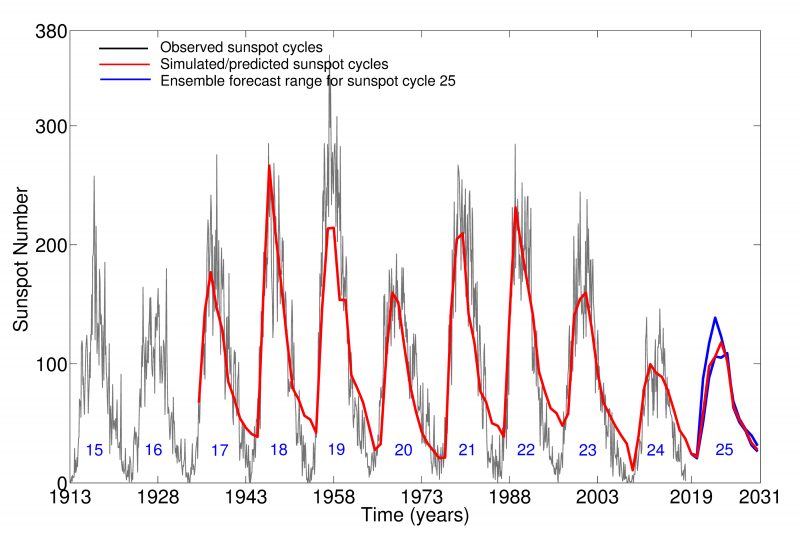
So we may or may not see a test of Prof Shaviv’s hypothesis in the near future.
Source: YouTube.
Hat tip to Clint Ballinger @clintballinger.
.


