


from the St Louis Fed
— this post authored by Bill Dupor, Assistant Vice President and Economist
New vehicle sales in the U.S. fell nearly 40 percent during the last recession. Over the 12 months ending in the fourth quarter of 2008, personal new vehicle sales fell by $107 billion. In addition, employment in the motor vehicle industry fell over 45 percent over a two-year period, and this job loss was likely amplified by effects impacting upstream and downstream industries.

In this post, we examine the relative importance of two potential causes of the auto sales decline: credit conditions and economic concerns. We’ll examine individual-level survey data collected at that time on people’s self-reported views towards car buying and their stated rationales for their views.
Potential Influences on Car Purchases
Credit/Debt Issues
Needless to say, a lot was happening in the U.S. economy during the last recession. First, the nation saw a major decline in home prices. Thus, auto purchases might have declined because homeowners felt less wealthy or because home equity that would have been used to finance auto purchases disappeared. More generally, the developing financial crisis may have reduced credit availability.
Economic Effects
Second, the economy had recently entered into a recession that was continuing to deepen. The recession began in December 2007, and the U.S. unemployment rate would climb from 5 percent to 10 percent by October 2009. The economic slowdown and increased unemployment (along with an increased risk that an employed person might lose his or her job) may have had a chilling effect on auto sales.
Sentiment about Buying a Car
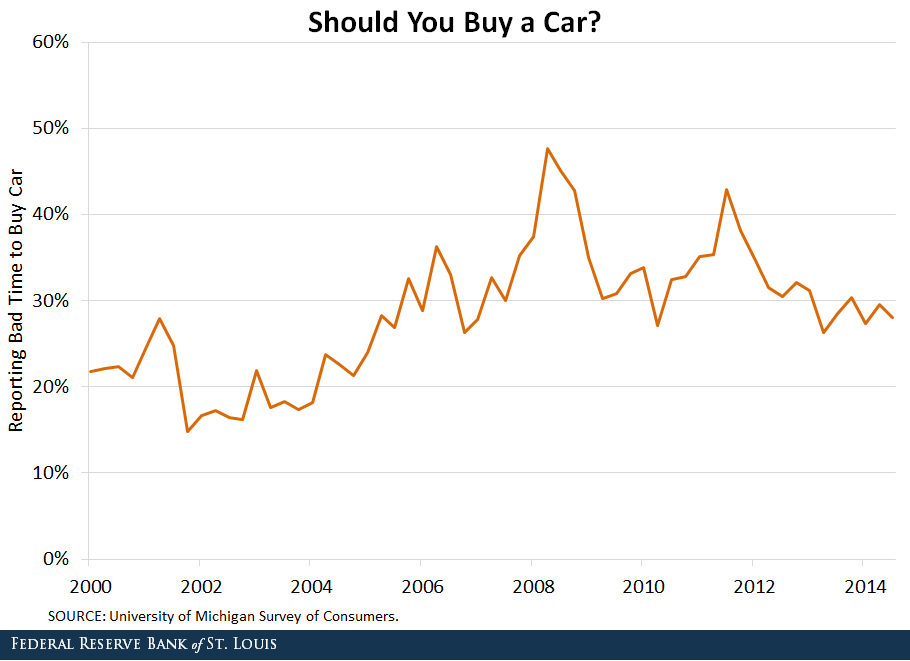
We used the University of Michigan Survey of Consumers in our analysis. Among the battery of questions the survey asked was whether the participant considered it a good or bad time to buy a car. As seen in the figure below, the percentage of individuals reporting that the concurrent quarter was a bad time to buy a car spikes around the time of the auto sales collapse. This is not surprising.
Why Is It a Bad Time to Buy a Car?
The survey probed deeper. Among those respondents who answered that it was a bad time to buy a car, surveyors asked respondents to choose (from a list of possible reasons) why they concluded that it was a bad time to buy a car.
To get a sense for how important credit conditions and economic concerns were at the time, we categorized a set of the possible reasons into either “credit/debt conditions” or “economic conditions.” Examples of the former included:
- Bad debt or credit
- Credit hard to get
- Larger/higher down payments required
Examples of the latter included:
- Bad times ahead
- Better to save money
- Cannot afford to buy now [1]
The figure below plots the percentage of individuals reporting either credit/debt conditions or economic conditions as the reason it was an unfavorable time to buy a car.
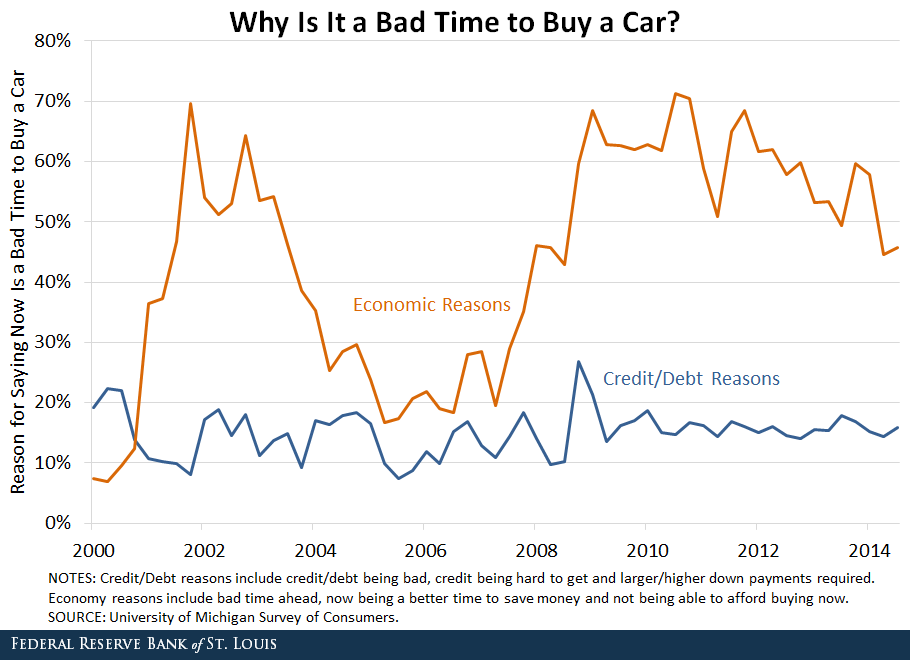
There is an overwhelming increase in the percentage that chose economic conditions. The percentage choosing the other answer stayed relatively flat. While not conclusive, we take this finding as some evidence that economic concerns were the primary drivers of the decline in auto sales during the episode.
These data – as well as other evidence on the auto sales decline, including declining home values and rising oil prices – are studied in my recent Federal Reserve Bank of St. Louis working paper “The 2008 Auto Market Collapse,” co-authored with Rong Li of Renmin University, Saif Mehkari of the University of Richmond and Yi-Chan Tsai of the National Taiwan University.
Notes and References
[1] Other categories of possible reasons for it currently being a bad time to buy a new car – such as changes in the price of gasoline – were dropped from our analysis.Additional Resources
- On the Economy: The Ties That Bind: The Auto Industry and the U.S. Economy
- On the Economy: Last Recession Effect: New Car Buyers Hold Cars Longer
- On the Economy: Did NAFTA Shift Car Making to Other Countries?
Source
Disclaimer
Views expressed are not necessarily those of the Federal Reserve Bank of St. Louis or of the Federal Reserve System.


