


from The Conversation
— this post authored by Ben Woodcock, Centre for Ecology & Hydrology
The humble honeybee and other pollinating bees and butterflies are all vital parts of the global food chain. Without them honey, strawberries, apples, pears or even a cold pint of cider just would not exist.

Please share this article – Go to very top of page, right hand side, for social media buttons.
But the burning question that I and other ecologists are asking is whether these insects – the majority of which are not pests – can coexist with our pesticides. In particular, scientists are worried about a class of pesticides known as “neonicotinoids”, which are more targeted in their application by being coated to the seed rather than being sprayed directly onto the crop. The farmers who use these chemicals aren’t beekeepers, after all, and their main concern is to ensure fruitful crops of oilseed rape and the like.
The jury is still out on whether the current EU ban on the use of neonicotinoids should be lifted, with a verdict due in the autumn. Clearly, legislators need to assess all the evidence first, yet previous research has been inconclusive. Some studies have shown clear evidence of harm to bees, while others raise more questions than answers.
Colleagues and I at the UK’s Centre for Ecology & Hydrology, along with international collaborators, have added to the evidence base with the first pan-European experiment to assess neonicotinoid impacts on honeybees and wild bees in a field-realistic way. Our work shows that under certain conditions and in certain countries neonicotinoids do harm bees.
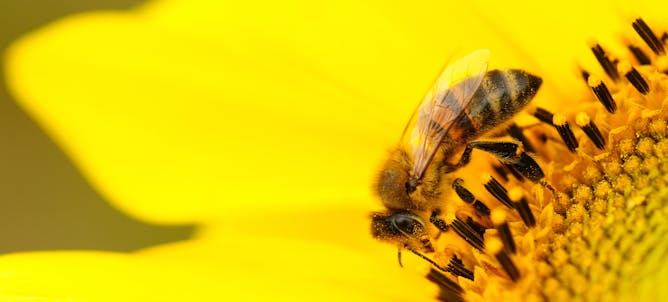
Honey bee colonies exposed to neonicotinoids were generally smaller the following spring. Lucy Hulmes / CEH, Author provided
In our experiment, undertaken at sites in the UK, Germany and Hungary, we exposed honeybees to oilseed rape treated with one of two neonicotinoids (clothanidin, from Bayer CropScience, or thiamethoxam, manufactured by Syngenta) or nothing at all. We repeated the experiment for two other species of wild bee, the buff-tailed bumblebee (Bombus terrestris) and the red mason bee (Osmia bicornis).
Our findings, published in Science, showed that exposure to treated crops reduced survival rates in honeybee colonies over the winter – a key measure of year-to-year viability – in two of the three countries. In Hungary, colony numbers fell by 24% in the following spring. In the UK, honeybee colony survival was generally very low, but lowest where bees fed on clothianidin-treated oilseed rape in the previous year. Perhaps surprisingly, no harmful effects on overwintering honeybees were found in Germany.
Neonicotinoids were linked to lower reproductive success in both bumblebees and red mason bees, across all three countries.
We believe the between country differences in the response of honeybees may be explained by factors including the availability of alternative flowers for bees to feed on, as well as general colony health. While the Hungarian and UK honeybees we looked at tended to be more diseased, the hives in Germany happened to be larger, showed little evidence of disease and had access to a wider range of wild flowers to feed on. Differences in the honeybee colonies between countries were not part of the experimental design, but were rather a product of where we locally sourced them. Ultimately the study was designed just to test for between-country differences in how bees respond to neonicotinoid treated oilseed rape.
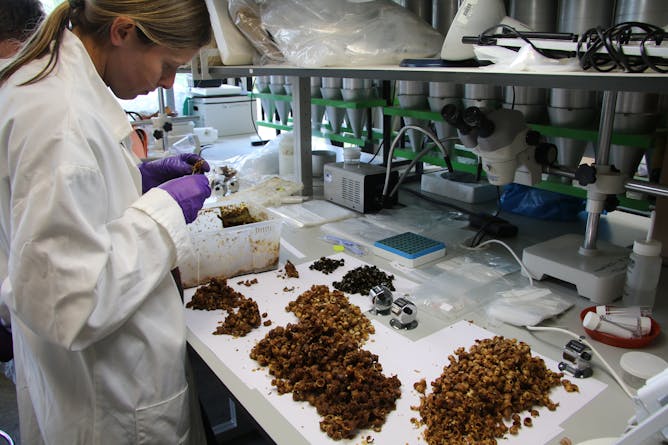
Assessing bumblebee hives back in the lab. CEH, Author provided
The effect of neonicotinoids is subtle and simply being exposed to treated crops does not mean a colony will die. But our research suggests that bees are most vulnerable to these pesticides when they are stressed and already not doing so well.
Don’t give up on neonicotinoids
Neonicotinoids do have a vital role to play in food production. As they can target particular insects they can be used in low dosages, reducing the need for broad spectrum insecticide sprays. They are also useful in controlling pests which have already developed some resistance to other pesticides.
The question then is could we learn to live with neonicotinoids? How can they on the one hand benefit the farmer – whose primary crops are not necessarily bee-dependent – while on the other hand not adversely affect pollinators?

Bee inspection, Germany. CEH, Author provided
There may be ways to mitigate the negative impacts of neonicotinoids on bees through improved honeybee husbandry or making more flowering plants available for bees to feed on across non-cropped areas. But this needs further research.
Although poor health is likely to make honeybees more susceptible to neonicotinoids, it’s unlikely to be as simple as asking people to ensure their hives are healthy. No bee keeper deliberately has unhealthy hives, although there is arguably always scope for new approaches.
It may be easier to achieve the creation of new habitats rich in flowering plants, in agricultural landscapes often stripped of these key resources. Certainly, UK agri-environment schemes can and do provide a mechanisms to achieve this. For wild bees, nesting habitats are also often absent, and creating such areas in agricultural land may also help. Healthy populations of honeybees and wild bees are far more likely to be able to cope with exposure to neonicotinoids, as well as other pesticides that they may be exposed to in these systems.
 The challenge for the EU, farmers, conservationists and consumers – and perhaps significantly the UK post-Brexit – is how to navigate the evidence and agree on solutions. It’s a challenge that will reap benefits not only in farmers’ fields but also on dinner menus – and perhaps most crucially on the very existence of global biodiversity.
Ben Woodcock, Ecological Entomologist, Centre for Ecology & Hydrology
This article was originally published on The Conversation. Read the original article.


