


One of the key traits that make human beings unique on planet Earth is that we’re aware of our own mortality.

Scientific advances have given us insight into which behaviors may prolong life, and which activities carry the greatest risk of death. Naturally, there have been some unique attempts to create a unified structure around risk and benefit, and to quantify every aspect of the human lifespan.
Certain events – such as a parachute failing to open or being hit by a meteor – have an easily quantifiable effect on life, but how do we measure the riskiness of day-to-day habits and situations? This is where a unique unit of measurement, micromorts, comes into play.
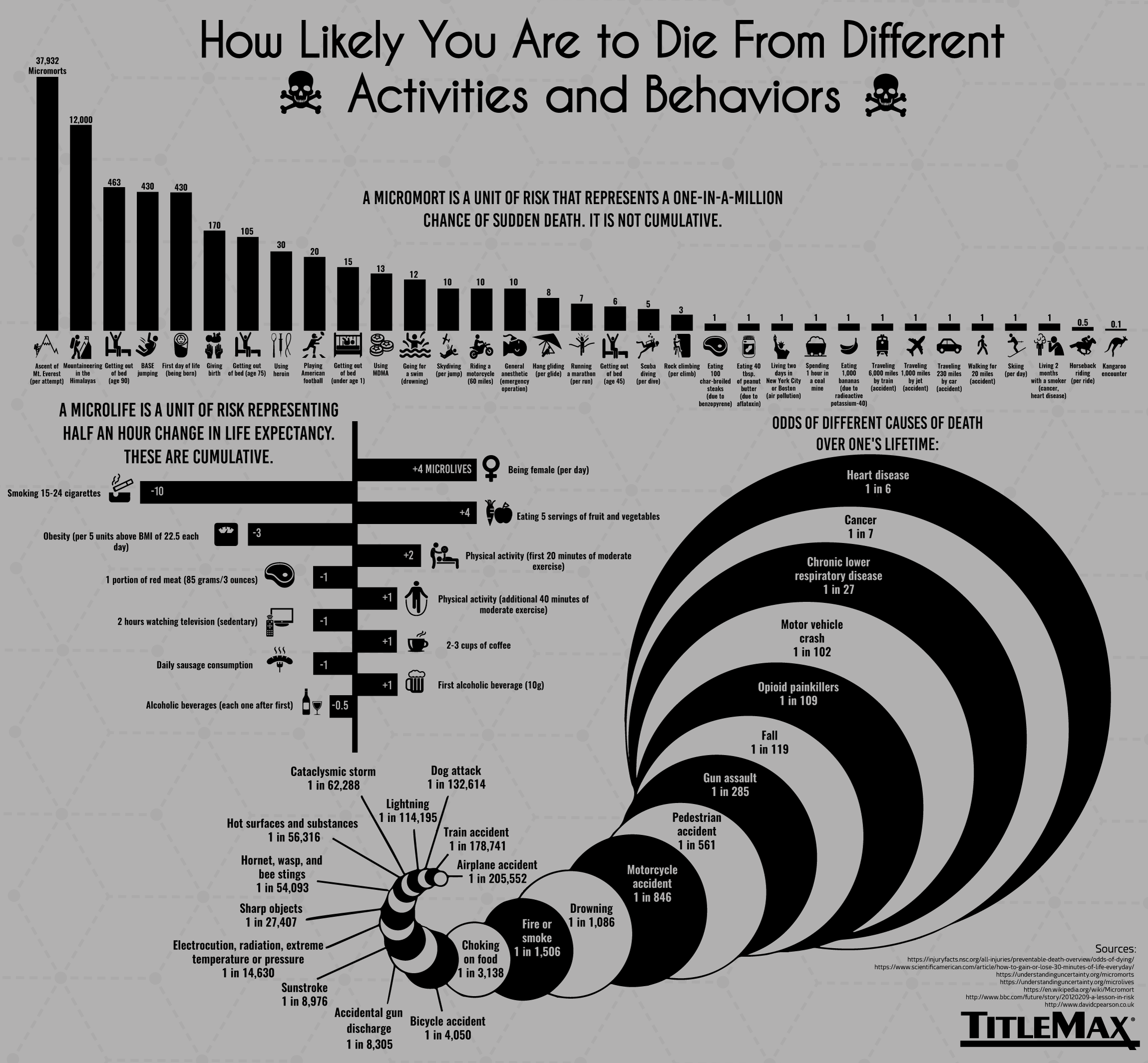
This concept, invented by renowned decision analyst Ronald A. Howard, helps compare any number of potentially lethal risks. One micromort equals a one in a million chance of sudden death. Here’s the riskiness of various activities measured in micromorts:
Life Units
The average person, by the time they reach adulthood, will live approximately one million half-hours. Those 30 minute units are known as microlives.
The microlife concept was invented by professor David Spiegelhalter as a way to measure the consequences of various behaviors. For example, 20 minutes of physical activity earns us two microlives, while watching TV for two hours subtracts one microlife.
This measurement extends beyond nutrition and eating habits. Simply living in a modern era earns us an additional 15 microlives per day compared to those who lived a century earlier.
Source: https://www.titlemax.com/discovery-center/lifestyle/life-expectancy-by-activity-behavior/


