Written by Econintersect
Early Bird Headlines 20 September 2016
Econintersect: Here are some of the headlines we found to help you start your day. For more headlines see our afternoon feature for GEI members, What We Read Today, which has many more headlines and a number of article discussions to keep you abreast of what we have found interesting.

Global
Asia markets mixed as traders gear up for BOJ, Fed decisions Wednesday (CNBC) Asia markets traded mixed on Tuesday, with traders likely taking to the sidelines to await Wednesday’s closely watched monetary policy decisions due in the U.S. and Japan.

Oil prices fall as Venezuela says market is 10 percent oversupplied (CNBC) Oil prices fell on Tuesday after Venezuela said that global crude supplies needed to fall by 10 percent in order to bring production down to consumption levels, confirming analyst views that markets remain heavily oversupplied. Global oil supply of 94 million barrels per day needs to fall by about a tenth if it is to match consumption, Venezuela’s Oil Minister Eulogio Del Pino said on Monday. International benchmark Brent crude oil futures were trading at $45.80 per barrel at 0048 GMT, down 15 cents from their last close. U.S. West Texas Intermediate (WTI) crude futures were down 25 cents at $43.05 a barrel.
Expert says meteor could wipe out Earth next week marking the end of humanity (Standard Digital, Kenya) Is this why they call it ‘darkest Africa’?
Slump in US imports threatens to derail emerging market growth (Financial Times) Demand for emerging market exports has hit a new post-crisis low, with US imports from China dropping sharply in July in the latest sign that the engine of growth for the world’s developing economies is sputtering. The US has been one of the bright spots in an otherwise gloomy global economy and one of the few sources of growth for emerging market exporters, which last year saw exports of goods and services fall for the first time since the global financial crisis, according to figures from the UN.


Heavy-Equipment Glut Weighs on Machine Makers (The Wall Street Journal) Used machinery is flooding the secondhand market, piling more pain on equipment makers battling slack demand from any customer that mines, moves or refines commodities amid a global slump in the value of everything from coal to corn. Instead of buying a new $500,000 bulldozer or $300,000 excavator, many construction firms and other equipment users are renting or entering longer-term leases for machines to expand their fleets or replace worn out equipment, dealers and analysts say. Dealers, in turn, are keeping smaller inventories of new wheel loaders, backhoes and other machinery. That is hurting sales for Caterpillar Inc., Volvo AB, Deere & Co. and other manufacturers.

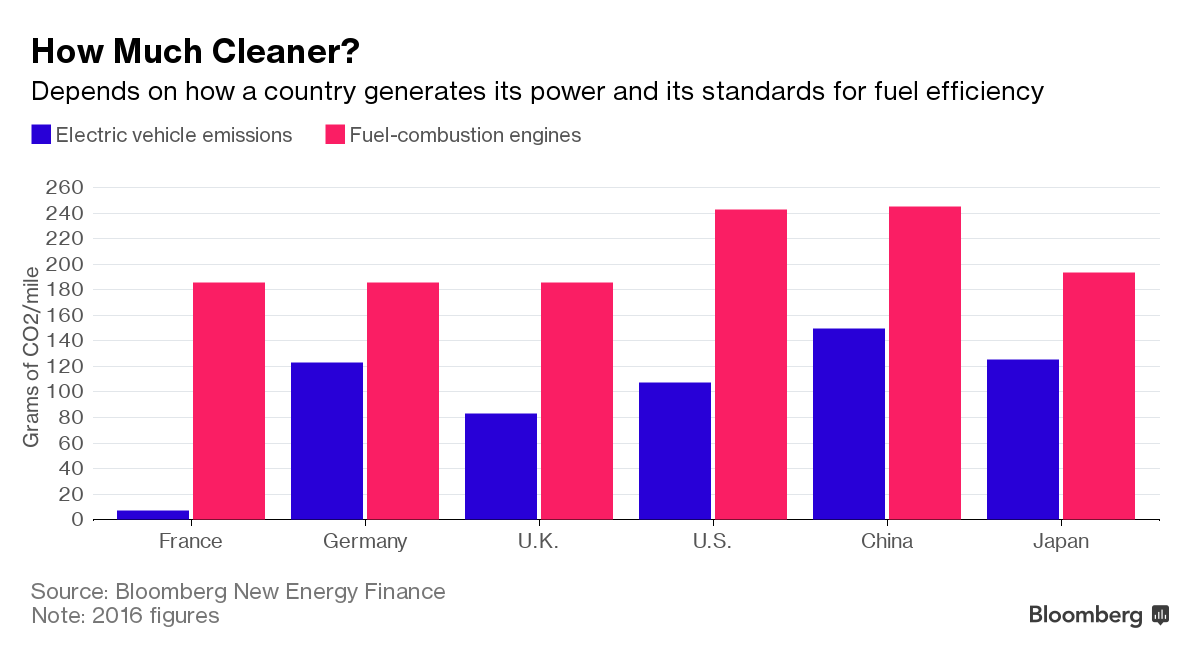
How Much Cleaner Really Is a Tesla? Depends on Where You Are (Bloomberg) How much cleaner are electric cars than the fossil-fuel powered alternative? The answer depends on exactly where you charge the batteries. In places that use low-carbon energy sources like renewables and nuclear, electric vehicles dramatically reduce emissions. There’s less of a difference in regions where most of the power comes from coal, like China.
U.S.
Elizabeth Warren is still mad about the financial crash, and we should be too (The Guardian) As we pass the eight anniversary of the crash, the senator is rightly demanding that the government explain why it has failed to prosecute those responsible. Econintersect: We expect that history’s harshest criticism of Obama’s presidency will be that he failed to address financial sector dysfunction and criminality.
Skeptical of Russia, Clinton seen going toe-to-toe with Putin (Reuters) When Hillary Clinton attended her first major White House meeting on Russia in February 2009, the new secretary of state insisted that she wanted to play a leading role in President Barack Obama’s effort to “reset” U.S. relations with Moscow. But while Clinton became implementer-in-chief for one of Obama’s signature first-term initiatives, she was consistently more skeptical than most of his top aides about how far Russian leader Vladimir Putin was prepared to go in turning the page, according to current and former U.S. officials. A hardline with Russia is what experts expect if she is elected president.
Senate negotiators near deal to fund government (The Hill) Senate negotiators are nearing a deal to fund the government that would allow lawmakers to get out of town and back on the campaign trail by the end of the week. The Senate delayed a procedural vote set for Monday evening on the measure, which would fund federal department and agencies through Dec. 9, to Tuesday afternoon. The vote is now set for 2:15 p.m. on Tuesday. The key issue in the talks is resolving a fight that would prevent $1.1 billion in new money to fight the spread of the Zika virus from being used by Planned Parenthood clinics in Puerto Rico. Republicans are close to a deal that would nix that language and allow the clinics in Puerto Rico, where Zika is rampant, to use the money.
Trump: Too bad NY suspect will get ‘amazing’ hospital and ‘outstanding lawyer’ (The Hill) said it’s a “sad, sad situation” that the New York bombing suspect will likely receive “amazing” hospitalization and be represented by and “outstanding” lawyer. Speaking from Fort Myers, Fla. Monday, Trump predicted that Ahmad Khan Rahami will receive a lesser sentence as the case drags for years through the court system. Rahami was arrested Monday and is believed to be responsible for the explosion in Manhattan on Saturday night that left 29 people injured.
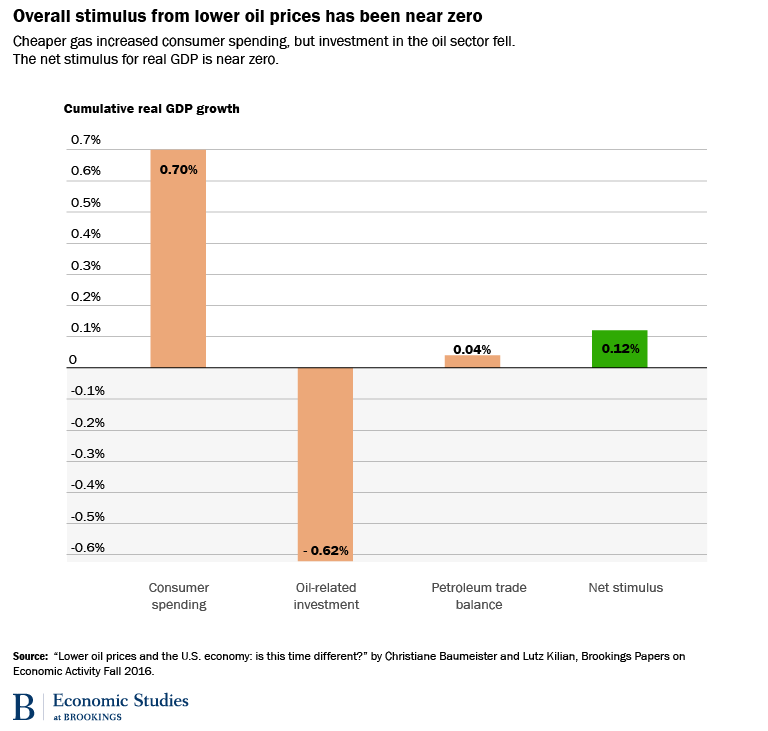
Why didn’t the recent oil price decline help the U.S. economy more? (James Hamilton, Econbrowser) JH has contributed to GEI. The reason the current low oil price regime did not boost GSP as much as the 2008-09 price slump derives from the higher U.S. oil production levels this time. There was an increase in consumer spending but it was largely offset by decreased oil sector investment.
UK
London’s core role in euros under spotlight after Brexit vote (Reuters) Banks in Britain are the largest borrowers and lenders of euros outside the single currency area, BIS figures showed on Sunday, underscoring what’s at stake for Britain if its lenders fail to maintain access to EU markets after the country leaves the bloc. The Bank for International Settlements (BIS) said in its Quarterly Review that Britain’s vote in June to leave the European Union has focused attention on the role of London in the European and international banking system. The forum for central banks gave no views on how the City of London, one of the world’s leading financial hubs and single biggest tax earning sector for the UK, would fare after Brexit.
North Korea
U.S., China to step up cooperation on North Korea (Reuters) U.S. President Barack Obama and Chinese Premier Li Keqiang agreed on Monday to step up cooperation in the United Nations Security Council and in law-enforcement channels after North Korea’s fifth nuclear test, the White House said. China and the United States are also targeting the finances of Liaoning Hongxiang Industrial, a Chinese conglomerate headed by a Communist Party cadre, that the Obama administration thinks has a role in assisting North Korea’s nuclear program, the Wall Street Journal reported on Monday. U.N. diplomats say the two countries have started discussions on a possible U.N. sanctions resolution in response to the nuclear test earlier this month, but Beijing has not said directly whether it will support tougher steps against North Korea. Obama met Li on the sidelines of the annual United Nations General Assembly session in New York.
China
Loan Demand Weakens to Historic Low (Caixin Online) The willingness of Chinese companies to borrow reached a 12-year low in the third quarter, according to a survey published by the country’s central bank on Sunday. Amid an economic slowdown, the overall index of loan demand was at 55.7 in the third quarter, the lowest since the People’s Bank of China started to compile the data in 2004. The index of loan demand from medium-sized enterprises fell to 52 and for small business to 55.8, both historic lows. However, the figure for large corporations slightly rebounded at 51.4, up 0.1 points from a quarter earlier. However, also see next article.
China’s credit binge increases risk of banking crisis, says watchdog (The Guardian) The slowdown in credit additions for small and medium sized companies (preceding article) is not seen as impacting the risk of a banking crisis due to a debt overload.
Australia
Robbing workers to pay for company tax cuts (Macro Business) The author opposes the cut of corporate income taxes from 30% to 25% for two reasons:
Benefits from cutting company taxes would primarily flow offshore to foreign owners/shareholders.
A company tax cut is a huge cost to the budget that would need to be made up by either raising taxes elsewhere or cutting government expenditure on public services and/or infrastructure – neither of which is a desirable outcome.
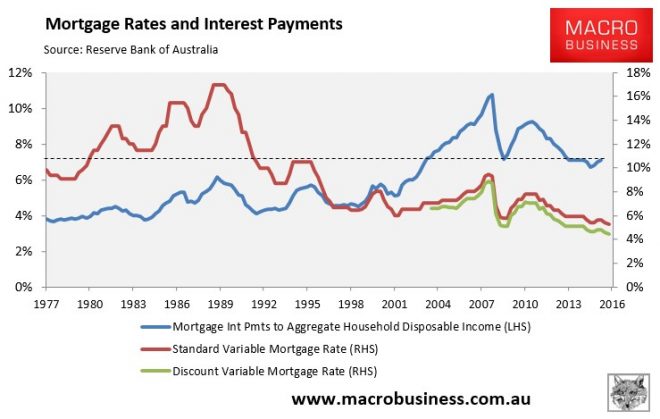
Australians are stuffed full of household debt (Macro Business) And despite record low mortgage rates, Australia’s mortgage slaves are still sacrificing a higher share of their income to pay mortgage interest (let alone principal) than when mortgage rates peaked in 1989-90. Australians have DSRs (debt service ratios) above 8 other developed economy country’s and trail only Norway and Denmark.