


by Lakshman Achuthan, Co-Founder and Chief Operations Officer of ECRI
Growing ranks of the great and the good are worried that the global economy, like Humpty Dumpty, will have a great fall, never to be put together again. We understand their apprehension, given our concern since the summer of 2008 about collapsing trend growth.

But in terms of our current assessment of global recession risk, we aren’t ready to join in. This is because the major developed economies aren’t yet in windows of vulnerability that our leading indexes are designed to detect.
In fact, over five years ago we had outlined why the alternatives to Greek default were unworkable, having discussed more than a decade ago why “the European project may run aground on the shoals of its own contradictions.” And the bad news is that Greece isn’t the only Eurozone problem, merely the most immediate one.
Today, for example, in contrast to Greece, there’s optimism about Spain, which continues to recover from a brutal five-year recession. The optimism really stems from the fact that, unlike Greece, it’s now in a business cycle upturn, as shown by the growth rate of ECRI’s Spanish Coincident Index (Chart 1), which includes the key measures of output (including GDP), employment, income and sales that delineate the timing of recessions. The chart covers a ten-year time frame starting in 2007, with the dark shading showing the period of the 2008-13 Spanish recession, and the orange-shaded areas marking off the slowdowns that we call growth rate cycle (GRC) downturns.
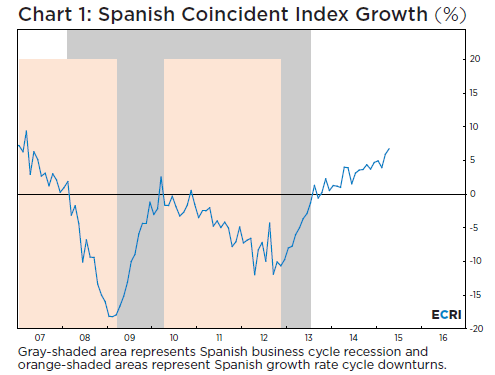
Please note that in 2009-10 there was a clear revival in Spanish growth, with quarterly annualized GDP growth rising from under -6% to over +1% – a seven-and-a-half-percentage-point swing. But that didn’t end the recession, and growth relapsed, becoming progressively more negative until 2012, when the next GRC upturn took hold, eventually ending the recession.
Abortive GRC upturns, like the one in 2009-10, are highly unusual. It tells us that Spanish trend growth must have been well below zero at the time, making it really hard to escape the recessionary clutches of negative growth even during a cyclical upturn in growth.
The other example of such behavior that comes to mind is from the U.S. – during its Great Depression. Just like Chart 1 on Spain, Chart 2 shows a ten-year period of coincident index growth, this time from 1929-38. The dark shaded areas are recessions, and the orange-shaded areas are GRC downturns.
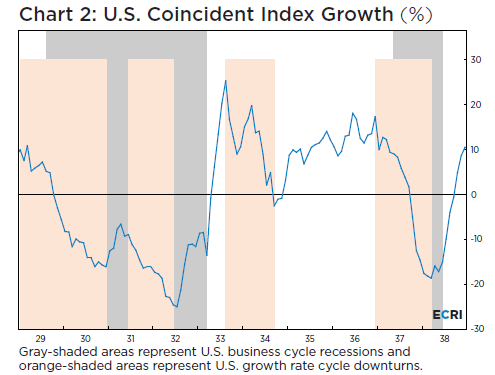
So here again, in 1930-31, there was a clear revival in growth, with quarterly annualized GNP growth – part of the U.S. Coincident Index – rising from -17% to +2%, which is a 19-percentage-point swing; only to relapse and becoming progressively more negative until 1932, when the next GRC upturn took hold, eventually ending the recession.
What followed is interesting but not widely known. Growth skyrocketed in 1933, only to soon fall back. But in the 1933-37 period, between the two dark shaded areas, real GNP growth averaged over +10% per year. Even so, the U.S. fell back into a deep recession in 1937-38, prolonging the Great Depression.
The moral of the story is that, just because it looks like a solid cyclical rebound from a deep recession, it doesn’t necessarily follow that the structural problems have been resolved. So it’s important not to confuse cyclical recoveries with what’s happening with long-term secular trend growth, and extrapolate those recoveries years into the future.
The good news for Spain is that it’s still rebounding from a severe recession, which should support Spanish growth for the time being. But given its sub-1% trend GDP growth, one shouldn’t presume that – just because the business cycle has turned up – trend growth has turned the corner too.
Confusing a cyclical upswing with improved long-term trend growth, and thus projecting cyclical upswings into the relatively distant future, people often become overly optimistic during business cycle upturns. But the structural problems cannot be wished away.
Right now, no matter what the source of the potential shock – Greece, China or the Fed – the major developed economies are unlikely to be tipped into recession. No doubt this will change in time, and the U.S., in particular, bears close watching. But it’s too soon to fret about recession just yet.


