


Written by Lance Roberts, Clarity Financial
Last weekend, all eyes were focused on the meeting between President Trump and President Xi Jinping. If this were a pay-per-view event, it might well rival the “Silva vs. Franklin” matchup at UFC 147 for total viewership. (That’s a joke, it was one of the lowest viewed PPV ever for the UFC).

Please share this article – Go to very top of page, right hand side, for social media buttons.
Kidding aside, there was a tremendous amount of “hope” currently built into the market for a “trade war truce” this weekend. However, as we suggested previously, the most likely outcome was a truce…but no deal.
That is exactly what happened. As noted by CNBC:
“Both sides confirmed in separate comments that they did not plan to levy any new tariffs against each other’s products at the present time. For one, Chinese state-run press agency Xinhua described the meeting result as the presidents agreeing ‘to restart trade consultations between their countries on the basis of equality and mutual respect.’
Speaking after the bilateral, Trump said it had gone as well as it could have, and that negotiations with China would continue. ‘We are right back on track,’ the president said.”
While the markets will likely react positively next week to the news that “talks will continue,” the impact of existing tariffs from both the U.S. and China continue to weigh on domestic firms and consumers.
More importantly, while the continued “jawboning” may keep “hope alive” for investors temporarily, these two countries have been “talking” for over a year with little real progress to show for it outside of superficial agreements.
Importantly, we have noted that Trump would eventually “cave” into the pressure from the impact of the “trade war” he started.
This was evident in this weekend’s agreement:
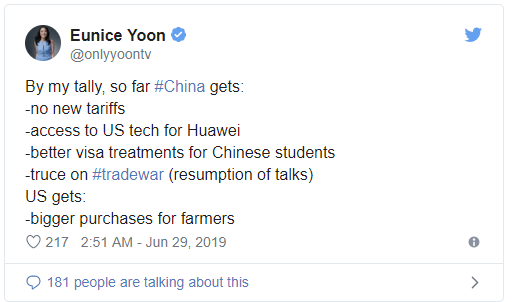
By agreeing to continue talks without imposing more tariffs on China, China gains ample running room to continue to adjust for current tariffs to lessen their impact. More importantly, Trump gave up a major bargaining chip – Huawei.
“One of the things I will allow, however, is – a lot of people are surprised we send and we sell to Huawei a tremendous amount of product that goes into a lot of the various things that they make – and I said that that’s OK, that we will keep selling that product.”
No, a lot of people weren’t surprised, just Trump as there has been pressure applied by U.S. technology firms to lift the ban on Huawei. While he may have appeased his corporate campaign donors for now, Trump gave up one of the more important “pain points” on China’s economy.
This gives China much needed room to run.
Let’s review what we said a couple of months ago as to why their will ultimately be no deal.
“The problem, is that China knows time is short for the President and subsequently there is ‘no rush’ to conclude a ‘trade deal’ for several reasons:
- China is playing a very long game. Short-term economic pain can be met with ever-increasing levels of government stimulus. The U.S. has no such mechanism currently, but explains why both Trump and Vice-President Pence have been suggesting the Fed restarts QE and cuts rates by 1%. (Update: Trump says the U.S. should have Mario Draghi at the helm of U.S. monetary policy.)
- The pressure is on the Trump Administration to conclude a “deal,” not on China. Trump needs a deal done before the 2020 election cycle AND he needs the markets and economy to be strong. If the markets and economy weaken because of tariffs, which are a tax on domestic consumers and corporate profits, as they did in 2018, the risk off electoral losses rise. China knows this and are willing to ‘wait it out’ to get a better deal.
- As I have stated before, China is not going to jeopardize its 50 to 100-year economic growth plan on a current President who will be out of office within the next 5-years at most. It is unlikely, the next President will take the same hard line approach on China that President Trump has, so agreeing to something that is unlikely to be supported in the future is unlikely. It is also why many parts of the trade deal already negotiated don’t take effect until after Trump is out of office when those agreements are unlikely to be enforced.
In the meantime, as noted in #3 above, corporate profits continued to come under pressure. As noted previously, corporate profits have declined over the last two quarters and are at the same level as in 2014 with the stock market higher by almost 60%.
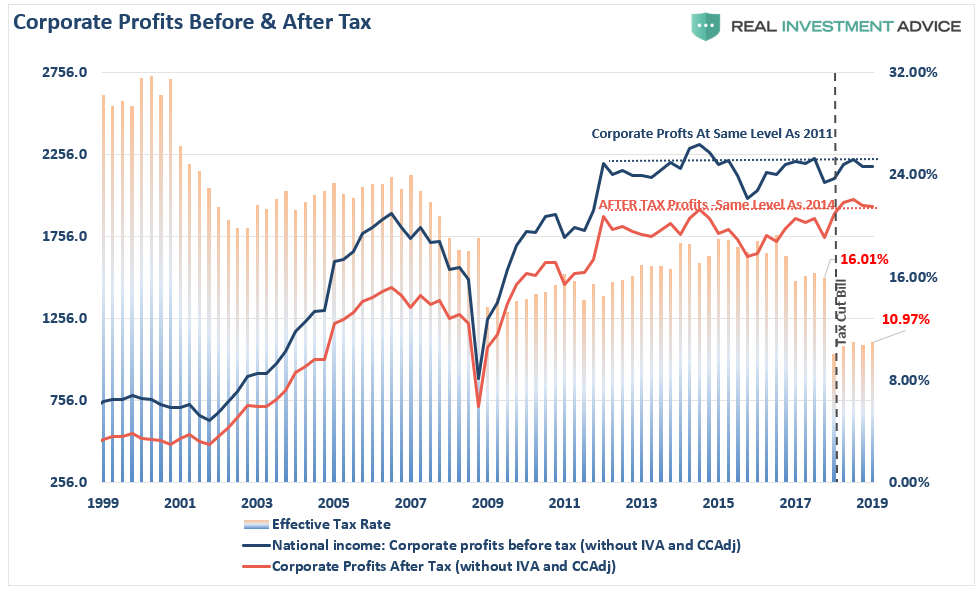
But, if you think China is going to acquiesce any time soon to Trump’s demands, you haven’t been paying attention. China has launched a national call in their press to unify support behind China’s refusal to give into Trump’s demands. To wit:
“Lying behind the trade feud is America’s intention to stifle China’s development. The U.S. wants to be a permanent leader in the world, and there is no way for China to avoid the ‘storm’ through compromise.
History proves that compromise only leads to further dilemmas. During previous trade tensions between the U.S. and Japan, Japan made concessions. As a result, its political stability and economic development were adversely affected, with structural reform being suspended and hi-tech companies being severely damaged.
China, with a population of 1.4 billion, is the world’s largest manufacturing base. Industrial upgrading and hi-tech innovation are crucial to China’s economic development. China needs to leave more resources to its descendants by protecting the environment, and reaping the dividends of further opening-up. These are the core interests of China, and it will never give them up.
The only way for a country to win a war is through development, not compromise. To achieve development, China will open its door wider to the world and fight to the end.”
These are Xi Jinping’s mandates, dictated directly from his party, for the meeting with the United States president in Osaka.
The only possible outcome for Trump was exactly what happened. Nothing. Just an agreement to talk more.
While Trump may be following his “Art Of The Deal” tactics, Xi is clearly operating on the foundation of Sun Tzu’s “The Art Of War.”
“If your enemy is secure at all points, be prepared for him. If he is in superior strength, evade him. If your opponent is temperamental, seek to irritate him. Pretend to be weak, that he may grow arrogant. If he is taking his ease, give him no rest. If his forces are united, separate them. If sovereign and subject are in accord, put division between them. Attack him where he is unprepared, appear where you are not expected.“
China has been attacking the “rust-belt” states, which are crucial to Trump’s 2020 re-election, states with specifically targeted tariffs. As noted by MarketWatch:
“China has lashed back with tariffs on $110 billion in American goods, focusing on agricultural products in a direct and painful shot at Trump supporters in the U.S. farm belt.”
While Trump is operating from a view that was a ghost-written, former best-seller, in the U.S. popular press, XI is operating from a centuries-old blueprint for victory in battle.
China clearly won this round, and the pressure is now squarely on Trump to get a deal done before the 2020 election.
That isn’t likely going to happen.


