


Written by Lance Roberts, Clarity Financial
–this post authored by Tom McClellan
Make me Emperor for a day, and I would compel the FOMC to outsource interest rate policy to the bond market. Why should we pay 12 experts, most with expensive Ivy League PhD degrees, to do what the bond market can do far more efficiently (and cheaply)?

Please share this article – Go to very top of page, right hand side, for social media buttons.
This week’s chart compares the 2-year T-Note yield to the stated Fed Funds target rate. The FOMC has actually said that the target rate is 1.5% to 1.75%, so I’m splitting the difference by calling it 1.625%. What this chart shows is that first, the two interest rates are very strongly correlated over time, which is as one would expect. But second and more importantly, the 2-year yield knows best what the Fed should do. And the Fed screws up when it does not listen.
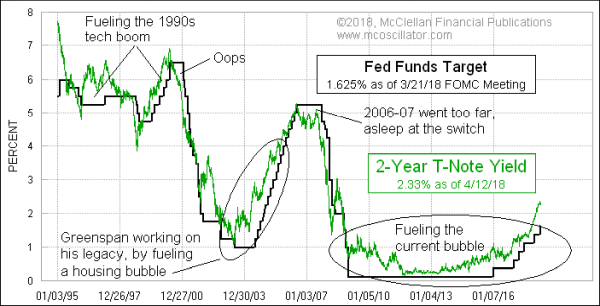
If the FOMC would just set the Fed Funds target to within a quarter point of wherever the 2-year T-Note yield is, we would have fewer and quieter bubbles, and also much less severe economic downturns. For whatever reason, the FOMC members have not learned this lesson. None of them, as far as I know, is a subscriber, which is their loss.
The “Taylor Rule” for setting short term rates is an equation involving figures for GDP, inflation rate, and “potential output”, all of which are numbers which can be fudged by statisticians.
The “McClellan Rule” is much simpler: listen to the 2-year T-Note Yield, which the statisticians cannot monkey around with. By this rule, the Fed is still being overly stimulative, by setting the Fed Funds target well below where it ought to be. In other words, the Fed is being “too loose” with interest rate policy, according to this measure.
But complicating that equation is what else the Fed is doing, in terms of liquidating its holdings of Treasury debt and Mortgage Backed Securities (MBS). During 3 separate rounds of “quantitative easing” or QE, the Fed got up to total holdings of $4.25 trillion. At the most rapid rate of acquisition, the Fed was buying up $85 billion per month in 2014.
In 2017, the Fed announced it would be starting to unwind those holdings, slowly at first, but accelerating to a rate of $30 billion per month of “quantitative tightening” (or QT) now in Q2 of 2018, and supposedly going to a rate of $40 billion per month in Q3. So while interest rate policy is still arguably stimulative, that effect is counteracted by what the Fed is doing in other ways, sucking liquidity out of the banking system with its QT.
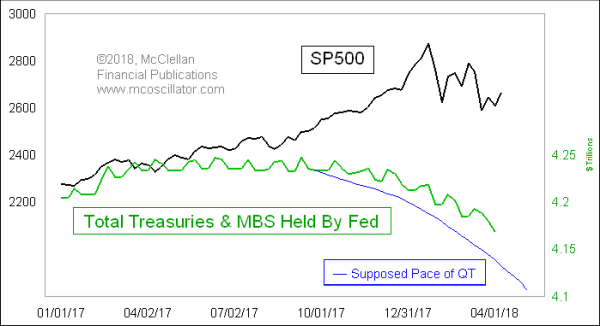
The Fed was a little bit slow at first in keeping up with its stated rate of QT, but it is catching up now. One could argue that the Fed is not really selling off these assets, and instead it is just allowing them to expire and not be renewed. But it is still the case that several billion dollars of debt are having to be absorbed by the market place instead of by the Fed. It is also true that the size of QE between 2009 and 2015 was small compared to the total amount of federal debt, but it was still important enough to lift the stock market in a huge way.
Now the amounts of the QT unwinding are pretty small compared to the total debt, but they are having a similar effect of depressing the stock market, just as QE elevated it. And this is where the modeling gets difficult – – interest rate policy is stimulative, by the Fed Funds target rate being below the 2-year yield. But at the same time the Fed is being repressive by sucking liquidity out of the banking system with QT. I don’t know how to construct a “balance of forces equation” to depict how those two factors interact with each other, as this is pretty new territory for market history.
But I can say that when the Fed worked hard to reduce the size of its balance sheet in 2008, during the worst liquidity crisis in decades, the effect was pretty direct and pretty obvious. The Fed blew up Bear Stearns and Lehman Brothers by sucking too much liquidity out of the banking system.
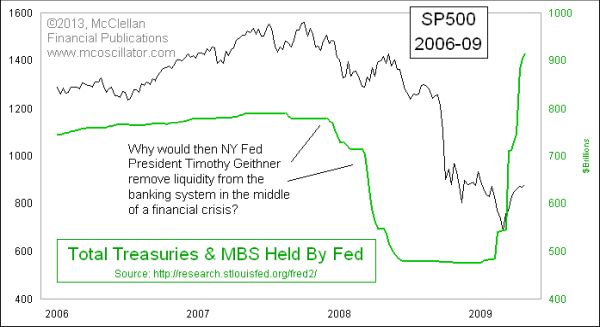
In a text note within this chart, I pose the rhetorical question of why the then-president of the NY Fed, Timothy Geithner, would orchestrate a huge reduction in the Fed’s holdings of Treasury debt during the worse liquidity crisis in years. Part of the answer can be found in the historical observation that this bear market helped to assure the election of President Obama in November 2008. And Mr. Obama very quickly appointed Timothy Geithner as his Treasury Secretary. You can insert your own conspiracy theory here, since I don’t have subpoena authority to investigate contacts between the Obama campaign and the New York Fed in 2008.
The point of that historical lesson which we should remember in the current moment is that having the Fed reduce the size of its balance sheet carries an enormously powerful effect on banking system liquidity. My expectation is that by sometime later this summer, the FOMC is going to realize that its reduction of holdings of Treasuries and MBS is creating a big liquidity problem, and they will abandon or curtail those plans. But it is going to require a lot of damage to the stock market to get them to realize what they need to do. I expect that realization to hit them sometime around August 2018, and it should lead to a huge stock market rebound into year-end. But it will be a rebound from a big selloff.
See you next week.


