


by Shah Gilani, Money Morning
Money Morning Article of the Week
These Stocks Just Went “On Sale”: Shah Gilani says we’re in the formative stages of a “generational bull market” that will make the savviest investors rich. And that means the market is actually “marking down” stocks and creating some of the biggest profit opportunities he’s ever seen. Shah identifies his most promising recommendations in a brand-new report. To access this free report and get all of Shah’s research, click here.

Everyone – from the suits on Wall Street and the pundits on television to individual retail investors – is talking about the U.S. Federal Reserve raising interest rates for the first time since 2006 – and what’s going to happen to stocks, bonds, and commodities here in the United States.
There’s a lot of noise out there, and it’s difficult to separate the valuable, useful information from the nonsense.
Today, I’m going to tell you exactly what’s going to happen with the Fed rate hike and what it’s going to do to stocks, bonds, and commodities.
But there’s a hidden impact to the Fed’s impending interest rate hike that people aren’t talking about. I’ll tell you about that, too.
And, of course, I’ll show you what you can do to protect yourself – and make money from what everyone else is so afraid of.
Here’s what’s happening…
The New “Normalization”
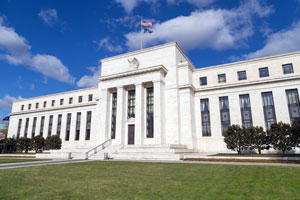
First of all, the Fed isn’t going to raise rates by very much or for very long when they eventually lead us back to “normalization.”
What does the Fed mean when it talks about normalization? They mean raising interest rates to where they might naturally be if we actually had a free market.
But we don’t have a free market – not here in the United States and not globally.
That’s because central banks have almost completely hijacked the free-functioning market that determines interest rate levels.
Left on their own, interest rates move up and down based on the supply and demand for money, credit, and loans.
It’s that simple.
With a limited amount of money in a financial system and a high demand for money, lenders will charge borrowers more because they can, so interest rates will rise.
If there’s not much demand for money, lenders will lower the interest they charge borrowers to entice them to borrow – otherwise they don’t earn anything.
During the financial crisis and the subsequent Great Recession, the Fed pushed down interest rates to stimulate borrowing and consumption. But there still wasn’t demand.
Then, under the guise of lowering rates more (which is hard to do when they’re at zero) to stimulate the economy, the Fed began quantitative easing, buying bonds from banks to flush them with cash.
But here’s the rub…
There still wasn’t demand for money throughout the economy. However, well-off individuals, institutions, and corporations could borrow as much money as they wanted at rock-bottom rates, and they did.
But because the economy wasn’t growing and there was no need for capital expenditures on plant and equipment, or any desire to start or expand businesses, massive amounts of cash got parked in financial assets like stocks and bonds.
Hence the country’s great stock and bond market rallies in the face of stagnant economic growth.
Now the Fed’s talking about normalizing rates.
But they can’t normalize rates for several reasons…
Why a Fed Rate Hike Won’t Fix This Mess
First, no one really knows what normal is anymore. Rates have been artificially manipulated for decades now.
Second, if there’s significant demand for money that the Fed doesn’t anticipate, and rates under normal circumstances start rising quickly, capital markets would freak out.
That’s because purchases of financial assets have been leveraged up with cheaply borrowed money, and corporations have leveraged themselves up with cheap borrowing to buy back their shares to lift their stock prices and their earnings per share metrics. In other words, the financial markets have been manipulated higher by artificially low rates.
Third, if U.S. rates rise too much, that would cause the already strong dollar to appreciate even more, and that would depress U.S. corporations’ overseas earnings and continue to depress prices of commodities like oil, which are priced in U.S dollars.
Fourth – and this is the thing people aren’t talking about – we live in a global economy. If the dollar strengthens too much too quickly, global borrowers who borrowed in U.S. dollars because U.S. interest rates were the lowest in the world, which adds up to about $9 trillion in loans, would be facing higher debt service costs as their currencies fall in value relative to the dollar.
Then consider what would happen if those foreign borrowers have to earn revenue in their own currencies selling commodities like oil, copper, iron ore, or steel, the prices of which keep falling as global growth slows and the U.S. dollar appreciates.
No one really knows what would happen, who would default, if countries saw massive capital flight and their currencies collapsed, what kind of recession or depression we might enter, or which countries would be at risk of social unrest, or worse.
The Fed can’t normalize rates any time soon. All they can do is raise rates a small amount and see what happens.
But just because the Fed can’t raise rates much or for long doesn’t mean even a small raise wouldn’t upset financial markets here and globally. It could happen.
If the Fed doesn’t raise rates at their next meeting, we’ll have to watch the financial markets to see how they react. They could rally, or they could sell off… but no one knows because we’ve never been here – or anywhere near here – before.
If they raise rates and markets sell off, the dominos will begin to fall – stocks will tumble, bond prices will take a hit, and commodities could see fresh new lows. The dollar will rise, hitting emerging economies particularly hard.
But not to worry… if that happens, you’re going to be prepared.
Here’s how.
How to Protect Yourself (and Profit) from a Global Sell-Off
To be prepared for the possibility of global markets falling, I like buying enough portfolio protection to cover any losses I may have to endure, and to actually make money if we get a global knee-jerk reaction to whatever the Fed announces at their next meeting.
To protect my portfolio against falling stocks domestically, I like the ProShares Short QQQ (NYSE Arca: PSQ). This exchange-traded fund (ETF) tracks the inverse of the Nasdaq 100 Index, which should be hit hard by any negative reaction to a rise in interest rates. PSQ is already close to its 52-week lows, so I like buying it down here and using a 3% stop to get out if stocks rally instead.
Next, I’d short emerging markets prone to capital flight and falling commodities prices. To do that, I’d short or buy puts on the iShares MSCI Emerging Markets ETF (NYSE Arca: EEM). EEM tracks emerging markets with a basket of large- and mid-cap emerging market equities such as Korea’s Samsung Electronics (OTCMKTS: SSNLF), Chinese e-commerce giant Alibaba Group Holding Ltd. (NYSE: BABA), and Taiwan Semiconductor Manufacturing (BMV: TSMN), as well as a variety of Chinese banks.
For shorting EEM, I’d use a 3% to 5% stop. If I bought puts (about six months out), I’d use a 25% stop.
Lastly, I’d short or buy puts on the PowerShares DB Base Metals ETF (NYSE Arca: DBB), which tracks changes in the DBIQ Optimum Yield Industrial Metals Index Excess Return. This is essentially a way for us to short commodity futures. I’d use the same stop-loss orders I’d put in on my EEM positions (3% to 5% on the short, 25% on the puts) to take small losses if all of a sudden the world decides it actually likes the new normal…
At least until Mr. Market has had enough and frees itself from its central bank shackles.
And if that happens, look out.


