


from The Conversation
— this post authored by Emma Long, University of East Anglia
Reproductive rights advocates in the US are expressing dismay at the announcement by the supreme court that it will hear argument in an appeal which, if successful, could threaten the legal basis on which women can obtain abortions in America.

Please share this article – Go to very top of page, right hand side, for social media buttons.
The case, Dobbs v Jackson Women’s Health Organization, involves a 2018 Mississippi law which prohibits doctors from performing abortions after 15 weeks except in medical emergency or in case of severe foetal abnormality. A local womens’ health group sued to overturn the law, which the district and federal appeals courts ruled was unconstitutional.
Now the supreme court will hear arguments in its next term, starting in October, and are likely to deliver a decision in the spring or early summer of 2022. Not only will this be the first major ruling on abortion from a court shaped by the three appointees of former president Donald Trump, but many commentators suspect that, as Slate’s legal reporter Mark Joseph Stern asserted: “the supreme court is taking direct aim at Roe v Wade“.
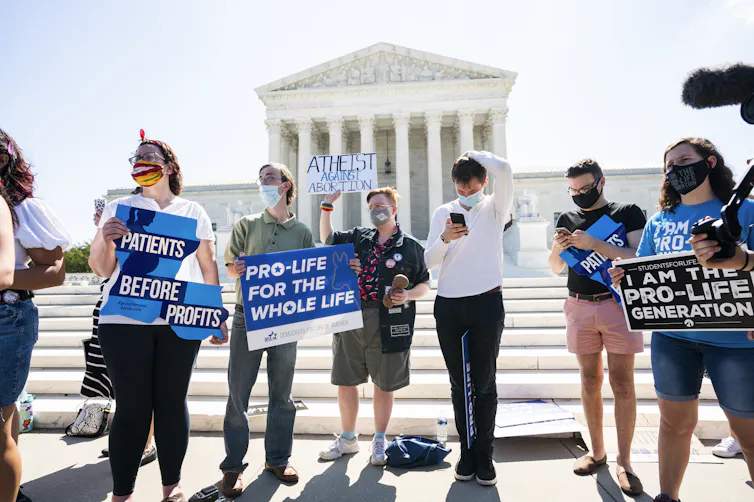
EPA_EFE/Jim Lo Scalzo
Roe v Wade is the 1973 Supreme Court ruling which established the legal baseline for American abortion law. It has become a touchstone for both the pro-choice and anti-abortion movements, seen by the former as the bedrock upon which women’s freedom to participate fully in society is built and by the latter as a licence to commit state-sanctioned murder.
Amid all the sound and fury, much about the court’s actual ruling in Roe gets lost. So what exactly did Roe establish?
What the decision means
In 1970, a Texan woman named Norma McCorvey, seeking to end her pregnancy, challenged the state law which outlawed abortion except to save the life of the woman. Her legal challenge ended up in front of the US supreme court in 1973. The case pitted McCorvey, referred to in court documents as “Jane Roe” to preserve her anonymity, against Henry Wade, the district attorney in McCorvey’s Dallas country district.
After hearing arguments in the case, the court not only upheld her challenge, but struck down all remaining state laws that banned abortion outright. The sheer breadth of this judgment led to a huge backlash, the consequences of which we still see in US politics today.
Roe established two main principles and a framework for putting them into effect. First, the court made clear that banning abortion completely was not acceptable. The court ruled that the right to privacy “is broad enough to encompass a woman’s decision whether or not to terminate her pregnancy”. An earlier case, Griswold v Connecticut, paved the way for this decision by establishing a couple’s right to use and to receive information about the use of contraceptives.
The Roe decision has become crucial for pro-choice groups seeking to protect abortion access across the country – at the very least Roe made clear abortion had to be an available option.
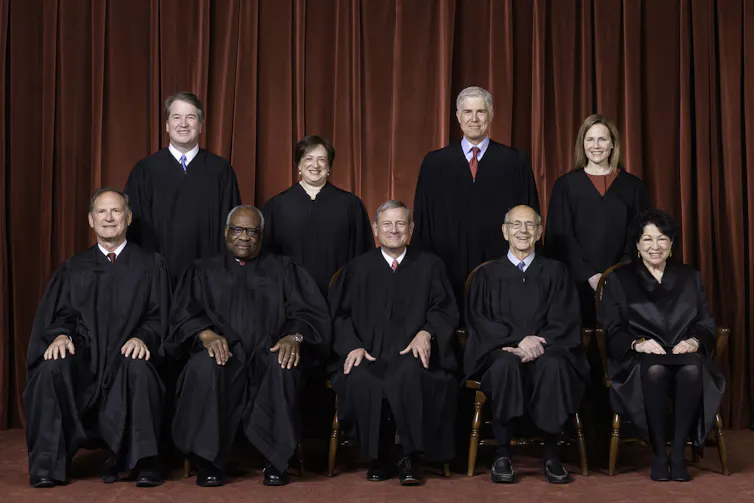
The ‘Roberts’ court: since the death of Ruth Bader Ginsburg in 2020 and the appointment of Amy Coney Barrett (back row, far right), the supreme court has a strong conservative representation. Fred Schilling, Collection of the Supreme Court of the United States
But, back in 1973, the supreme court also recognised that the state had a legitimate interest in seeking to protect the health and safety of the pregnant woman and that “as long as at least potential life is involved, the state may assert interests beyond the protection of the pregnant woman alone”.
So Roe did not, as is too often claimed, establish an absolute right to terminate a pregnancy. In the words of Justice Harry Blackmun who wrote for the majority:
[Some] argue that the woman’s right is absolute and that she is entitled to terminate her pregnancy at whatever time, in whatever way, and for whatever reason she alone chooses. With this we do not agree.
To balance these interests, the court created the trimester framework in which the interests of the state in protecting the health of the woman and the life of the foetus increase as pregnancy progresses. In the second trimester, regulations to protect the health of the woman are permitted. In the final trimester, the point after which a foetus was assumed by the court to be able to live separately from the mother, the court allowed that the state “may go so far as to proscribe abortion … except when it is necessary to preserve the life or health of the mother”.
The Mississippi law at question in Dobbs then violates Roe only insofar as it seeks to restrict abortion before the third trimester.
Legal and political backlash
The court’s ruling acted as a catalyst to what became the pro-life movement. The anti-Roe backlash was neither smooth, organised, nor inevitable. But it drew on wider trends in US society and politics. The decision became a shibboleth for both sides: a statement of women’s social and political equality that must be protected on one hand, and, on the other, evidence of the decline of traditional family values which must be firmly opposed.
The Dobbs case represents only one of thousands of legal challenges posed in the past few decades. Most are decided at local level and never reach the supreme court, but each attempt raises the political temperature and further entrenches the positions on both sides.
Dobbs represents perhaps the best opportunity for success in weakening Roe anti-abortion campaigners have had since 1992. In Planned Parenthood of Southeastern Pennsylvania v Casey, the court declared continuing support for Roe but ultimately weakened the legal principles underpinning it.
It did so by abandoning the trimester framework and replacing it with the “undue burden” test. Under Casey, a state’s abortion law may be found unconstitutional only if it creates a “substantial obstacle” to obtaining an abortion. But “substantial” is in the eye of the beholder and laws that severely restriction abortion access, especially for poorer women, have been found acceptable under Casey.
Pro-choice advocates fear this latest case will further weaken Roe v Wade. And with a newly deeply conservative supreme court signalling that it is prepared to hear the case, there is some justification for their misgivings.
Emma Long, Senior Lecturer in American Studies, University of East Anglia
This article is republished from The Conversation under a Creative Commons license. Read the original article.
.


