


from The Conversation
— this post authored by Adam Taylor, Lancaster University
By the end of March, 79 cases of rare blood clots had been reported in those who’d received the AstraZeneca vaccine the UK, with cases occurring more frequently in younger women. Because of this, comparisons have been drawn with the contraceptive pill, which carries a greater relative risk of clots.

Please share this article – Go to very top of page, right hand side, for social media buttons.
In the UK, blood clots have occurred in people taking the AstraZeneca vaccine at a rate of roughly one in every 250,000, whereas blood clots caused by the pill are estimated to affect one in every 1,000 women each year.
Tatiana Shepeleva/Shutterstock
But this isn’t the only difference between the two. Although evidence is still emerging, the mechanisms behind the type of clotting linked to the vaccine and that linked to the pill appear to be quite different. It’s a reminder of how complex the blood and clotting is, with multiple parts of the process that can be disrupted.
The cause of vaccine-induced clots
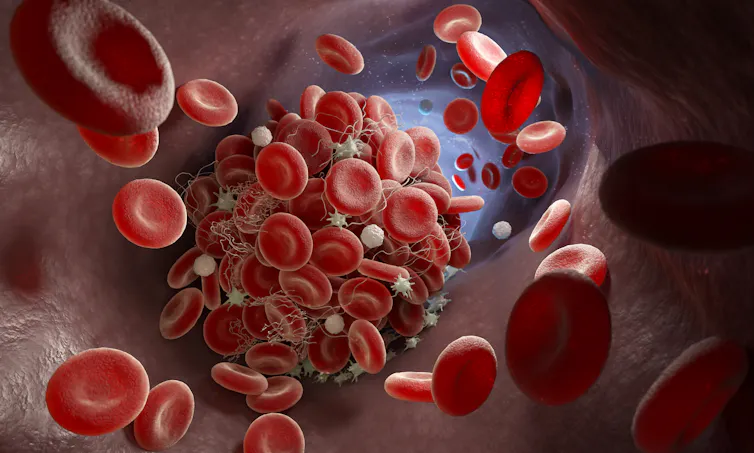
With the AstraZeneca vaccine, clots appear to be associated with having low levels of platelets in the blood. Platelets are the smallest of our blood cells. Produced in our bone marrow, they travel to anywhere there is damage to blood vessels to help clotting (to prevent blood from escaping) and start the repair process.
A normal number of platelets is anywhere between 150,000 and 450,000 platelets per microlitre of blood (there are 1,000 microlitres in one millilitre). If you have too few platelets, less than 150,000 per microlitre, then you have a deficiency – known as thrombocytopenia.
Thrombocytopenia can be inherited, acquired through lifestyle factors over time (such as poor diet combined with alcohol) or brought on by medicines or infections. And although yet to be confirmed, it seems the AstraZeneca vaccine may lead to it in an extremely small number of people too.
Although mainly known for inhibiting the blood’s ability to clot, thrombocytopenia can also sometimes cause clots to occur when they shouldn’t, and this can be fatal. In some people who have had the first dose of the AstraZeneca vaccine, a newly identified type of thrombocytopenia – called vaccine-induced prothrombotic immune thrombocytopenia (VIPIT) – is causing unwanted clotting to form in the brain, known as cerebral venous sinus thromboembolism (CVST).
As blood leaves the brain, it drains into a dedicated space that exists around it – the cerebral venous sinuses – prior to it being channelled into the major veins that drain out of the head and into the neck, back to the heart.
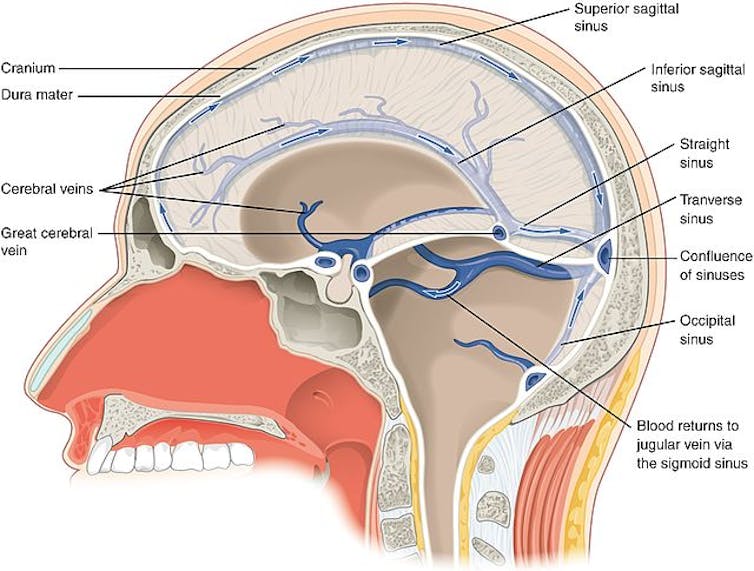
Blood leaves the brain by moving into the venous sinuses (blue) and draining into the jugular vein. OpenStax/Wikimedia Commons, CC BY
But for some who’ve taken the vaccine, platelets appear to stick together in the venous sinuses of the brain, which causes a blockage that prevents blood draining out of the brain tissues. This creates back pressure in the small vessels of the brain and blood leaks into the brain itself, causing damage in the same way a haemorrhagic stroke would.
Accompanying symptoms include headache, tiny red spots under the skin, blurred vision, fainting or loss of consciousness, loss of movement in parts of the body, or coma. These typically appear between four and 20 days after vaccination.
These symptoms, as well as the mechanism underlying the formation of these clots, are similar to those from a different type of thrombosis, heparin induced thrombocytopenia (HIT), where specific antibodies bind to a molecule in the blood called heparin, causing platelets to become super sticky and clot. It’s been suggested some form of immune activation, similar to that seen in HIT, might be the cause of what is happening in some vaccinated people.
Clotting and contraception
Despite the combined oral contraceptive pill also increasing the risk of blood clots in those who take it, these clots are likely formed by a different mechanism to those seen in CVSTs.
Clotting is a complex system. It involves more than just platelets. There are also many proteins dissolved in the plasma of blood, which when damage to tissues or blood vessels occurs, launch a series of steps to produce fibrin, an insoluble protein that then combines with platelets and red blood cells to form a clot. These dissolved proteins are called clotting factors, and some of the ingredients in contraceptives increase the levels of certain clotting factors in the blood, which raises the odds of clots forming in veins.
Genetic factors can also work to increase the likelihood of abnormal clots forming in women taking the pill. For instance, having a genetic mutation that affects a specific clotting factor called factor V Leiden is associated with a three-fold increase in risk. About 5% of people categorised as white have this mutation, though it is much less common in other ethnic groups.
It’s plausible that there may be genetic factors that increase the risk of the AstraZeneca vaccine in some people in a similar way, but at this stage, we don’t know. And due to not knowing what the risk factors are for CVST, it is also not possible to say what the risk of taking the combined oral contraceptive pill and having the AstraZeneca vaccine might be. There are a lot of things that still need to be explored.

Oral contraceptives increase the risk of blood clots by raising the amounts of clotting factors in the blood. PATCHARIN SIMALHEK/Shutterstock
Finally, it’s important to note that COVID-19 itself has been reported to lead to thrombocytopenia in up to 41% of positive patients, with the figure rising to up to 95% in those with severe disease. There are many reports of small blood clots in multiple organs in COVID-19 patients causing organ damage, failure and death.
The mechanism behind this is also unclear, but the COVID-19 infection likely causes these clots either by destroying the bone marrow and preventing platelets from being made, by causing the immune system to destroy platelets, or by increasing the use of platelets to repair damage to lungs and other tissues as a result of the infection (or a combination of all these things).
With this in mind, it’s worth remembering that while there is a small risk of clotting in some individuals who take the AstraZeneca vaccine, this clotting risk is much less than with many other things, including contraceptive pills – and significantly less than the risk of clotting after a COVID-19 infection.
Adam Taylor, Professor and Director of the Clinical Anatomy Learning Centre, Lancaster University
This article is republished from The Conversation under a Creative Commons license. Read the original article.
.


