


from The Conversation
— this post authored by Lena Ciric, UCL; Andrew Lee, University of Sheffield, and Danny Dorling, University of Oxford
Faced with rising infections and a new, more infectious strain of the coronavirus, the UK government has come under pressure not to relax COVID-19 restrictions over the Christmas period. Despite this, the government has said that the rules allowing households to mix are “unlikely to change”. But is this wise? Here, three experts discuss the risks of mixing over Christmas and whether celebrating separately might be better.

Please share this article – Go to very top of page, right hand side, for social media buttons.
Lena Ciric, Associate Professor in Environmental Engineering, UCL
My answer is a definitive no. Cases are on the up and relaxing the rules will lead to a new peak in the new year. We know close contact leads to transmission, but Christmas in the UK does not lend itself to social distancing. For a start, the weather is not going to favour outdoor activities.
Spending the holiday with your family means a number of rules that we have lived by for the past nine months will have to be broken. Various generations – older ones at high risk and some too young to adhere to distancing measures – will congregate in one another’s homes. It is virtually impossible to keep one to two metres apart at home.
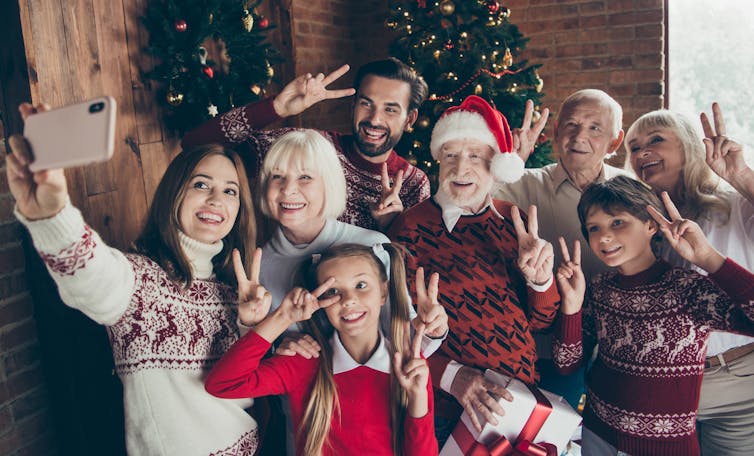
We then throw into the mix indoor spaces with inadequate ventilation to prevent viral transmission. We know face coverings offer some protection, but it’s unlikely that families will wear coverings throughout the holiday, especially with the amount of eating and drinking that will take place. Indeed, a Christmas Day gin and tonic or glass of champagne is likely to make us more confident in breaking the distancing rules. For me, the risk isn’t worth it.
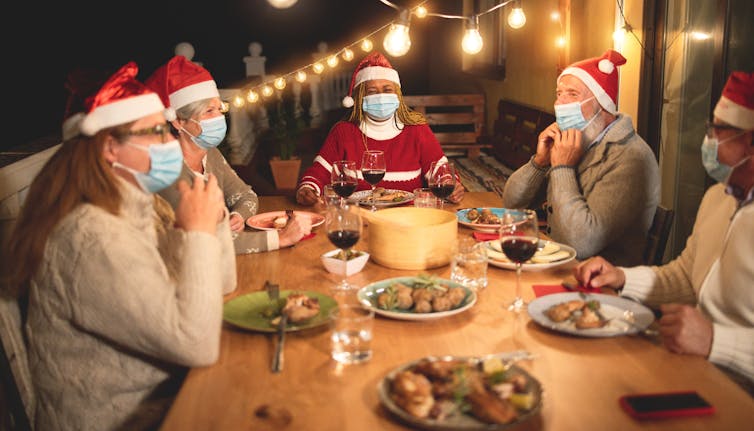
The control measures we’ve become used to are unlikely to be practical at Christmas time. DisobeyArt/Shutterstock
Danny Dorling, Halford Mackinder Professor of Geography, University of Oxford
For the third of society who live within a few miles of their parents, not seeing relatives at Christmas will make little sense if you see them most weeks anyway. If Grandad and Granny normally look after the toddler on the days when you go out to work, you are hardly going to improve their chances of avoiding the virus by not seeing them at Christmas.
But for the third whose elderly relatives live many miles away, if they have been isolating themselves already, you may be less likely to meet up. With the vaccine now being rolled out, people in this group are more likely to think: why risk being Wilfred Owen, who died a week before the Armistice? For the other third somewhere in between, there may be more of a conundrum.
No one knows the exact proportion of people who are in each group, just as no one knows the actual risk of pulling a cracker round the Christmas table – with or without gloves and masks on. What we do know is that people aged over 70 are at a much higher risk than others and have already altered their collective behaviour to reduce risk the most. In the latest ONS survey, COVID-19 infections among over-70s in England had reduced from 0.80% at the end of October to 0.48% by the start of December. And according to the latest REACT-1 survey, across roughly the same period infections among over-65s almost halved. More than 99.5% of elderly people are currently not infected.
So what is to be done? Here is a simple rule: ask the oldest person(s) what they want to do. The risk to them of meeting up is many times greater than the risk to everyone else combined. They have spent a lifetime assessing and taking risks, possibly ranging from driving a car to having a smoke, and (by definition) they have so far been more successful than you have at doing that. They might be unsure and want to talk about it, possibly even wanting to know the odds. Ultimately, Christmas means different things to different people, and their decision should be respected.
The worst Christmas is often the first one after a loved one has died. That too can change the calculus of the costs of spending Christmas alone.

Older family members are more at risk, so they should decide whether to celebrate in person or not. DisobeyArt/Shutterstock
Andrew Lee, Reader in Global Public Health, University of Sheffield
At its peak, there were 25,000 new cases of COVID-19 per day nationally during the second wave. The second lockdown then reversed rising trends and brought infection numbers down to 15,000 per day by the end of November. In comparison, there were less than 1,000 cases a day in the summer. However, since restrictions have lifted, those numbers are rising worryingly again. This matters, as a proportion will translate into hospitalisations and more deaths.
Winter is always a challenging time for health services, which are stretched to the limit. The added burden of COVID-19 ill health will worsen the situation. It is also likely that the need to treat COVID-19 cases will displace non-COVID healthcare. That means delayed hospital investigations, procedures and treatments for non-COVID medical problems, which could have serious consequences.
Allowing households to mix at Christmas is akin to adding fuel to the fire and boosting the spread of infections. Households are the highest risk setting for transmission of COVID-19 – if someone is infected, early research suggests those around them have just under a 20% chance of then catching the virus.
Moreover, household mixing cannot be made risk-free. Infections in a household can lead to household-level outbreaks that are likely to disproportionately affect vulnerable family members. In turn, rising numbers of infections will then spill over into other settings, such as schools, care homes and workplaces, causing wider socioeconomic disruption.
With the promise of vaccine protection on the horizon, every effort now should be focused on buying time for the NHS to vaccinate as many of the vulnerable as possible. Allowing families to mix at Christmas is an unnecessary risk to take and comes at a price in lives lost, which is not worth paying for the few days of relaxed restrictions.
Lena Ciric, Associate Professor in Environmental Engineering, UCL; Andrew Lee, Reader in Global Public Health, University of Sheffield, and Danny Dorling, Halford Mackinder Professor of Geography, University of Oxford
This article is republished from The Conversation under a Creative Commons license. Read the original article.


