


from The Conversation
— this post authored by J. Robin Moon, City University of New York
In 2019, about 567,715 homeless people were living in the United States. While this number had been steadily decreasing since 2007, in the past two years it has started to increase.

Please share this article – Go to very top of page, right hand side, for social media buttons.
For New York City, even before COVID-19, 2020 was already turning out to be a record year for homelessness. But as the lockdown commenced in mid-March, the 60,923 homeless people staying at the city’s shelter system found themselves disproportionately affected by the pandemic.
That’s not all of the city’s homeless, of course; the 60,000-plus doesn’t include homeless people hidden within patient rolls and emergency department waiting rooms. In 2019, the city’s annual count of hospital homeless shows more than 300 on any given night who are patients or using the hospital as temporary shelter.
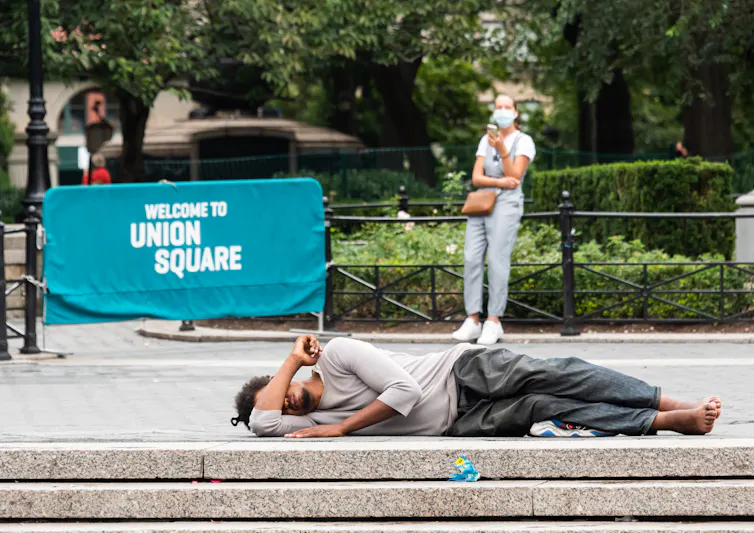
Union Square in Manhattan, where many of New York City’s homeless live. Noam Galai via Getty Images
As a health care practitioner, educator and researcher in the field of public health and social epidemiology who works in the city, I’m fully aware of the challenges faced and the tragedies already seen. As of May 31, the New York Department of Homeless Services had reported 926 confirmed COVID-19 cases across 179 shelter locations and 86 confirmed COVID-19 deaths. In April alone, DHS reported 58 homeless deaths from COVID-19, 1.6 times higher than the overall city rate. While there is no reliable analogous data for other cities, what happens in New York can be a lesson for others.
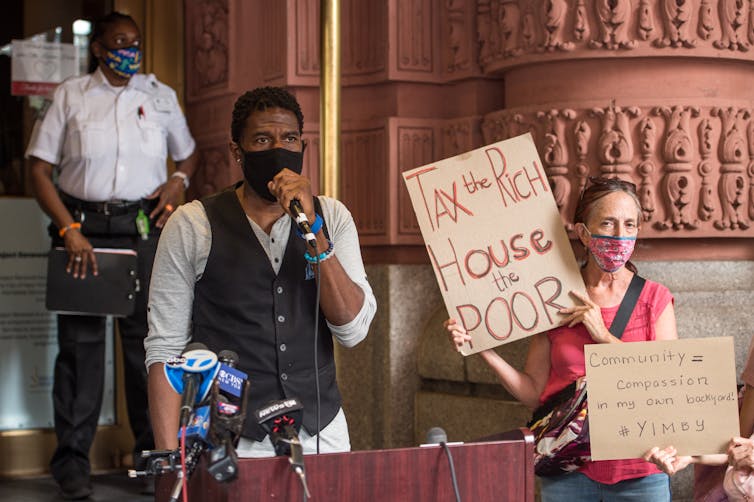
A protest supporting the homeless men given temporary living quarters at New York City’s Lucerne Hotel in the Upper West Side. Steven Ferdman via Getty Images
Homeless shelters are vulnerable
The susceptibility of the homeless population to COVID-19 is not unique to New York City. Homeless shelters nearly everywhere are particularly vulnerable to disease transmission. Shelters are typically unequipped, heavily trafficked and generally unable to provide safe care, particularly to those recuperating from surgery, wounds or illnesses.
Add to that the inability to isolate, quarantine or physically distance the homeless from one another during COVID-19. New York City responded by using almost 20% of its hotels as temporary shelter facilities, with one to two clients per room. That helped, but it was hardly a perfect situation.
So the question is: Where do homeless patients go to convalesce when discharged from acute medical care, especially in the post-COVID-19 era?
Homeless patients discharged from hospitals or clinics who then go to drop-in centers, shelters or the street sometimes do not fully recover from their illnesses. Some inevitably wind up back in the hospital. The result is a detrimental and costly cycle for both patients and the health care system.
And the situation continues to deteriorate: Between July 2018 and June 2019, 404 of the city’s homeless died – 40% higher than the previous year and the largest year-over-year increase in a decade. There is no data since the outbreak began, but early evidence suggests that the number of deaths is higher between June 2019 and June 2020.
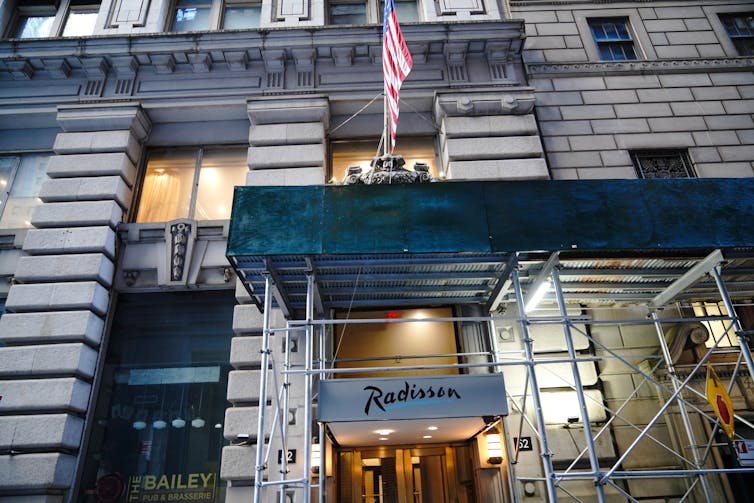
A former Radisson Hotel in New York City converted to a homeless shelter. John Nacion/SOPA Images/LightRocket via Getty Images
Medical respite: A possible solution
Medical respite is short-term residential care for homeless people too ill or frail to recover on the streets, but not sick enough to be in a hospital. It provides a safe environment to recover and still access post-treatment care management and other social services. Medical respite care can be offered in freestanding facilities, homeless shelters, nursing homes and transitional housing.
Medical respite has worked in municipalities across the U.S.; health outcomes for patients have improved, and hospitals and insurance providers, particularly Medicaid, have saved money. But these programs are few and far between. In 2016 there were 78 programs operating across 28 states. Most programs are small, with 45% having fewer than 20 beds.
The care models vary, but essentially they provide beds in a space designed for convalescence, follow-up appointment support, medication management, medically appropriate meals and access to social services such as housing navigation and benefits assistance. Some programs provide on-site clinical care.
Research shows that homeless patients in New York City stay in the hospital 36% longer and cost an average of US$2,414 more per stay than those with stable housing. By discharging patients to respite programs, hospitals reduced emergency visits post-discharge by 45%, and readmissions by 35%. The New York Legal Assistance Group, conducting a cost-benefit analysis, showed savings of nearly $3,000 per respite stay (the provider saved $1,575, the payers saved $1,254) through reduced hospital readmissions and length of stay.
Studies outside of New York also show improved health outcomes in a variety of ways. One noted that 78% of patients were discharged from respite “in improved health.” Patients showed 15% to 19% increases in connection with primary care after discharge to medical respite. Moreover, at least 10% and up to 55% of medical respite patients who discharged eventually went to permanent or improved housing situations.
Next steps
While there are agreed-upon national standards for medical respite, program models can adapt to meet the needs of a specific community. Already, dozens of respite models exist across the country, in both major cities and small towns. One complication, however, is the sheer breadth of the medical respite approach. Because it intersects housing, homelessness and health care, medical respite does not fit neatly within a single system and would require collaboration and agreement among multiple city and state agencies.
[Deep knowledge, daily. Sign up for The Conversation’s newsletter.]
Still, a growing number of communities are looking to medical respite to fill the gap. Chicago is partnering with providers to deliver health care to the homeless. This includes providing them with temporary residential facilities and clinics to help blunt the impact of COVID-19.
There is a dire need to help the homeless with both housing and health care. Medical respite is a potential solution. It has successfully provided recuperative housing and medical care during a pandemic. Why shouldn’t it become a permanent part of our service system?
Andrew Lin, Supportive Housing Program Developer at BronxWorks, a non-profit group that offers homeless and housing support services in the Bronx, contributed to this article.
J. Robin Moon, Adjunct Associate Professor, City University of New York
This article is republished from The Conversation under a Creative Commons license. Read the original article.
.


