


by Charles Hugh Smith, Of Two Minds
Flexible labor is the future for the basic reason that it is the only viable model going forward.
If we can’t go forward, then let’s go back: this is the guiding philosophy of the labor movement that seeks security via strict work rules. The premise here is simple: employers could provide their employees with secure employment if only they weren’t so greedy.

Unfortunately, it isn’t this simple. Even the most generous employers–for example, worker-owned co-ops and state-owned enterprises–must generate a profit that can be reinvested to replace obsolete equipment and boost productivity.
To get guaranteed employment security, you must first guarantee profits that can be reinvested to keep the enterprise afloat.
In today’s world of global competition and stagnation, guaranteed profits and guaranteed employment security are both scarce. What could be more guaranteed than profits from oil? Oops. How about offering ObamaCare/ACA health plans? Oops. It turns out profits, even in supposedly rock-solid industries, are not guaranteed.
As a result, the entire idea that employers facing a rocky, uncertain future can guarantee employees anything is nonsensical. Flexible labor is the future for the basic reason that it is the only viable model going forward.
Even the most secure employer–the government–will start shifting to flexible-labor models once local government revenues start drying up and generous salaries-pension-benefits packages become unaffordable.
Rather than attempting to go back to a model that has evaporated, we have to move forward to a model in which employment security is not based on any employer. I sketch out just such a model in my book A Radically Beneficial World.
The insanity of basing employees’ security on any employer’s ability to permanently navigate increasingly treacherous waters is a core reason why healthcare in the U.S. is a mess: the obvious solution is a system in which employees have health coverage regardless of the financial health and stability of their employer of the moment.
I call the model of flexible labor that shifts to fill whatever scarcities arise mobile creatives. In this model, security is generated by multiple income streams from a broad network of clients, customers and collaborators.
Rather than rely on a single industry and employer to provide security, the mobile creative gains security from a dynamic network of paid work across a variety of industries and fields.
Mobile creatives operate by the principle trust your network, not the corporation or the state. Chasing after security by demanding the impossible of corporations or the state only guarantees failure of the entire system.
It would be nice if we could go back to a time in which employees could count on one employer to provide guaranteed employment for life–but we can’t. Even the 20% of the work force that works for the government will have to adapt eventually, as the government itself lives off private-sector profits and wages.
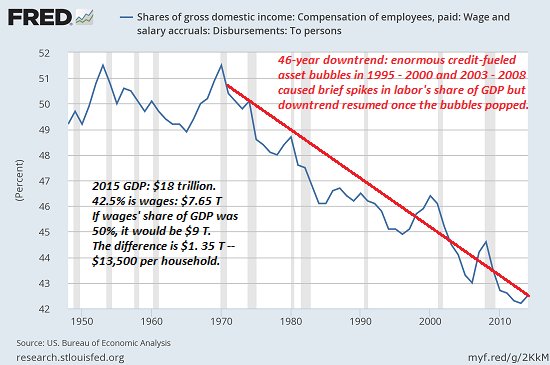
And as this chart shows, wages as a share of GDP have been declining for decades:
We can’t go back, so we must go forward. It is possible to create employment security, but it can’t be forced by imposing guarantees on employers. If employers can’t respond flexibly to a dynamic global economy, their only choice will be to shut down. When that happens, everyone loses.
A Radically Beneficial World: Automation, Technology and Creating Jobs for All is now available as an Audible audio book.
My new book is #2 on Kindle short reads -> politics and social science: Why Our Status Quo Failed and Is Beyond Reform ($3.95 Kindle ebook, $8.95 print edition) For more, please visit the book’s website.
.


