


Written by Steven Hansen
The U.S. new cases 7-day rolling average is 7.6 % lower than the 7-day rolling average one week ago. U.S. deaths due to coronavirus are now 15.9 % lower than the rolling average one week ago. At the end of this post is a set of interactive graphs and tables for the world and individual States – as well as today’s headlines which include;
- Global total deaths due to coronavirus now exceeds 900,000
- How Drugmakers Can Keep Their Pledge and Still Deliver an October Vaccine Surprise
- The CDC banned evictions, but some renters are still vulnerable
- The C.D.C. says health screenings at airports were not effective in the ‘current phase of the pandemic’
- Coronavirus May Have Hit L.A. in December 2019, as Coughs Spiked Before First Official Case
- British company launches 20-second COVID-19 test
- WHO calls delay in AstraZeneca coronavirus vaccine trial a ‘wake-up call’
- Cats in Wuhan provided clues about the course of SARS-CoV-2 infection in a study.
- Wildfire smoke creates more risks during COVID-19 pandemic
- Russia Completes Early Trials of Second Potential COVID-19 Vaccine

My continuing advice is to continue to wash your hands, wear masks, and maintain social distancing. No handwashing, mask, or social distancing will guarantee you do not get infected – but it sure as hell lowers the risk in all situations. In addition, certain activities are believed to carry higher risk – like being inside in air conditioning and removing your mask (such as restaurants, around your children/grandchildren, bars, and gyms). It is all about viral load – and outdoor activities are generally very safe.
The daily number of new cases in the U.S. is remaining stubbornly and embarrassedly high.
The following graphs show the 7-day rolling average for new coronavirus cases and deaths have been updated through 10 September 2020:


z coronavirus.png
Coronavirus Statistics For 10 September 2020 |
| U.S. Only | Global | U.S Percentage of Total | ||||
| Today*** | Cumulative | Today*** | Cumulative | Today | Cumulative | |
| New Confirmed Cases | 35,044 | 6,360,000 | 260,215 | 27,890,000 | 13.5% | 22.8% |
| Deaths** | 1,136 | 190,815 | 5,859 | 903,991 | 19.4% | 21.1% |
| Mortality Rate | 3.2% | 3.0% | 2.3% | 3.2% | ||
total COVID-19 Tests per 1,000 people | 1.78* | 281.87* | ||||
* as of 06 Sep 2020
** evidently several States included “probable” deaths today in the number
*** red color indicates record number
Trump talks COVID-19 with journalist Bob Woodward: “I always wanted to play it down”
Coronavirus News You May Have Missed
COVID vaccine: 8,000 jumbo jets needed to deliver doses globally, says IATA – BBC
The equivalent of 8,000 Boeing 747s will be needed, the International Air Transport Association (IATA) has said.
There is no Covid-19 vaccine yet, but IATA is already working with airlines, airports, global health bodies and drug firms on a global airlift plan.
The distribution programme assumes only one dose per person is needed.
… Not all planes are suitable for delivering vaccines as they need a typical temperature range of between 2 and 8C for transporting drugs. Some vaccines may require freezing temperatures which would exclude more aircraft.
Transportation will need “almost military precision” and will require cool facilities across a network of locations where the vaccine will be stored.
How Drugmakers Can Keep Their Pledge and Still Deliver an October Vaccine Surprise – Medscape
As questions mount over whether the United States will authorize a coronavirus vaccine ahead of November elections, experts say there is a slim chance that enough evidence will be available to prove one is safe and effective in that time frame.
… Vaccines must demonstrate they are at least 50% more effective than a placebo to be considered for approval. To prove that, government officials have said, at least 150 COVID-19 infections must be recorded among trial participants with at least twice as many occurring among the placebo group.
If a vaccine is especially effective, companies could have their answer sooner. Pfizer Inc and Moderna Inc, whose U.S. vaccine trials have enrolled thousands of people and are the most advanced, say they may have proof after just a few dozen subjects become infected.
Independent panels of experts called data and safety monitoring boards (DSMB) will review trial data at pre-specified points. These boards can recommend companies stop the trials if the evidence is overwhelmingly positive or negative.

Russia Completes Early Trials of Second Potential COVID-19 Vaccine – Medscape
Siberia’s Vector virology institute on Tuesday completed early-stage human trials, known as Phase II, of a second potential Russian vaccine against COVID-19, the state consumer safety watchdog was cited by the Interfax news agency as saying.
Russia registered its first vaccine candidate, developed by Moscow’s Gamaleya Institute, in August. Late-stage trials of this vaccine, due to involve 40,000 participants, were launched last week.
Human trials of the second potential COVID-19 vaccine, a peptide-based jab, began on July 27 and involved a group of 100 volunteers, Interfax cited watchdog Rospotrebnadzor as saying.
“Today … the final group of 20 volunteers was released from hospital,” said in a statement. “All 100 volunteers were vaccinated with two doses and have completed a 23-day monitoring period in hospital. The volunteers are feeling good.”
Results are due to be published on Sept. 30, Interfax said.
The CDC banned evictions, but some renters are still vulnerable – CNBC
- In an unprecedented move, the Centers for Disease Control and Prevention has made it illegal for landlords across the U.S. to evict tenants who can’t afford to pay their rent through the end of the year.
- The ban doesn’t relieve tenants of their obligation to pay rent or offer any rental assistance, making it likely that many will rack up debt during the reprieve. And for many, the order will just delay their eviction.
- And other holes in the federal protection and inconsistent state applications also leave renters vulnerable, housing advocates say.
Is The Pandemic Over? – ZeroHedge
A curious but fortunate characteristic of virus epidemics is their limited lifespans. No one knows why, but guesses include herd immunity and mutations of the virus.
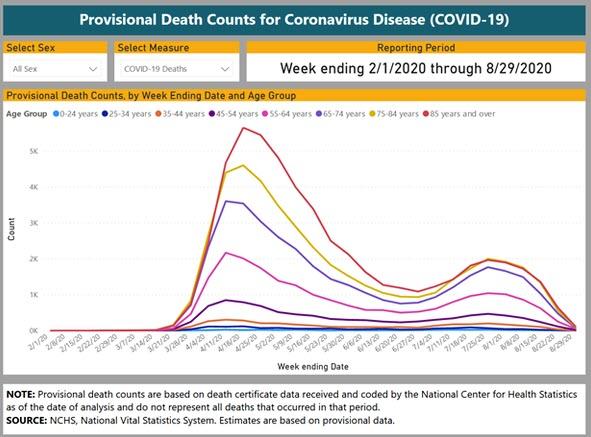
The following graph from the Centers for Disease Control and the National Center for Health Statistics shows the time profile of the COVID-19 weekly death counts from February onward. (For an interactive version of the graph go here.)
… Virus epidemics, however, have relatively short time profiles, like what we’re seeing with COVID-19. There’s nothing unusual about the fact that the coronavirus death count is dying a natural death. That should have been anticipated, and it should now be widely publicized. Why are we pretending not to know this good news? These facts are easy to find. We ought to be celebrating like we did when WWII ended.
This COVID-19 death profile is extremely significant yet is almost totally ignored by the media. Their focus is on cases, not deaths. The number of cases has not decreased as rapidly as the number of deaths. Only a small percentage of cases now ends in death, and the death count is vastly more important than the case count. The case count may linger, but that problem is becoming increasingly manageable.
The latest reported weekly death count (August 29) was 370. That’s out of a population of 330 million people. In a single week, between August 8 and August 15, the number of deaths dropped 85 percent (from 3,169 to 455). The COVID-19 death rate in the U.S. is now barely more than one per million and dropping like a rock. Coronavirus deaths are currently half the number of weekly vehicle fatalities. We’re now seeing the pandemic in our rearview mirror.
Wildfire smoke creates more risks during COVID-19 pandemic – KIRO
With wildfires burning throughout the state [Washington], the air quality is suffering. Health officials agree, the timing is terrible.
Normally, they would recommend people wear N95 masks to protect themselves from the smoke particles. They are asking people to take other precautions instead and to save the masks for first responders and medical professionals.
State health officials acknowledge the recommendations to keep yourself safe from wildfire smoke, conflict with preventing the spread of COVID-19.
“When air quality is bad, stay indoors, close windows to keep air clean indoors. But we also know with COVID if you’re indoors and you don’t have good ventilation and you’re with multiple other people, that can increase the risk of COVID transmission, “said Dr. Kathy Lofy, State Health Officer with the Washington State Department of Health.
The air quality was so poor in Snohomish County it forced the health department to close it’s two coronavirus testing sites. The location at the Lynnwood Food Bank closed Tuesday. The site in Everett near the Aqua Sox stadium was closed again Wednesday. They hope to re-open on Thursday.
The C.D.C. says health screenings at airports were not effective in the ‘current phase of the pandemic.’ – New York Times
The federal government next week will halt its policy of screening international travelers for coronavirus symptoms at 15 designated airports across the country, according to the Centers for Disease Control and Prevention. Passengers from regions of the world that were previously deemed hot spots for the virus will also no longer be funneled to those airports, beginning Monday.
The C.D.C. said that the federal government would instead commit resources to a different — and vague — set of procedures, including “health education” before, during and after flights, “illness response” at airports, and “potential testing.”
In a statement, the C.D.C. said that the health screenings, which involved temperature checks and interviews about possible symptoms of the coronavirus, were no longer a sound way of detecting infections in the “current phase of the pandemic.”
“We now have a better understanding of Covid-19 transmission that indicates symptom-based screening has limited effectiveness because people with Covid-19 may have no symptoms or fever at the time of screening, or only mild symptoms,” the agency wrote.
British company launches 20-second COVID-19 test – Reuters
British start-up company iAbra said it had developed a 20-second saliva COVID-19 test which had 99.8% sensitivity and 96.7% specificity.
Trials of the “Virolens” test have taken place at Heathrow Airport, the company, which was founded in 2010, said.
“Our system allows simple, high speed, reliable and low-cost testing in dynamic environments,” Greg Compton, CEO of iAbra, added in a statement.
Some scientists spot ‘unlikely’ patterns in Russia vaccine data – Reuters
Twenty-six scientists, most of them working at universities in Italy, have signed an open letter questioning the reliability of the data presented in the early-stage trial results of the Russian COVID-19 vaccine, named “Sputnik-V”.
Addressing the editor of The Lancet, the international peer-reviewed medical journal in which Moscow’s Gamaleya Institute published its early-stage trial results, the scientists said they saw patterns in the data that looked “highly unlikely”.
The letter, published on the personal blog page of one of the signatories, said the Phase I/II trial results data showed multiple participants reporting identical antibody levels.
“On the ground of simple probabilistic evaluations the fact of observing so many data points preserved among different experiments is highly unlikely,” the open letter said.
However, the scientists said they were basing their conclusions on summaries of the Russian trial result data, published in the journal, rather than the original data itself.
Cats in Wuhan provided clues about the course of SARS-CoV-2 infection in a study. – Emerging Microbes & Infections
COVID-19 is a new respiratory illness caused by SARS-CoV-2, and has constituted a global public health emergency. Recent studies have demonstrated that cat is susceptible to SARS-CoV-2. However, the prevalence of SARS-CoV-2 in cats remains largely unknown. Here, we investigated the infection of SARS-CoV-2 in cats during the COVID-19 outbreak in Wuhan by serological detection methods. A cohort of serum samples were collected from cats in Wuhan, including 102 sampled after COVID-19 outbreak, and 39 prior to the outbreak. Fifteen sera collected after the outbreak were positive for the receptor binding domain (RBD) of SARS-CoV-2 by indirect enzyme linked immunosorbent assay (ELISA). Among them, 11 had SARS-CoV-2 neutralizing antibodies with a titer ranging from 1/20 to 1/1080. No serological cross-reactivity was detected between the SARS-CoV-2 and type I or II feline infectious peritonitis virus (FIPV). In addition, we continuously monitored the serum antibody dynamics of two positive cats every 10 days over 130 days. Their serum antibodies reached the peak at 10 days after first sampling, and declined to the limit of detection within 110 days. Our data demonstrated that SARS-CoV-2 has infected cats in Wuhan during the outbreak and provided serum antibody dynamics in cats, providing an important reference for the clinical treatment and prevention of COVID-19.
Yes, COVID-19 Kills Younger Adults, Too – MedPage
Younger adults were not immune to the effects of COVID-19, as a review of a large healthcare database found a substantial minority of these patients had serious clinical outcomes.
About 3% of adults, ages 18-34, who were hospitalized with COVID-19 died, but 21% required intensive care and 10% required mechanical ventilation, reported Scott Solomon, MD, of Brigham and Women’s Hospital in Boston, and colleagues.
Moreover, while this mortality rate was lower than that in older adults with coronavirus, it was approximately double that for young adults with acute myocardial infarction, they wrote in a JAMA Internal Medicine research letter.
Coronavirus May Have Hit L.A. in December 2019, as Coughs Spiked Before First Official Case – Newsweek
The coronavirus which causes COVID-19 may have been circulating in the Los Angeles region as early as December 2019, according to a study.
The number of people who sought care for coughs at UCLA Health outpatient clinic between December 2019 to February 2020 was significantly higher than the same period in the five years prior, the paper published in the Journal of Medical Internet Research showed.
There were similar trends for people visiting emergency rooms for coughs, and of patients with acute respiratory failure in hospital. Both coughing and acute respiratory failure is linked to COVID-19.
“A significantly higher number of patients with respiratory complaints and diseases starting in late December 2019 and continuing through February 2020 suggests community spread of SARS-CoV-2 [the coronavirus] prior to established clinical awareness and testing capabilities,” the authors wrote.
WHO calls delay in AstraZeneca coronavirus vaccine trial a ‘wake-up call’ – CNBC
- WHO officials said AstraZeneca’s decision to delay the phase three trial of its experimental Covid-19 vaccine is a reminder that vaccine development is “not always a fast and a straight road.”
- WHO Chief Scientist Dr. Soumya Swaminathan said Thursday there’s no need to be “overly discouraged” by the news, adding that “these things happen.”
- While the WHO hopes the vaccine’s trials will resume soon, it must wait for more information provided by a data and safety monitoring board, which will determine how to proceed with the trials, she said.
The following are foreign headlines with hyperlinks to the posts
Citizens Stop Spanish Police From Arresting Woman For Not Wearing Mask
Sweden’s Public Health Director Explains Why Lack of Lockdown Was a Success
India sets global record with 95,735 COVID-19 cases in 24 hrs
Singapore Airlines plans to cut 4,300 jobs due to impact of coronavirus pandemic
The following are additional national and state headlines with hyperlinks to the posts
250,000 COVID-19 infections from Sturgis? ‘Made up’ numbers, S.D. governor says [see post below]
New York City To Resume Indoor Dining, With Restrictions, Later This Month
Poll: Most Americans wouldn’t take a COVID-19 vaccine before the election
Ohio college student throws house party 1 week after coronavirus diagnosis
Pence denies Trump’s downplaying hampered COVID-19 response
Trump slams Woodward: If remarks were bad, why didn’t he ‘immediately report them’
Apple reveals face mask made in-house for employees
Despite COVID, GOP State Leader Attends No-Mask 12,000-Person Church Event
Century 21 files for bankruptcy and will close all of its stores
A 28-year-old elementary teacher dies three days after coronavirus diagnosis in South Carolina
Today’s Posts On Econintersect Showing Impact Of The Pandemic With Hyperlinks
July 2020 Headline Wholesale Sales and Inventories Remain In Contraction
August 2020 Producer Price Final Demand Year-over-Year Growth Remains Slightly In Contraction
05 September 2020 Initial Unemployment Claims Rolling Average Declined Again

Wall Street Not Connected To The Economy
Road Traffic Falls To 1995 Levels Amid Pandemic
Coronavirus INTERACTIVE Charts
include($_SERVER[‘DOCUMENT_ROOT’].’/pages/coronavirus.htm’); ?>
Analyst Opinion of Coronavirus Data
There are several takeaways that need to be understood when viewing coronavirus statistical data:
- The global counts are suspect for a variety of reasons including political. Even the U.S. count has issues as it is possible that as much as half the population has had coronavirus and was asymptomatic. It would be a far better metric using a random sampling of the population weekly. In short, we do not understand the size of the error in the tracking numbers.
- Just because some of the methodology used in aggregating the data in the U.S. is flawed – as long as the flaw is uniformly applied – you establish a baseline. This is why it is dangerous to compare two countries as they likely use different methodologies to determine who has (and who died) from coronavirus.
- COVID-19 and the flu are different but can have similar symptoms. For sure, COVID-19 so far is much more deadly than the flu. [click here to compare symptoms]
- From an industrial engineering point of view, one can argue that it is best to flatten the curve only to the point that the health care system is barely able to cope. This solution only works if-and-only-if one can catch this coronavirus once and develops immunity. In the case of COVID-19, herd immunity may need to be in the 80% to 85% range. WHO warns that few have developed antibodies to COVID-19. At this point, herd immunity does not look like an option although there is now a discussion of whether T-Cells play a part in immunity [which means one might have immunity without antibodies]
- Older population countries will have a higher death rate.
- There are at least 8 strains of the coronavirus. New York may have a deadlier strain imported from Europe, compared to less deadly viruses elsewhere in the United States.
- Each publication uses different cutoff times for its coronavirus statistics. Our data uses 11:00 am London time. Also, there is an unexplained variation in the total numbers both globally and in the U.S.
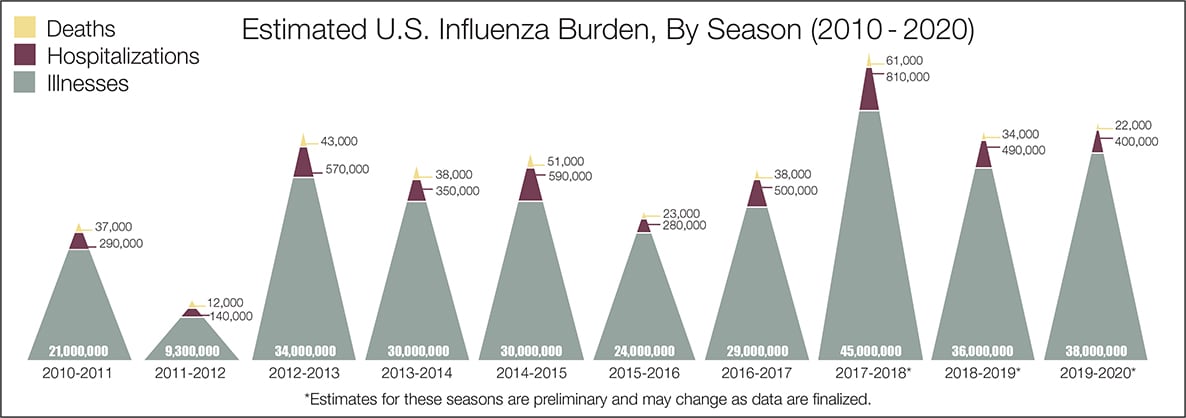
- The real question remains if the U.S. is over-reacting to this virus. The following graphic from the CDC puts the annual flu burden in perspective [click on image to enlarge]. Note that using this data is dangerous as the actual flu cases are estimated and not counted – nobody knows how accurate these guesses are.
What we do not know about the coronavirus [actually there is little scientifically proven information]. Most of our knowledge is anecdotal, from studies with limited subjects, or from studies without peer review.
- How many people have been infected as many do not show symptoms?
- Masks do work.
- Do we develop lasting immunity to the coronavirus? Another coronavirus – the simple cold – does not develop long term immunity.
- To what degree do people who never develop symptoms contribute to transmission?
- The US has scaled up coronavirus testing – and the accuracy of the tests has been improving. However, if one loses immunity – the coronavirus testing value is reduced.
- Can children widely spread coronavirus? [current thinking is that they are becoming a major source of the pandemic spread]
- Why have some places avoided big coronavirus outbreaks – and others hit hard?
- What effect will the weather have? At this point, it does not seem hot weather slows this coronavirus down – and it seems air conditioning contributes to its spread.
- Outdoor activities seem to be a lower risk than indoor activities.
- Can the world really push out an effective vaccine in 12 to 18 months?
- Will other medical treatments for Covid-19 ease symptoms and reduce deaths? So far only one drug (remdesivir) is approved for treatment.
- A current scientific understanding of the way the coronavirus works can be found [here].
Heavy breakouts of coronavirus have hit farm workers. Farmworkers are essential to the food supply. They cannot shelter at home. Consider:
- they have high rates of the respiratory disease [occupational hazard]
- they travel on crowded buses chartered by their employers
- few have health insurance
- they cannot social distance and live two to four to a room – and they eat together
- some reports say half are undocumented
- they are low paid and cannot afford not to work – so they will go to work sick
- they do not have access to sanitation when working
- a coronavirus outbreak among farmworkers can potentially shutter entire farm
The bottom line is that COVID-19 so far has been shown to be much more deadly than the data on the flu. Using CDC data, the flu has a mortality rate between 0.06 % and 0.11 % Vs. the coronavirus which to date has a mortality rate of 4 % [the 4% is the average of overall statistics – however in the last few months it has been hovering around 1.0%] – which makes it between 10 and 80 times more deadly. The reason for ranges:
Because influenza surveillance does not capture all cases of flu that occur in the U.S., CDC provides these estimated ranges to better reflect the larger burden of influenza.
There will be a commission set up after this pandemic ends to find fault [it is easy to find fault when a once-in-a-lifetime event occurs] and to produce recommendations for the next time a pandemic happens. Those that hate President Trump will conclude the virus is his fault.
Resources:
- Get the latest public health information from CDC: https://www.coronavirus.gov .
- Get the latest research from NIH: https://www.nih.gov/coronavirus.
- Find NCBI SARS-CoV-2 literature, sequence, and clinical content: https://www.ncbi.nlm.nih.gov/sars-cov-2/.
- List of studies: https://icite.od.nih.gov/covid19/search/#search:searchId=5ee124ed70bb967c49672dad
include(“/home/aleta/public_html/files/ad_openx.htm”); ?>


