


Written by Steven Hansen
The U.S. new cases 7-day rolling average are 15.7 % lower than the 7-day rolling average one week ago. U.S. deaths due to coronavirus worsened and are now 2.4 % above the rolling average one week ago. At the end of this post is a set of interactive graphs and tables for the world and individual states – as well as today’s headlines which include;
- Global cases of coronavirus are now over 19 million
- New COVID-19 Forecasts See Nearly 300,000 Deaths by December 1
- Man Wearing Only Mask and Underwear Attacks Elderly Walmart Workers
- UPS adds ‘peak’ surcharge amid coronavirus fueled delivery spike
- Pfizer Will Help Manufacture Gilead’s Remdesivir Therapeutic
- A new risk at CDC: Legionnaire’s disease
- Young women ‘most likely to suffer depression, anxiety and loneliness in lockdown’

My continuing advice is to continue to wash your hands, wear masks, and maintain social distancing. No handwashing, mask, or social distancing will guarantee you do not get infected – but it sure as hell lowers the risk in all situations. In addition, certain activities are believed to carry a higher risk – like being inside in air conditioning and removing your mask (such as restaurants, around your children/grandchildren, bars, and gyms). It is all about viral load.
The daily number of new cases in the U.S. is remaining stubbornly and embarrassedly high.
The following graphs show the 7-day rolling average for new coronavirus cases and deaths have been updated through 07 August 2020:


z coronavirus.png
Coronavirus Statistics For 07 August 2020 |
| U.S. Only | Global | U.S Percentage of Total | ||||
| Today*** | Cumulative | Today*** | Cumulative | Today | Cumulative | |
| New Confirmed Cases | 59,755 | 4,880,000 | 278,531 | 19,080,000 | 21.5% | 25.6% |
| Deaths** | 1,848 | 160,104 | 6,903 | 714,618 | 26.8% | 22.4% |
| Mortality Rate | 3.1% | 3.3% | 2.5% | 3.7% | ||
total COVID-19 Tests per 1,000 people | 2.21* | 180.22* | ||||
* as of 06 Aug 2020
** evidently several states included “probable” deaths today in the number
*** red color indicates record number
Coronavirus News You May Have Missed
Dr. Anthony Fauci says chance of coronavirus vaccine being highly effective is ‘not great’ – CNBC
White House coronavirus advisor Dr. Anthony Fauci said Friday the chances of scientists creating a highly effective vaccine — one that provides 98% or more guaranteed protection — for the coronavirus are slim.
Scientists are hoping for a coronavirus vaccine that is at least 75% effective, but 50% or 60% effective would be acceptable too, Fauci, director of the National Institute of Allergy and Infectious Diseases, said during a Q&A with the Brown University School of Public Health. “The chances of it being 98% effective is not great, which means you must never abandon the public health approach.”
Russia offers to supply Philippines with COVID-19 vaccine – Reuters
Russia is willing to supply a coronavirus vaccine to the Philippines, or team up with a local firm to mass produce it, its ambassador to Manila said on Friday, as infections in the Southeast Asian nation surge.
Russia is expecting regulatory approval for its first potential COVID-19 vaccine this month, with doses to be administered to frontline health workers first.
But the frenetic race globally to develop a COVID-19 vaccine is raising some concern that speed could compromise safety and that some countries could be putting national prestige before solid science.
“We are ready to supply vaccines to the Philippines,” Igor Khovaev, Russia’s ambassador to the Philippines, told a virtual news conference.
New IHME COVID-19 Forecasts See Nearly 300,000 Deaths by December 1 – IHME
America’s COVID-19 death toll is expected to reach nearly 300,000 by December 1; however, consistent mask-wearing beginning today could save about 70,000 lives, according to new data from the Institute for Health Metrics and Evaluation (IHME) at the University of Washington’s School of Medicine.
The US forecast totals 295,011 deaths by December. As of today, when, thus far, 158,000 have died, IHME is projecting approximately 137,000 more deaths. However, starting today, if 95% of the people in the US were to wear masks when leaving their homes, that total number would decrease to 228,271 deaths, a drop of 49%. And more than 66,000 lives would be saved.
Masks and other protective measures against transmission of the virus are essential to staying COVID-free, but people’s inconsistent use of those measures is a serious problem, said IHME Director Dr. Christopher Murray.
“We’re seeing a rollercoaster in the United States,” Murray said. “It appears that people are wearing masks and socially distancing more frequently as infections increase, then after a while as infections drop, people let their guard down and stop taking these measures to protect themselves and others – which, of course, leads to more infections. And the potentially deadly cycle starts over again.”
Germany and France quit WHO reform talks amid tension with Washington – CNBC
- France and Germany have quit talks on reforming the World Health Organization in frustration at attempts by the United States to lead the negotiations, despite its decision to leave the WHO, three officials told Reuters.
- The move is a setback for President Donald Trump as Washington, which holds the rotating chair of the G7, had hoped to issue a common roadmap for a sweeping overhaul of the WHO in September, two months before the U.S. presidential election.
- The United States gave the WHO a year’s notice in July that it is leaving the U.N. agency – which was created to improve health globally – after Trump accused it of being too close to China and having mishandled the coronavirus pandemic.
Man Wearing Only Mask and Underwear Attacks Elderly Walmart Workers
Last month, an incident at a Walmart in Minnesota attracted nationwide outrage after two people were seen wearing Nazi flags on their faces in protest at the store’s mask policy.
It was later revealed that couple were cited by the police for trespassing and banned from Walmart for at least a year
“What happened at our store in Marshall, MN is unacceptable,” a spokesperson told Newsweek.
“We strive to provide a safe and comfortable shopping environment for all our customers and will not tolerate any form of discrimination or harassment in any aspect of our business.”
UPS adds ‘peak’ surcharge amid coronavirus fueled delivery spike – Reuters
United Parcel Service Inc (UPS.N) on May 31 will slap surcharges on U.S. e-commerce companies that have flooded its delivery network with shipments of everything from packaged food to patio furniture since the coronavirus took hold in March.
Such fees are common during the winter holiday season, when package volumes more than double. This round follows stay-at-home orders to fight the spread of the novel coronavirus. That public health effort shifted shopping online and resulted in what many are calling a “second Christmas” for UPS, FedEx Corp (FDX.N) and upcoming delivery rival Amazon.com Inc (AMZN.O).
The new fees will hit large, high-volume shippers and companies that send oversized items. It could drive up costs at a time when many retailers are fighting to shelter profits.
Amazon, its biggest client, and the online divisions of Walmart Inc (WMT.N) and Target Corp (TGT.N) have seen sales surge since shoppers have hunkered down at home during the pandemic.
Pfizer Will Help Manufacture Gilead’s Remdesivir Therapeutic – US News
Pfizer announced on Friday that it will manufacture remdesivir, Gilead’s antiviral drug that aims to treat COVID-19.
The multi-year agreement will scale-up the supply of the drug, which Pfizer will make at its McPherson, Kansas facility. Gilead has been under pressure to increase supplies of the drug, which is one of just two that studies have shown to be effective against coronavirus.
“From the beginning it was clear that no one company or innovation would be able to bring an end to the COVID-19 crisis,” Pfizer CEO Albert Bourla said in a statement. “Pfizer’s agreement with Gilead is an excellent example of members of the innovation ecosystem working together to deliver medical solutions.”
Coronavirus shutdown causes new risk at CDC: Legionnaire’s disease – CNN
The US Centers for Disease Control and Prevention says it has closed several buildings it leases in Atlanta because Legionella bacteria have been found in their water systems — bacteria that likely grew because of the prolonged pandemic shutdown.
It’s a problem that people across the country need to be on the lookout for, the CDC says. The bacteria, which can cause deadly pneumonia, grow in warm or stagnant water.
The plumbing in buildings that have been closed for months because of the coronavirus pandemic could provide a perfect breeding ground for Legionella and other waterborne pathogens, the CDC cautions.
It even happened to the CDC itself.
“During the recent closures at our leased space in Atlanta, working through the General Services Administration (GSA), CDC directed the landlord to take protective actions,” the CDC said in a statement to CNN.
Young women ‘most likely to suffer depression, anxiety and loneliness in lockdown’ – Independent
Young women are the most likely group to have suffered high levels of depression, anxiety and loneliness during the coronavirus lockdown, a new study has found.
A major UCL report found 19-year-olds were most likely to be experiencing poor mental health during the lockdown – with 30-year-olds being the second most likely to endure this.
Researchers who examined the mental health of over 18,000 people aged between 19 and 62 found that women were more likely than men to be experiencing mental health issues across all ages.
Just over one third of 19-year-old women were suffering from symptoms of depression, while just under one quarter of men of the same age said the same.
Researchers polled respondents from four generations, ranging from people born in 1958now aged 62, those born in 1970 who are 50, individuals born in 1989-90 who are aged 30, and those who are aged 19.
The following are foreign head
India’s Coronavirus Cases Top 2 Million; More Than 62,000 Reported In A Single Day
Borders Across Europe Shutting as COVID-19 Cases Spike
Gates Foundation invests in $3 COVID-19 vaccine for poorer countries
Germany closes two schools due to fresh coronavirus outbreaks
Germany, with over 1,100 cases, reports first two coronavirus deaths
Japan has now identified more than 900 cases of Covid-19 for 10 days in a row
The following are additional national and state headlines with hyperlinks to the posts
Just One Texas Prison Has Zero COVID Cases—and It’s Because of the Warden
100-Plus People Have Died in U.S. While on Hydoxychloroquine for COVID-19
U.K. Scientists Say Hydroxychloroquine May Still Have Promise
Alabama Coronavirus Cases Fall After State Issues Mask Mandate
Hawaii reinstates coronavirus restrictions: ‘There’s no question that the virus is surging’
U.S. COVID-19 Deaths Projected to Be Higher Than Soldiers Killed in WW2
The pandemic has sharply curtailed investigations into accusations of child abuse or neglect.
Pandemic home remodeling is booming: Here’s what your neighbors are doing
Georgia school lifts suspension of student who posted photos of crowded hall
7-year-old becomes youngest to die of coronavirus in Georgia
Today’s Posts On Econintersect Showing Impact Of The Pandemic With Hyperlinks
31 July 2020 ECRI’s WLI Improvement Continues But Remains In Contraction
June 2020 Headline Wholesale Sales and Inventories Remain In Contraction But Significantly Improved
July 2020 BLS Jobs Situation – Employment Grew 1,763,000 But Still Down 12,572,000 Year-to-Date
Creating The Digital Commons After COVID-19
Coronavirus INTERACTIVE Charts
include($_SERVER[‘DOCUMENT_ROOT’].’/pages/coronavirus.htm’); ?>
Analyst Opinion of Coronavirus Data
There are several takeaways that need to be understood when viewing coronavirus statistical data:
- The global counts are suspect for a variety of reasons including political. Even the U.S. count has issues as it is possible that as much as half the population has had coronavirus and was asymptomatic. It would be a far better metric using a random sampling of the population weekly. In short, we do not understand the size of the error in the tracking numbers.
- Just because some of the methodology used in aggregating the data in the U.S. is flawed – as long as the flaw is uniformly applied – you establish a baseline. This is why it is dangerous to compare two countries as they likely use different methodologies to determine who has (and who died) from coronavirus.
- COVID-19 and the flu are different but can have similar symptoms. For sure, COVID-19 so far is much more deadly than the flu. [click here to compare symptoms]
- From an industrial engineering point of view, one can argue that it is best to flatten the curve only to the point that the health care system is barely able to cope. This solution only works if-and-only-if one can catch this coronavirus once and develops immunity. In the case of COVID-19, herd immunity may need to be in the 80% to 85% range. WHO warns that few have developed antibodies to COVID-19. At this point, herd immunity does not look like an option although there is now a discussion of whether T-Cells play a part in immunity [which means one might have immunity without antibodies]
- Older population countries will have a higher death rate.
- There are at least 8 strains of the coronavirus. New York may have a deadlier strain imported from Europe, compared to less deadly viruses elsewhere in the United States.
- Each publication uses different cutoff times for its coronavirus statistics. Our data uses 11:00 am London time. Also, there is an unexplained variation in the total numbers both globally and in the U.S.
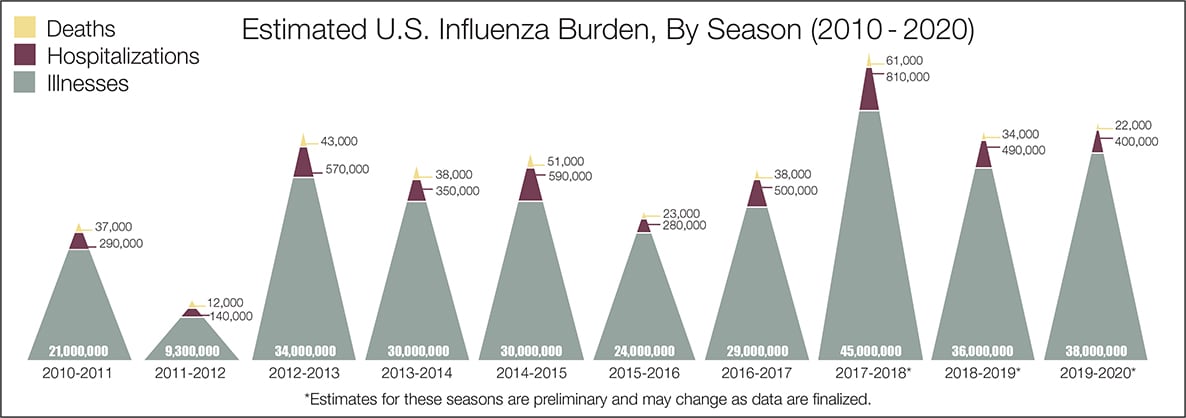
- The real question remains if the U.S. is over-reacting to this virus. The following graphic from the CDC puts the annual flu burden in perspective [click on image to enlarge]. Note that using this data is dangerous as the actual flu cases are estimated and not counted – nobody knows how accurate these guesses are.
What we do not know about the coronavirus [actually there is little scientifically proven information]. Most of our knowledge is anecdotal, from studies with limited subjects, or from studies without peer review.
- How many people have been infected as many do not show symptoms?
- Masks do work.
- Do we develop lasting immunity to the coronavirus? Another coronavirus – the simple cold – does not develop long term immunity.
- To what degree do people who never develop symptoms contribute to transmission?
- The US has scaled up coronavirus testing – and the accuracy of the tests has been improving. However, if one loses immunity – the coronavirus testing value is reduced.
- Can children widely spread coronavirus? [current thinking is that they are becoming a major source of the pandemic spread]
- Why have some places avoided big coronavirus outbreaks – and others hit hard?
- What effect will the weather have? At this point, it does not seem hot weather slows this coronavirus down – and it seems air conditioning contributes to its spread.
- Outdoor activities seem to be a lower risk than indoor activities.
- Can the world really push out an effective vaccine in 12 to 18 months?
- Will other medical treatments for Covid-19 ease symptoms and reduce deaths? So far only one drug (remdesivir) is approved for treatment.
- A current scientific understanding of the way the coronavirus works can be found [here].
Heavy breakouts of coronavirus have hit farm workers. Farmworkers are essential to the food supply. They cannot shelter at home. Consider:
- they have high rates of the respiratory disease [occupational hazard]
- they travel on crowded buses chartered by their employers
- few have health insurance
- they cannot social distance and live two to four to a room – and they eat together
- some reports say half are undocumented
- they are low paid and cannot afford not to work – so they will go to work sick
- they do not have access to sanitation when working
- a coronavirus outbreak among farmworkers can potentially shutter entire farm
The bottom line is that COVID-19 so far has been shown to be much more deadly than the data on the flu. Using CDC data, the flu has a mortality rate between 0.06 % and 0.11 % Vs. the coronavirus which to date has a mortality rate of 4 % [the 4% is the average of overall statistics – however in the last few months it has been hovering around 1.0%] – which makes it between 10 and 80 times more deadly. The reason for ranges:
Because influenza surveillance does not capture all cases of flu that occur in the U.S., CDC provides these estimated ranges to better reflect the larger burden of influenza.
There will be a commission set up after this pandemic ends to find fault [it is easy to find fault when a once-in-a-lifetime event occurs] and to produce recommendations for the next time a pandemic happens. Those that hate President Trump will conclude the virus is his fault.
Resources:
- Get the latest public health information from CDC: https://www.coronavirus.gov .
- Get the latest research from NIH: https://www.nih.gov/coronavirus.
- Find NCBI SARS-CoV-2 literature, sequence, and clinical content: https://www.ncbi.nlm.nih.gov/sars-cov-2/.
- List of studies: https://icite.od.nih.gov/covid19/search/#search:searchId=5ee124ed70bb967c49672dad
include(“/home/aleta/public_html/files/ad_openx.htm”); ?>


