


Written by Steven Hansen
The U.S. new cases declined today (although significantly elevated) – and today’s 7 day rolling average of new cases is now 41 % higher than one week ago (yesterday it was 43 %). At the end of this post is a set of interactive graphs and tables for the world and individual states – as well as today’s headlines which include;
- A recap of where we are in the pandemic
- Countries are “mad” that opted for strict lockdown
- Drinking Surged During The Pandemic
- What doctors have learned about fighting COVID-19
- Are Face Mask Requirements Legal?

My continuing warning is to continue to wear masks and maintain social distancing. No mask or social distancing will guarantee you do not get infected – but it sure as hell lowers the risk.
The number of new cases in the U.S. is remaining stubbornly high, increasing, and now is in record territory for new cases this week.
The following graph showing the 7-day rolling average for new coronavirus cases has been updated through 28 June 2020:

z coronavirus.png​
The following graph shows that new infections increased this week both globally and in the U.S. – and remain historically high.

The following graph shows that deaths increased this week in the U.S. and globally but the U.S. number included a one-off adjustment of people that “may” have died of coronavirus.

Coronavirus Statistics For 28 June 2020 |
| U.S. Only | Global | U.S Percentage of Total | ||||
| Today*** | Cumulative | Today*** | Cumulative | Today | Cumulative | |
| New Cases | 42,486 | 2,510,000 | 180,989 | 9,950,000 | 23.5% | 25.2% |
| Deaths** | 500 | 125.539 | 4,623 | 498,519 | 10.8% | 25.2% |
| Mortality Rate | 1.2% | 5.0% | 2.6% | 5.0% | ||
total COVID-19 Tests per 1,000 people | 1.93* | 88.24* | ||||
* as of 25 June 2020
** evidently several states included “probable” deaths today in the number
*** red color indicates record number
Recapping The Pandemic
The weekends see little new information – so a recap of the pandemic is beneficial. Econintersect has also published two posts which summarized the pandemic news this past week:
Journey to the center of a virus – Scientific American
The SARS-CoV2 virus is wreaking global havoc, a striking feat for a thing so tiny. Also impressive is how quickly scientists are learning about it. Head over to Scientific American for a splendid visual primer on how the virus enters cells, reproduces, then bursts out to infect anew – as well as how our immune system responds, and more.
How the Virus Won – New York Times
Invisible outbreaks sprang up everywhere. The United States ignored the warning signs. We analyzed travel patterns, hidden infections and genetic data to show how the epidemic spun out of control.
Drinking Surged During The Pandemic. Do You Know The Signs Of Addiction? – Kaiser Health
Loo is the bar manager for the popular restaurant in Kansas City, Missouri, and he credits increased drinking and looser liquor laws during the pandemic for his brisk business. Alcohol also seemed to help his customers deal with all the uncertainty and fear.
“Drinking definitely was a way of coping with it,” said Loo. “People did drink a lot more when it happened. I, myself, did drink a lot more.”
Many state laws seemed to be waived overnight as stay-at-home orders were put into place, and drinkers embraced trends such as liquor delivery, virtual happy hours and online wine tasting. Curbside cocktails in 12- and 16-ounce bottles particularly helped Waldo Thai make up for its lost revenue from dine-in customers.
Retail alcohol sales jumped by 55% nationally during the third week of March, when many stay-at-home orders were put in place, according to Nielsen data, and online sales skyrocketed.
Packed Bars Serve Up New Rounds Of COVID Contagion – Kaiser Health
[editor’s note: Texas and Florida have closed bars in their states]
As states ease their lockdowns, bars are emerging as fertile breeding grounds for the coronavirus. They create a risky cocktail of tight quarters, young adults unbowed by the fear of illness and, in some instances, proprietors who don’t enforce crowd limits and social distancing rules.
Public health authorities have identified bars as the locus of outbreaks in Louisiana, Florida, Wyoming and Idaho. Last weekend, the Texas alcohol licensing board suspended the liquor licenses of 17 bars after undercover agents observed crowds flouting emergency rules that required patrons to keep a safe distance from one another and limit tavern occupancy.
Adriana Megas found HandleBar Houston so crowded when she went one night two weekends ago that she left. “They weren’t counting who came in and came out,” said Megas, 38, a nursing student. “Nobody was wearing any masks. You would never think COVID happened.”
The owners of HandleBar Houston, one of the bars whose licenses were suspended, did not respond to requests for comment. Megas said she and her friends drove by five other jammed bars on their way home. “The street was insanely busy,” she said. “Every single bar was filled.”
Sweden’s Covid Expert Says the World Still Doesn’t Understand – Bloomberg
Over the past week, the epidemiologist [Sweden’s top epidemiologist Anders Tegnell] has made headlines by lashing out at the World Health Organization and labeling as “mad” countries that opted for strict lockdowns.
Throughout it all, Tegnell has argued that the world is only in the first stage of dealing with a long, uncertain battle with Covid-19. That’s why Sweden’s strategy — keep much of society open, but train people to observe distancing guidelines — is the only realistic way to cope in the long run, he says.
… On Friday, Tegnell won a very public victory against the WHO, after lambasting the organization for making a “total mistake.” The WHO had initially placed Sweden in a group of 11 countries where it said “accelerated transmission has led to very significant resurgence that, if left unchecked, will push health systems to the brink.”
But the WHO then amended its assessment, and said Swedish contagion rates are in fact “stable.” It linked the high number of cases to an increase in testing.
What doctors have learned about fighting COVID-19 – Reuters
What doctors have learned about fighting COVID-19:
- Patients are at increased risk of blood clots, and blood thinning agents can help.
- “Proning” – putting patients on their stomachs to relieve pressure on the lungs – can stave off the need for mechanical ventilation.
- Besides the respiratory system and lungs, the coronavirus can attack many other organs, including the heart, liver, kidneys, and brain.
- The most promising treatments so far seem to be the anti-viral remdesivir; dexamethasone, a steroid to treat the body’s inflammatory response to COVID-19; and plasma donated by patients who have antibodies to the disease.
- More widespread testing and quicker results helps relieve pressure on hospitals.
- Information-sharing among health professionals worldwide is crucial.
- Prevention is critical. Doctors are relying on the public to do their part with good hygiene, masks and social distancing.
Some of the biggest unknowns:
- Exactly which treatments will work for which patients.
- How quickly some treatments will gain widespread distribution, especially remdesivir.
- How long it will take for COVID-19 patients to recover.
- The long-term effects of the infection.
Coronavirus News You May Have Missed
Are Face Mask Requirements Legal? – NPR
[editor.s note: this article covers quite a bit of issues, and is worth a read]
But even a simple cloth face covering has become political.
Earlier this month, for example, California Gov. Gavin Newsom issued guidance that required most Californians to wear masks in most public settings. Public health officials say masks can prevent wearers, whether or not they’re expressing symptoms of COVID-19, from spreading the virus to others. Newsom’s mandate drew pushback from both residents and local officials, who argued that the governor doesn’t have the legal authority to make masks a requirement.
But, according to Lindsay Wiley, the director of the Health Law and Policy Program at American University, there is a legal basis for mandatory masks.
In an interview with NPR’s Weekend Edition Sunday, Wiley said “state and local governments have really quite broad authority” to require the public to wear masks during a pandemic. This interview has been edited for length and clarity.
Plastic waste surges as coronavirus prompts restaurants to use more disposable packaging – CNBC
- Before the start of the coronavirus outbreak, cities and states were making some progress on banning plastic bags, shifting from singe-use plastic to paper products and encouraging shoppers to bring reusable bags.
- But now health concerns over Covid-19 have reversed that progress. Some cities have rolled back the bans on plastic bags and retailers are stopping customers from using reusable bags.
- “The environmental fallout is definitely real,” said Sandra Noonan, chief sustainability officer of Just Salad, a popular chain that shifted away from reusable bowls once the pandemic hit.
The pandemic could lead to longer power outages following a hurricane, industry leaders warn – CNN
Power companies across hurricane-prone states are forced to face a prospect they’ve never dealt with before: restoring power after a major storm amid a global pandemic.
Long restoration times are likely depending on how the coronavirus plays out during the six-month Atlantic hurricane season, which started June 1 and is predicted to be extremely active.
“While we are committed to restoring power to customers as quickly as possible following a hurricane, I am not willing to sacrifice safety for speed,” Florida Power & Light Company President and CEO Eric Silagy noted Friday after the company concluded its two-week storm preparedness drill.
“The No. 1 priority of every employee and contractor working to restore power is to return home safely to loved ones,” he said. “This has always been at the core of our hurricane response and it remains at the heart of everything we do this hurricane season.”
The following are foreign headlines with hyperlinks to the posts
In Colombia, Tax-Free Holidays Lead Critics To Decry ‘COVID Friday’
Wearing face masks, French voters return to delayed municipal elections
Masked and distanced, Spanish PM Sanchez hits the campaign trail
Coronavirus: Leicester could be first city to go into local lockdown amid ‘spike’ in COVID-19 cases
Nearly 20,000 Coronavirus Cases In India In 24 Hours For First Time
A 10,000-bed Covid-19 facility is set to open in India
The following are additional national and state headlines with hyperlinks to the posts
Justice Department Issues Warning About Fake Mask Exempt Cards
Arizona nursing homes brace for another coronavirus surge as cases continue to rise
Only two US states are reporting a decline in new coronavirus cases
Today’s Posts On Econintersect Showing Impact Of The Pandemic With Hyperlinks
More Households Face Food Scarcity During COVID-19
Will COVID-19 Leave Lasting Economic Scars?
Did State Reopenings Increase Social Interactions?
Coronavirus Disease Weekly News 27June 2020
Coronavirus Economic Weekly News 27June 2020
3 Moral Virtues Necessary For An Ethical Pandemic Response And Reopening
Coronavirus INTERACTIVE Charts
include($_SERVER[‘DOCUMENT_ROOT’].’/pages/coronavirus.htm’); ?>
Analyst Opinion of Coronavirus Data
There are several takeaways that need to be understood when viewing coronavirus statistical data:
- The global counts are suspect for a variety of reasons including political. Even the U.S. count has issues as it is possible that as much as half the population has had coronavirus and was asymptomatic. It would be a far better metric using a random sampling of the population weekly. In short, we do not understand the size of the error in the tracking numbers.
- Just because some of the methodology used in aggregating the data in the U.S. is flawed – as long as the flaw is uniformly applied – you establish a baseline. This is why it is dangerous to compare two countries as they likely use different methodologies to determine who has (and who died) from coronavirus.
- COVID-19 and the flu are different but can have similar symptoms. For sure, COVID-19 so far is much more deadly than the flu. [click here to compare symptoms]
- From an industrial engineering point of view, one can argue that it is best to flatten the curve only to the point that the health care system is barely able to cope. This solution only works if-and-only-if one can catch this coronavirus once and develops immunity. In the case of COVID-19, herd immunity may need to be in the 80% to 85% range. WHO warns that few have developed antibodies to COVID-19. At this point, herd immunity does not look like an option.
- Older population countries will have a higher death rate.
- There are at least 8 strains of the coronavirus. New York may have a deadlier strain imported from Europe, compared to less deadly viruses elsewhere in the United States.
- Each publication uses different cutoff times for its coronavirus statistics. Our data uses 11:00 am London time. Also, there is an unexplained variation in the total numbers both globally and in the U.S.
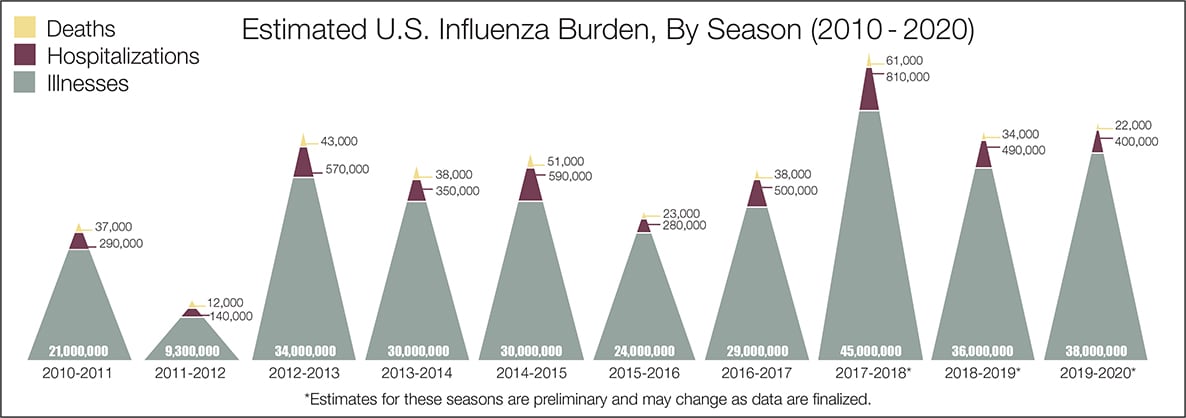
- The real question remains if the U.S. is over-reacting to this virus. The following graphic from the CDC puts the annual flu burden in perspective [click on image to enlarge]. Note that using this data is dangerous as the actual flu cases are estimated and not counted – nobody knows how accurate these guesses are.
What we do not know about the coronavirus [actually there is little scientifically proven information]. Most of our knowledge is anecdotal, from studies with limited subjects, or from studies without peer review.
- How many people have been infected as many do not show symptoms?
- To what degree do people who never develop symptoms contribute to transmission?
- The US has scaled up coronavirus testing – but the accuracy of the tests is in question.
- Can children widely spread coronavirus?
- Why have some places avoided big coronavirus outbreaks – and others hit hard?
- What effect will the weather have? At this point, it does not seem hot weather slows this coronavirus down.
- Outdoor activities seem to be a lower risk than indoor activities.
- Do we develop lasting immunity to the coronavirus? Another coronavirus – the simple cold – does not develop long term immunity.
- Can the world really push out an effective vaccine in 12 to 18 months?
- Will other medical treatments for Covid-19 ease symptoms and reduce deaths?
- A current scientific understanding of the way the coronavirus works can be found [here].
Heavy breakouts of coronavirus have hit farmworkers. Farmworkers are essential to the food supply. They cannot shelter at home. Consider:
- they have high rates of the respiratory disease [occupational hazard]
- they travel on crowded buses chartered by their employers
- few have health insurance
- they cannot social distance and live two to four to a room – and they eat together
- some reports say half are undocumented
- they are low paid and cannot afford not to work – so they will go to work sick
- they do not have access to sanitation when working
- a coronavirus outbreak among farmworkers can potentially shutter entire farm
The bottom line is that COVID-19 so far has been shown to be much more deadly than the data on the flu. Using CDC data, the flu has a mortality rate between 0.06 % and 0.11 % Vs. the coronavirus which to date has a mortality rate of over 5 % – which makes it between 45 and 80 times more deadly. The reason for ranges:
Because influenza surveillance does not capture all cases of flu that occur in the U.S., CDC provides these estimated ranges to better reflect the larger burden of influenza.
There will be a commission set up after this pandemic ends to find fault [it is easy to find fault when a once-in-a-lifetime event occurs] and to produce recommendations for the next time a pandemic happens. Those that hate President Trump will conclude the virus is his fault.
Resources:
- Get the latest public health information from CDC: https://www.coronavirus.gov .
- Get the latest research from NIH: https://www.nih.gov/coronavirus.
- Find NCBI SARS-CoV-2 literature, sequence, and clinical content: https://www.ncbi.nlm.nih.gov/sars-cov-2/.
- List of studies: https://icite.od.nih.gov/covid19/search/#search:searchId=5ee124ed70bb967c49672dad
include(“/home/aleta/public_html/files/ad_openx.htm”); ?>


