



Of the four regional manufacturing surveys released for September, two were in expansion and two were in contraction.
Analyst Opinion of Kansas City Fed Manufacturing
Kansas City Fed manufacturing has been one of the more stable districts and their index even though below the range seen in the last 12 months. Note that the key internals were in contraction. This should be considered about the same as last month.
Market expectations from Econoday were -4 to -1 (consensus -3). The reported value was -2. Any value below zero is in contraction.

z kansas_man.PNG
The Federal Reserve Bank of Kansas City released the September Manufacturing Survey today. According to Chad Wilkerson, vice president and economist at the Federal Reserve Bank of Kansas City, the survey revealed that Tenth District manufacturing activity edged down in September, and expectations for future activity moderated but remained positive.
“Regional factory activity continued to decline in September, though not as much as last month,” said Wilkerson. “Although the employment index dropped further this month, firms as a whole indicated 2019 employment expectations have increased slightly since the beginning of the year.”
Tenth District manufacturing activity edged down in September, and expectations for future activity moderated but remained positive. The month-over-month price index for raw materials continued to fall, while the price index for finished products inched higher. Firms continued to expect prices to rise over the next 6 months, but at a slower pace.
Factory Activity Edged Down in September
The month-over-month composite index was -2 in September, up slightly from -6 in August and similar to -1 in July (Table 1). The composite index is an average of the production, new orders, employment, supplier delivery time, and raw materials inventory indexes. The dip in manufacturing activity was driven by continued declines at durable goods plants, especially from decreases in nonmetallic mineral products, primary metal, computer and electronic products, and transportation equipment manufacturing. While the month-over-month employment index dropped further in September, the production and shipments indexes rebounded considerably. Year-over-year factory indexes were somewhat mixed in September, but the composite index was unchanged at -1. The future composite index remained positive, but slowed from 9 to 5, the lowest future composite index since May 2016.
Summary of all Federal Reserve Districts Manufacturing:
Richmond Fed (hyperlink to reports):

z richmond_man.PNG​
Dallas Fed (hyperlink to reports):

z dallas_man.PNG
Philly Fed (hyperlink to reports):

z philly fed1.PNG
New York Fed (hyperlink to reports):

z empire1.PNG
Federal Reserve Industrial Production – Actual Data (hyperlink to report):
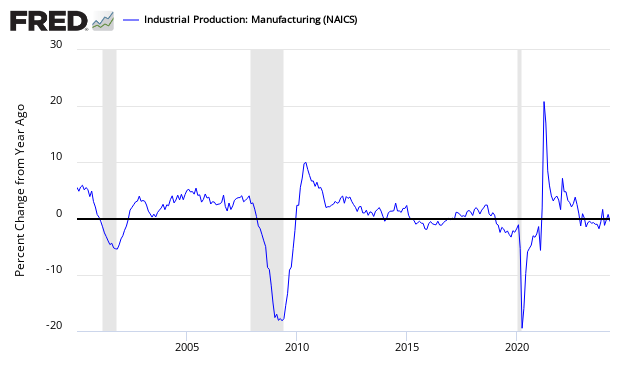
Holding this and other survey’s Econintersect follows accountable for their predictions, the following graph compares the hard data from Industrial Products manufacturing subindex (dark blue bar) and US Census manufacturing shipments (red bar) to the Kansas City Fed survey (light green bar).
Comparing Surveys to Hard Data:

z survey1.png
In the above graphic, hard data is the long bars, and surveys are the short bars. The arrows on the left side are the key to growth or contraction.
include(“/home/aleta/public_html/files/ad_openx.htm”); ?>


