


 Written by Steven Hansen
The Philly Fed Business Outlook Survey growth was statistically unchanged and continues to suggest weaker growth. Consider however that this is the thirteenth month in a row of expansion – even though the expansion was weaker or stronger in any particular month. Key elements were mixed. This survey came in under expectations.
This is a very noisy index which readers should be reminded is sentiment based. The Philly Fed historically is one of the more negative of all the Fed manufacturing surveys but has been positive over the last 13 months.
The market was expecting the index value of +2.0 to +12.0 (consensus 7.0) versus the actual at 5.0. Positive numbers indicate market expansion, negative numbers indicate contraction.
Manufacturing activity in the region increased at a modest pace in March, according to firms responding to this month’s Manufacturing Business Outlook Survey. The survey’s current indicators for general activity and new orders were positive and remained near their low readings in February. Firms reported overall declines in shipments and in work hours, while overall employment increased only slightly. Firms reported more widespread price reductions in March, although most firms continued to report steady prices. The survey’s indicators of future activity showed mixed results but continued to suggest that the manufacturing sector is expected to continue growing over the next six months.
Indicators Suggest Modest Growth
The survey’s broadest measure of manufacturing conditions, the diffusion index of current activity, at 5.0, was virtually unchanged from its reading of 5.2 in February (see Chart 1). The demand for manufactured goods, as measured by the current new orders index, remained at a very low, albeit positive, reading of 3.9 and edged 2 points lower than in February. The current shipments index fell more dramatically (16 points) and returned the index to negative territory (its second negative reading in three months). Firms reported faster delivery times and a decrease in unfilled orders this month compared with February.
Firms’ responses suggest weaker labor market conditions compared with most of last year. Although the current employment index, at just 3.5, was virtually unchanged from last month, the index remains well below its average reading of about 14 over the second half of last year. The percentage of firms reporting an increase in employees in March (17 percent) narrowly exceeded the percentage reporting a decrease (14 percent). Firms also reported reductions in the workweek in March: The percentage of firms reporting a shorter workweek (24 percent) was greater than the percentage reporting a longer workweek (13 percent).

z philly fed1.PNG
Econintersect believes the important elements of this survey are new orders and unfilled orders . Unfilled orders has reversed again and is now in contraction territory, and new orders expansion continued at a slower rate.

This index has many false recession warnings. However, holding this and other survey’s Econintersect follows accountable for their predictions, the following graph compares the hard data from Industrial Products manufacturing subindex (long dark blue bar) and US Census manufacturing shipments (long pink bar) to the Philly Fed Survey (yellow bar).
Summary of all Federal Reserve Districts Manufacturing:
Richmond Fed (hyperlink to reports):

z richmond_man.PNG
Kansas Fed (hyperlink to reports):

z kansas_man.PNG
Dallas Fed (hyperlink to reports):

z dallas_man.PNG
Philly Fed (hyperlink to reports):

z philly fed1.PNG
New York Fed (hyperlink to reports):

z empire1.PNG
Federal Reserve Industrial Production – Actual Data (hyperlink to report):
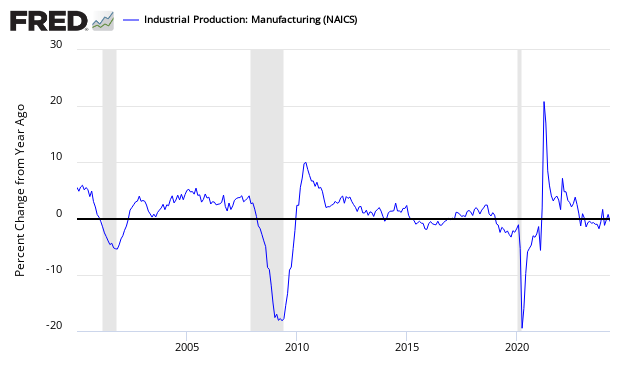
Holding this and other survey’s Econintersect follows accountable for their predictions, the following graph compares the hard data from Industrial Products manufacturing subindex (dark blue bar) and US Census manufacturing shipments (lighter blue bar) to the Dallas Fed survey (light blue bar).
Comparing Surveys to Hard Data:

z survey1.png
In the above graphic, hard data is the long bars, and surveys are the short bars. The arrows on the left side are the key to growth or contraction.
Caveats on the use of Philly Fed Business Outlook Survey:
This is a survey, a quantification of opinion – not facts and data. Surveys lead hard data by weeks to months, and can provide early insight into changing conditions. Econintersect finds they do not necessarily end up being consistent compared to hard economic data that comes later, and can miss economic turning points.
This survey is very noisy – and recently showed recessionary conditions. And it is understood from 3Q2011 GDP that the economy was expanding even though this index was in contraction territory. On the positive side, it hit the start and finish of the 2007 recession exactly.
No survey is accurate in projecting employment – and the Philly Fed Business Outlook Survey is no exception. Although there are some general correlation in trends, month-to-month movements have not correlated with the BLS Service Sector Employment data.
Over time, there is a general correlation with real business data – but month-to-month conflicts are frequent.
include(“/home/aleta/public_html/files/ad_openx.htm”); ?>


