


Written by Sig Silber
Looking out into the future, we have a Modoki type El Nino which might not have the longevity that both NOAA and JAMSTEC have assigned to it. This coming week should be mostly calm and then next week it gets more interesting. From the NOAA 8 – 14 Day Forecast:
Probabilities of above normal precipitation are enhanced from eastern Texas into the Central Mississippi Valley and the Tennessee and Ohio Valleys, as moisture continues to be expected to be drawn northward from the Gulf of Mexico at low levels. Probabilities of above normal precipitation are slightly enhanced for much of the central CONUS with the potential development of storm systems across the region east of the Rockies.

Please share this article – Go to the very top of the page, right-hand side for social media buttons. Also, feel free to send this article to anyone you feel will benefit from it.
Today is June 25, 2019 If you are reading this article later than this date, there may be a later version which you can access by clicking here and selecting the latest version of this article from the top of the Directory and clicking on that. Many of the graphics in this article will update continually. So many but not all of the graphics continue to update but the latest version of the article has my updated commentary and updated NOAA discussions when we update those which may be done on the day after the article is first published or later in the week depending on how fast conditions are changing. So if you have an older version, e.g. from an email you received yesterday, the graphics that auto-update are always current but if you want to be sure you have the most current discussions, click here and then click again to go to the most recently published version. It is our goal to provide the most current information and discussion practical. You do not need the most up-to-date version to have the most up-to-date forecast as that updates automatically but if you are interested in my comments or the NOAA discussion the text in this article is updated manually if we republish the article to keep it as current as possible. I hope this explanation is not too confusing.
New Kelvin Wave looks weak

It is definitely westerly displaced

How is your Upper Heat?

Tropical Activity

Recent CONUS Weather
Here is the recent history of the overall atmospheric pattern for North America and the North Pacific.

And now looking at the recent weather.
| And the 30 Days ending a week ago Saturday | And the 30 Days ending last Saturday |
|  |
| Mexico is less dry and the cool anomaly is less expansive and intense. | It is less wet especially in the West and the temperature anomlies are deamplified. |
Remember, these maps are a 30 average so the most distant seven days are removed and the most recent seven days are added. | |

Summary of the Forecast
We now provide our usual summary first for temperature and then for precipitation of small images of the four short-term maps. You can click on these maps to see larger versions. The easiest way to return to this report is by using the “Back Arrow” usually found at the top left corner of your screen to the left of the URL Box. Larger maps are available later in the article with the discussion and analysis.
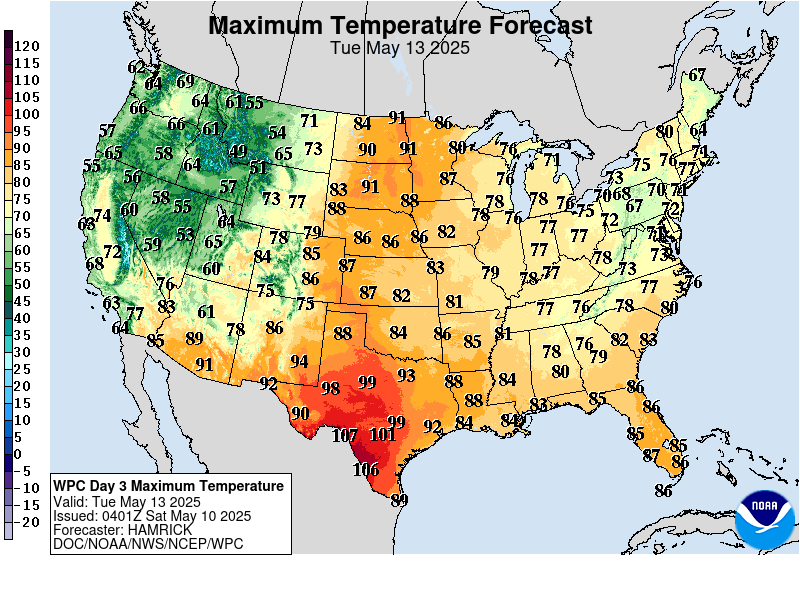
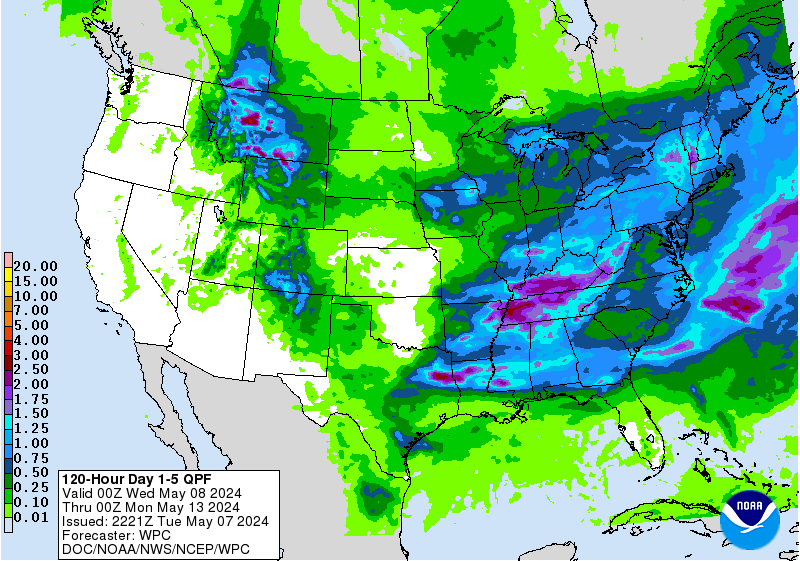
Sometimes it is useful to see the evolution of the forecasts from the 1 – 5 Day, 6 – 10 Day (which NOAA considers to be Week-1 of their intermediate forecast) , 8 – 14 Day (which NOAA considers to be Week-2) and Week 3 and 4 (which after being issued overlap with Week-2). I do not have comparable maps for the Day 1 – 5 forecast in the same format as the three maps we generally work with. What I am showing for temperature is the Day 3 Maximum Temperature and for precipitation the five-day precipitation: the latter being fairly similar in format to the subsequent set of the maps I present each week but showing absolute QPF (inches of precipitation) not QPF deviation from Normal.
First Temperature
|
|
|
|
This shows magnitude rather than the probability of being higher or lower than Normal and shows the middle day of the five day period. | The pattern is pretty much stagnant in terms of west to east movment in exchange for south to north movement. The transition from the 8 – 14 day forecast shown above to the week 3/4 forecast which was updated on June 21, 2019 seems feasible. | ||
And then Precipitation
|
|
| |
The five-day QPF is shown above. The units are different than the other maps i.e. in units of precipitation (inches) not probabilities of exceeding or being less than climatology. | The pattern is mostly stagnant. The Middle and Lower Mississippi River Valley remains wet. There is sort of a GOM oriented Monsoon to pulse in Week – 2 The transition from the 8 -14 day forecast shown above to the week 3/4 forecast which was updated on June 21, 2019 seems feasible. | ||
A. Now we will begin with our regular approach and focus on Alaska and CONUS (all U.S.. except Hawaii).
Water Vapor.
This view of the past 24 hours provides a lot of insight as to what is happening.
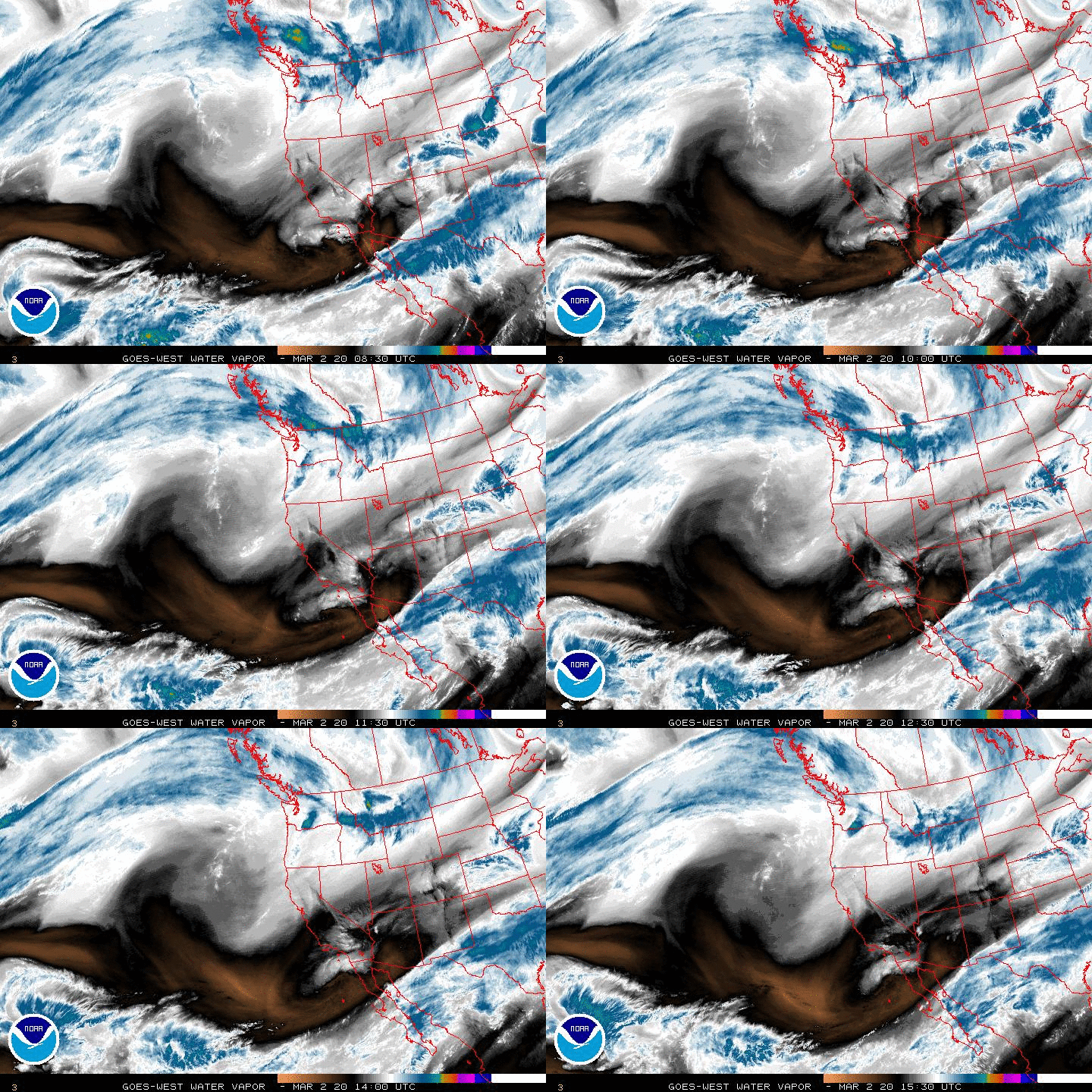
You can see from this animation that there is some limited moisture entering from the Pacific in some cases via Mexico, or perhaps only from the Gulf of Mexico. .

Tonight, Monday, June 24, 2019, as I am looking at the above graphic, you see clouds over the Western States and continuing into the Great Plains. It is not very intense and other than the moisture entering via the GOM it is not impacting the Southern Tier states.
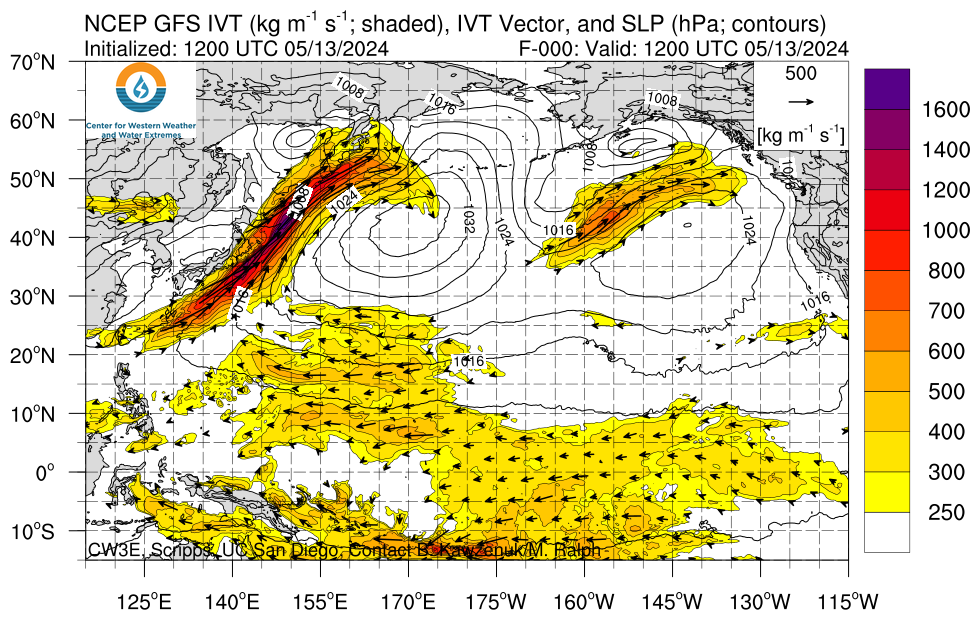
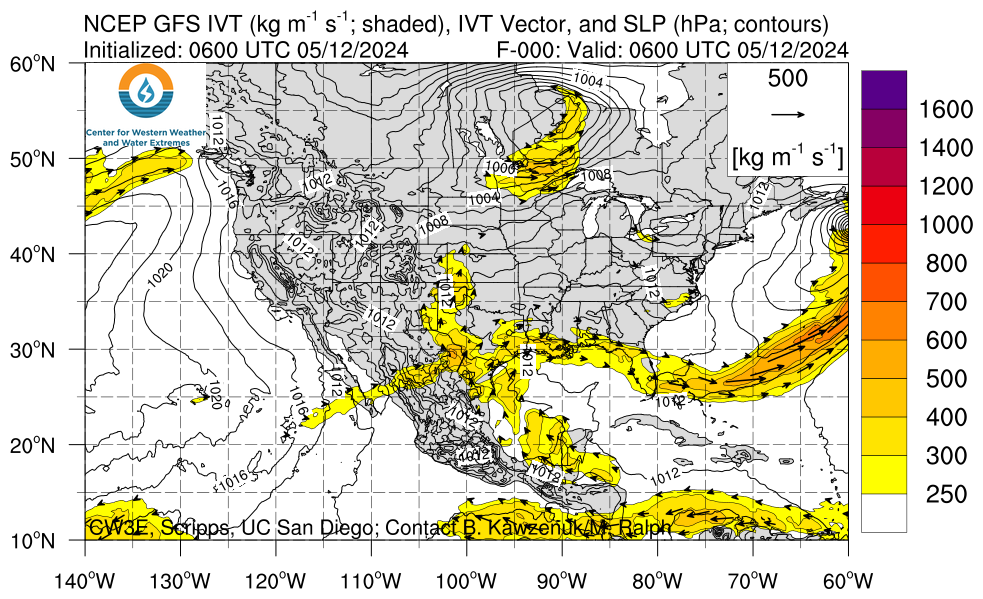
We now discuss Atmospheric Rivers i.e. thick concentrated movements of water moisture. More explanation on Atmospheric Rivers can be found by clicking here or if you want more theoretical information by clicking here. The idea is that we have now concluded that moisture often moves via narrow but deep channels in the atmosphere (especially when the source of the moisture is over water) rather than being very spread out. This raises the potential for extreme precipitation events. You can convert this graphic into a flexible forecasting tool by clicking here. One can obtain views of different geographical areas by clicking here.
The graphic we had been using was not always updating so, for the time being, we added another version which is updating. It does not cover all of CONUS but it does provide a very good view of what is happening in the Pacific and the North American West Coast. But the original graphic we were using is not working so we are using both.
 There
There
And this graphic provides a better view of all of CONUS.
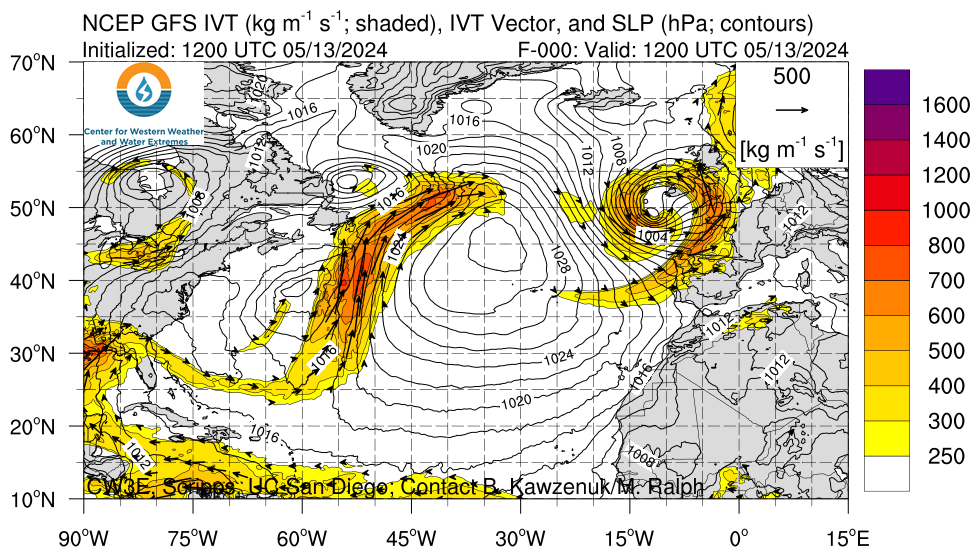
This graphic shows the Atlantic.
And Now the Day One and Two CONUS Forecasts (These graphics have recently been revised by NOAA and I think greatly improved).
Day One CONUS Forecast | Day Two CONUS Forecast |
|
|
These graphics update and can be clicked on to enlarge but my brief comments are only applicable to what I see on Monday night prior to publishing. | |
 | |
We no longer see snow. We see more convective activity. | |


Additional useful forecasts are available from our Severe Weather Report which this week can always be located via this directory.
60 Hour Forecast Animation
Here is a national animation of weather fronts and precipitation forecasts with four 6-hour projections of the conditions that will apply covering the next 24 hours and a second day of two 12-hour projections the second of which is the forecast for 48 hours out and to the extent it applies for 12 hours, this animation is intended to provide coverage out to 60 hours. Beyond 60 hours, additional maps are available at links provided below. The explanation for the coding used in these maps, i.e. the full legend, can be found here although it includes some symbols that are no longer shown in the graphic because they are implemented by color coding.
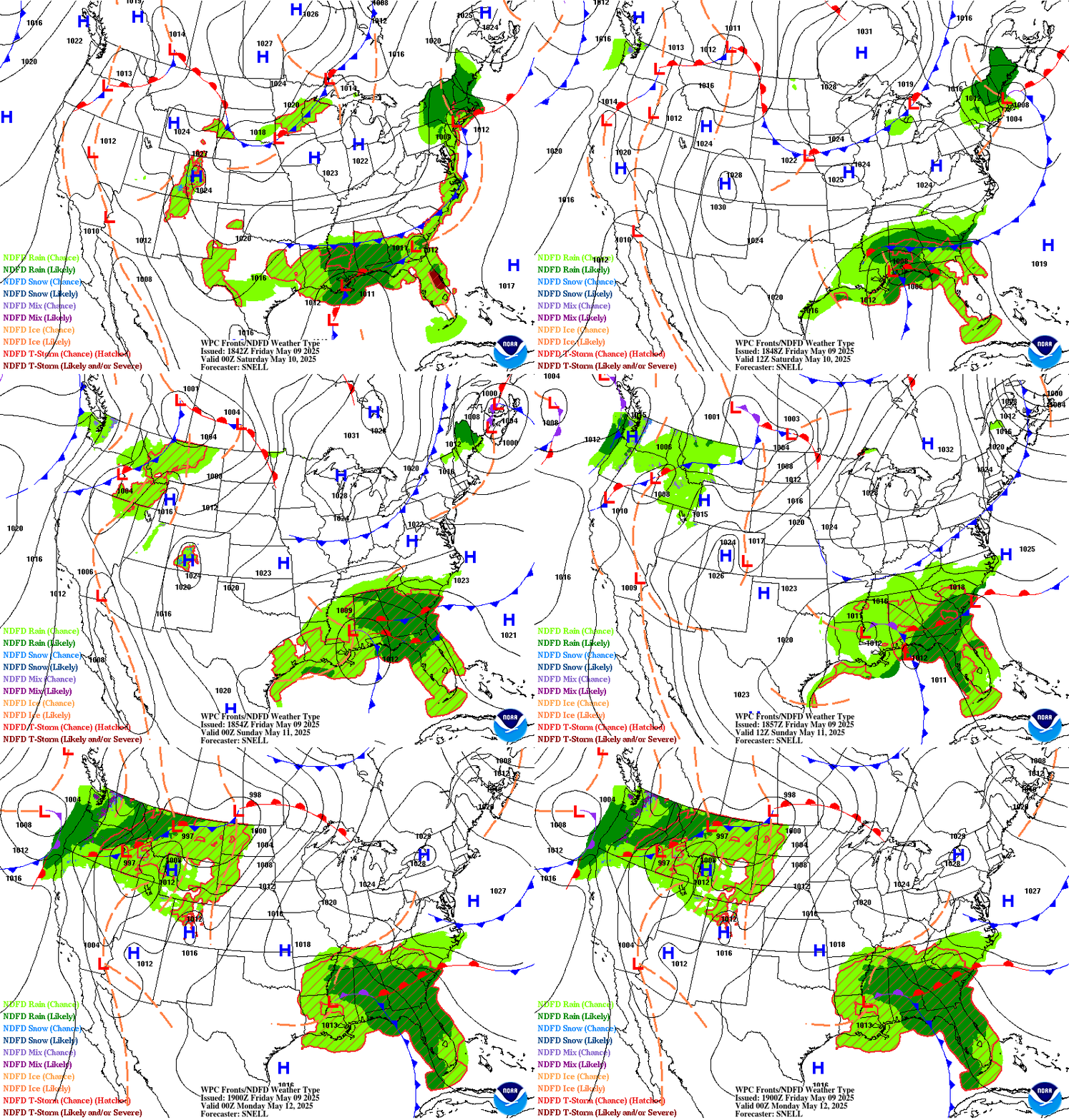
The below makes it easier to focus on a particular day. The best way to read them is from left to right on the first row and then from left to right in the row below it.
include(“/home4/aleta/public_html/pages/weather/modules/Weather_Map_by_Day_Matrix.htm”); ?>
What is Behind the Forecasts? Let us try to understand what NOAA is looking at when they issue these forecasts.
Below is a graphic which highlights the forecast surface Highs and the Lows re air pressure on Day 7. The Day 3 forecast can be found here. the Day 6 Forecast can be found here.
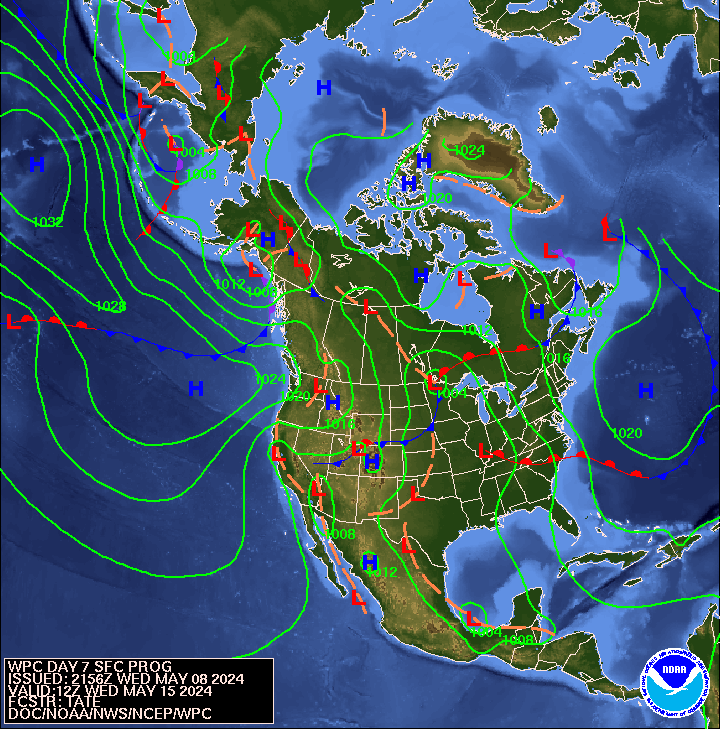
There really is not an Aleutian Low at this point although there is a weak Low near Kamchatka with surface central pressure of 1008 hPa. There is a Western Canada Low with surface central pressure of 1008 hPa extending west from Hudson Bay. The Hawaiian High has surface central pressure of 1028 hPa and it extends inland to some extent with a Low intruding into it which I think will have impacts in the following week. Way to the east there is a Maritime Low in the Atlantic with surface central pressure of 1008 hPa. And again there is an inverted Trough in the Sea of Cortez extending into the Southwest almost like what we see during the Monsoon. The High over the Mississippi River Valley may be the key for the following week.
include(“/home4/aleta/public_html/pages/weather/modules/Air_Pressure_Map_by_Day_Matrix.htm”); ?>
Looking at the current activity of the Jet Stream. The below graphics and the above graphics are very related.
Not all weather is controlled by the Jet Stream (which is a high altitude phenomenon) but it does play a major role in steering storm systems especially in the winter The sub-Jet Stream level intensity winds shown by the vectors in this graphic are also very important in understanding the impacts north and south of the Jet Stream which is the higher-speed part of the wind circulation and is shown in gray on this map. In some cases however a Low-Pressure System becomes separated or “cut off” from the Jet Stream. In that case, it’s movements may be more difficult to predict until that disturbance is again recaptured by the Jet Stream. This usually is more significant for the lower half of CONUS with the cutoff lows being further south than the Jet Stream. Some basic information on how to interpret the impact of jet streams on weather can be found here and here. I have not provided the ability to click to get larger images as I believe the smaller images shown are easy to read.
| Current | Day 5 |
 |  |
You can see the current pattern here. The pattern is far north. But it is more meridional than recently. | The pattern is forecast to shift east and continue being predominately zonal but that looks like a Pacific Trough entering CONUS. There is a lot of room for moist air to enter from the GOM. |
Putting the Jet Stream into Motion and Looking Forward a Few Days Also
To see how the pattern is projected to evolve, please click here. In addition to the shaded areas which show an interpretation of the Jet Stream, one can also see the wind vectors (arrows) at the 300 Mb level.
This longer animation shows how the jet stream is crossing the Pacific and when it reaches the U.S. West Coast is going every which way.
Click here to gain access to a very flexible computer graphic. You can adjust what is being displayed by clicking on “earth” adjusting the parameters and then clicking again on “earth” to remove the menu. Right now it is set up to show the 500 hPa wind patterns which is the main way of looking at synoptic weather patterns. This amazing graphic covers North and South America. It could be included in the Worldwide weather forecast section of this report but it is useful here re-understanding the wind circulation patterns.
500 MB Mid-Atmosphere View
The map below is the mid-atmosphere 7-Day chart rather than the surface highs and lows and weather features. In some cases, it provides a clearer less confusing picture as it shows only the major pressure gradients. This graphic auto-updates so when you look at it you will see NOAA’s latest thinking. The speed at which these troughs and ridges travel across the nation will determine the timing of weather impacts. This graphic auto-updates I think every six hours and it changes a lot. Thinking about clockwise movements around High-Pressure Systems and counterclockwise movements around Low-Pressure Systems provides a lot of information.
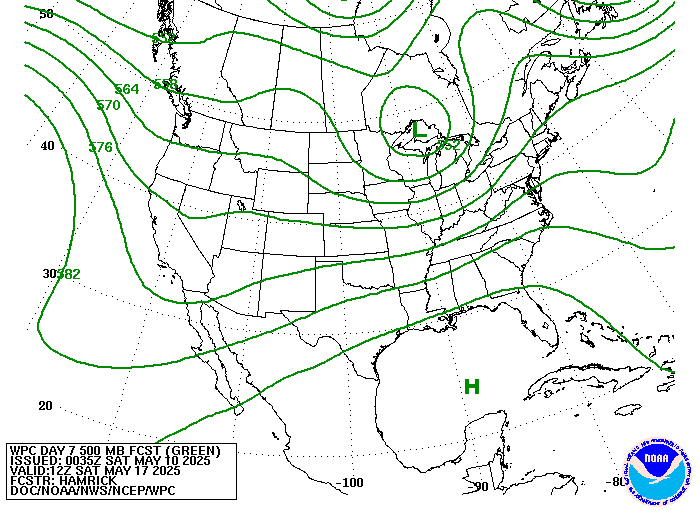
Here is the whole suite of similar maps for Days 3, 4, 5, 6 and repeated for Day 7. It is quite complicated. Read from left to right first row and then left to right on the second row. The maps resemble another set of maps presented earlier but those showed the surface pattern and this is the 500 MB pattern.
include (“/home4/aleta/public_html/pages/weather/modules/500_Millibar_by_Day_Matrix.htm”); ?>
Here is the seven-day cumulative precipitation forecast. More information on how to interpret this graphic is available here.
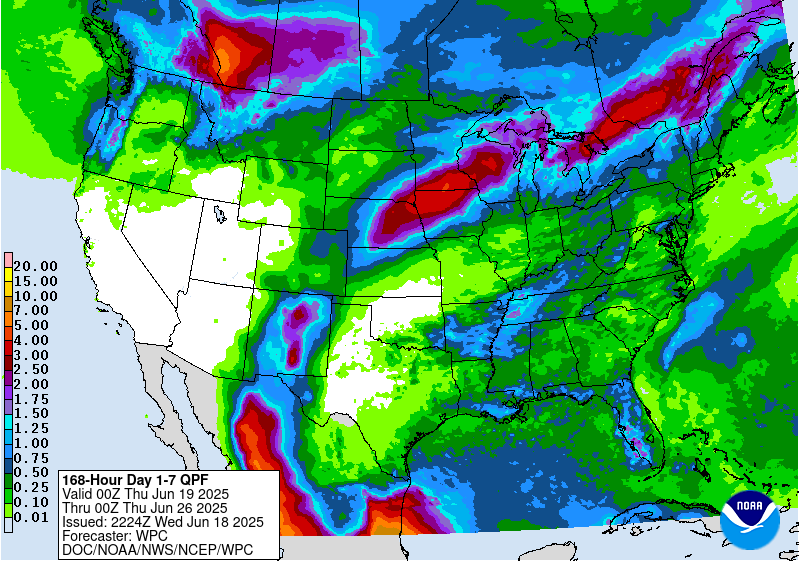
Four – Week Outlook: Looking Beyond Days 1 to 5, What is the Forecast for the Following Three + Weeks?
I use “EC” in my discussions although NOAA sometimes uses “EC” (Equal Chances) and sometimes uses “N” (Normal) to pretty much indicate the same thing although “N” may be more definitive.
First – Temperature
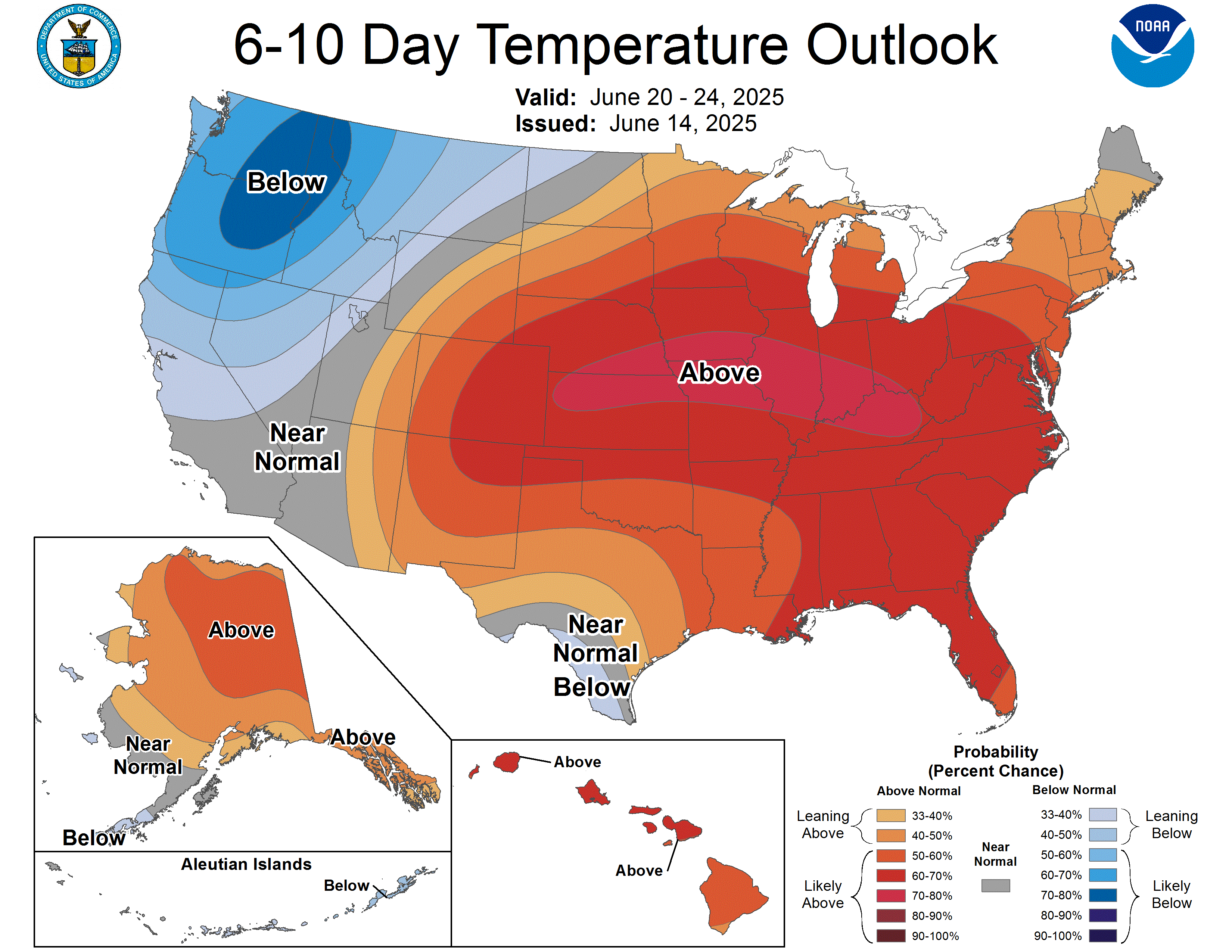
6 – 10 Day Temperature Outlook issued today (Note the NOAA Level of Confidence in the Forecast Released on June 24, 2019 was 4 out of 5
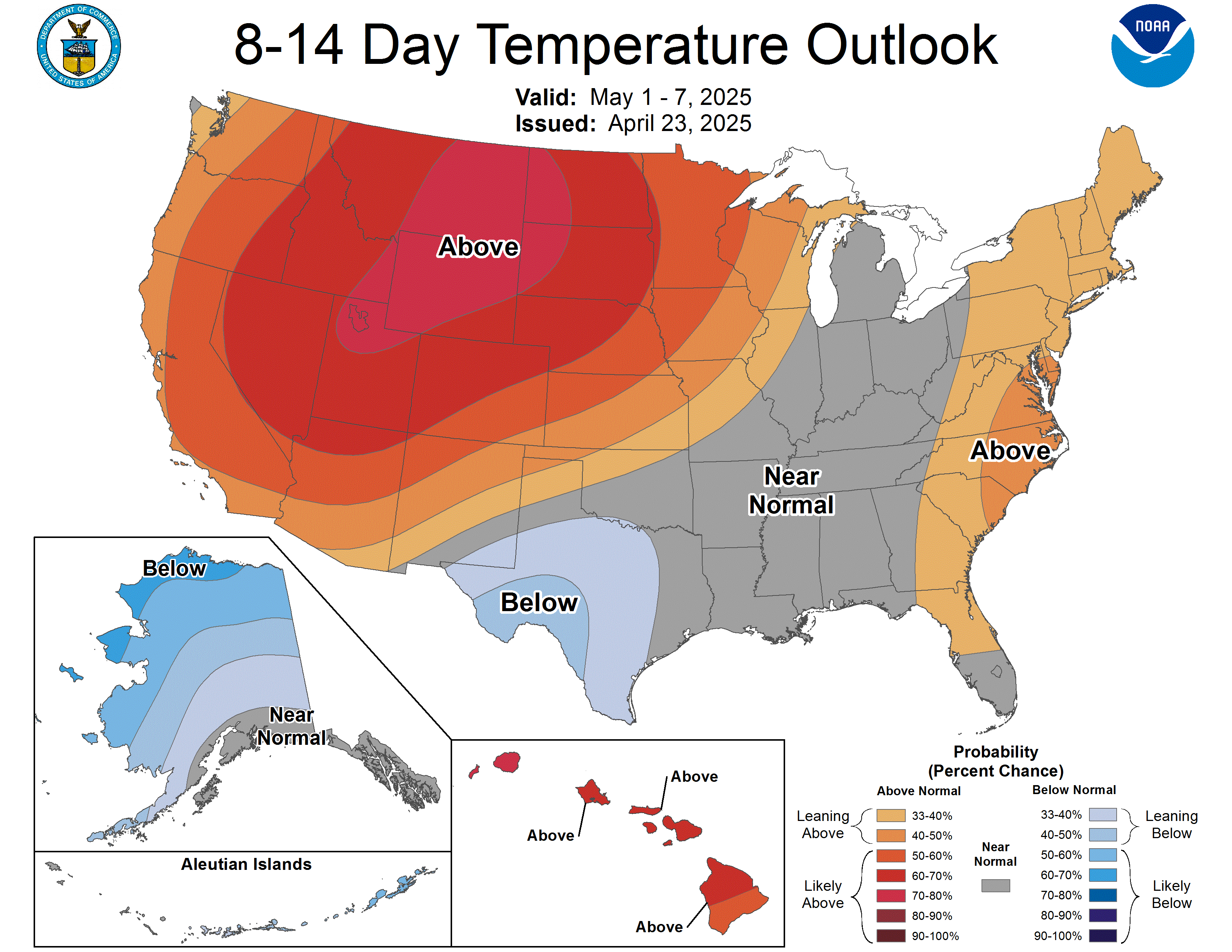
8 – 14 Day Temperature Outlook issued today (Note the NOAA Level of Confidence in the Forecast Released on June 24, 2019 was 3 out of 5).
 –
–
Looking further out.
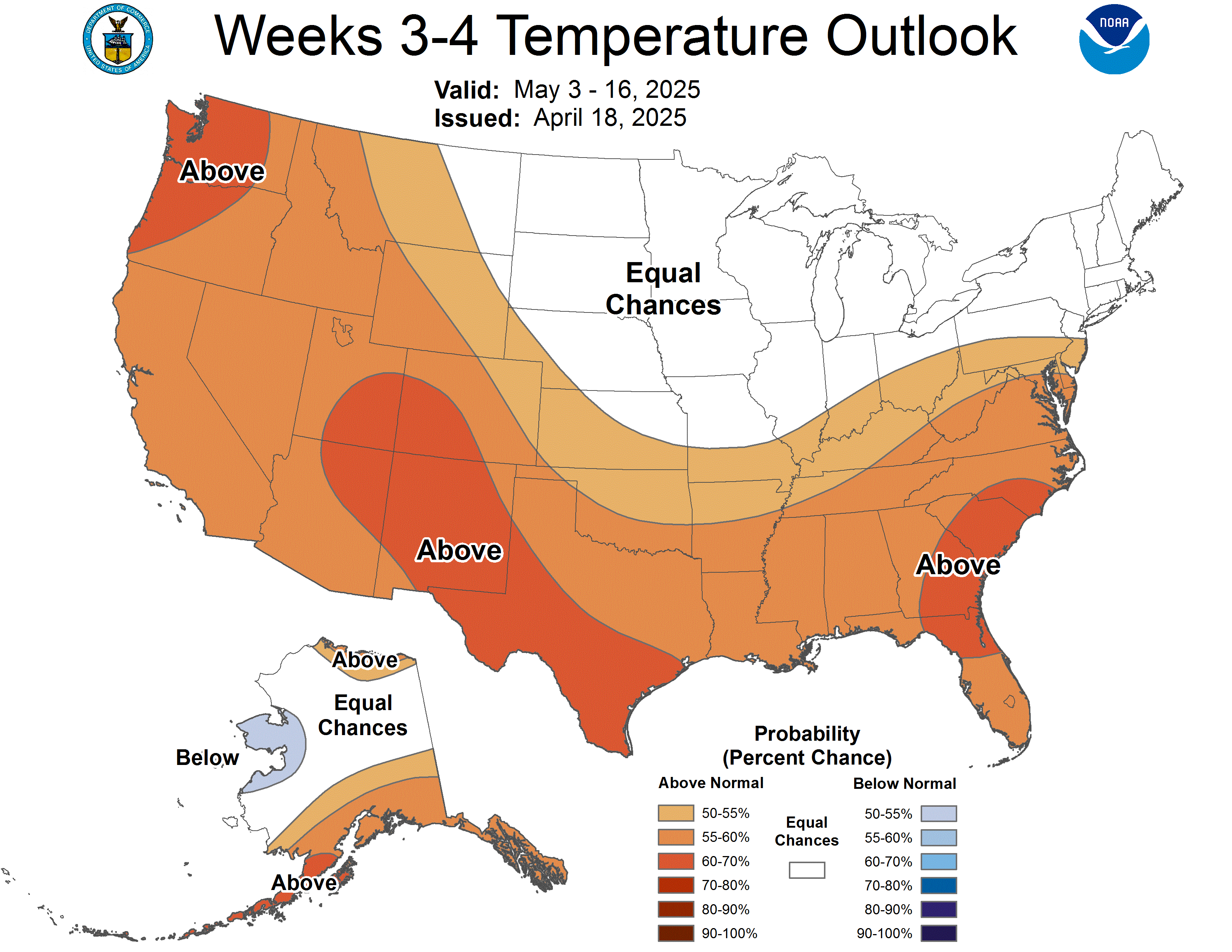
Now – Precipitation
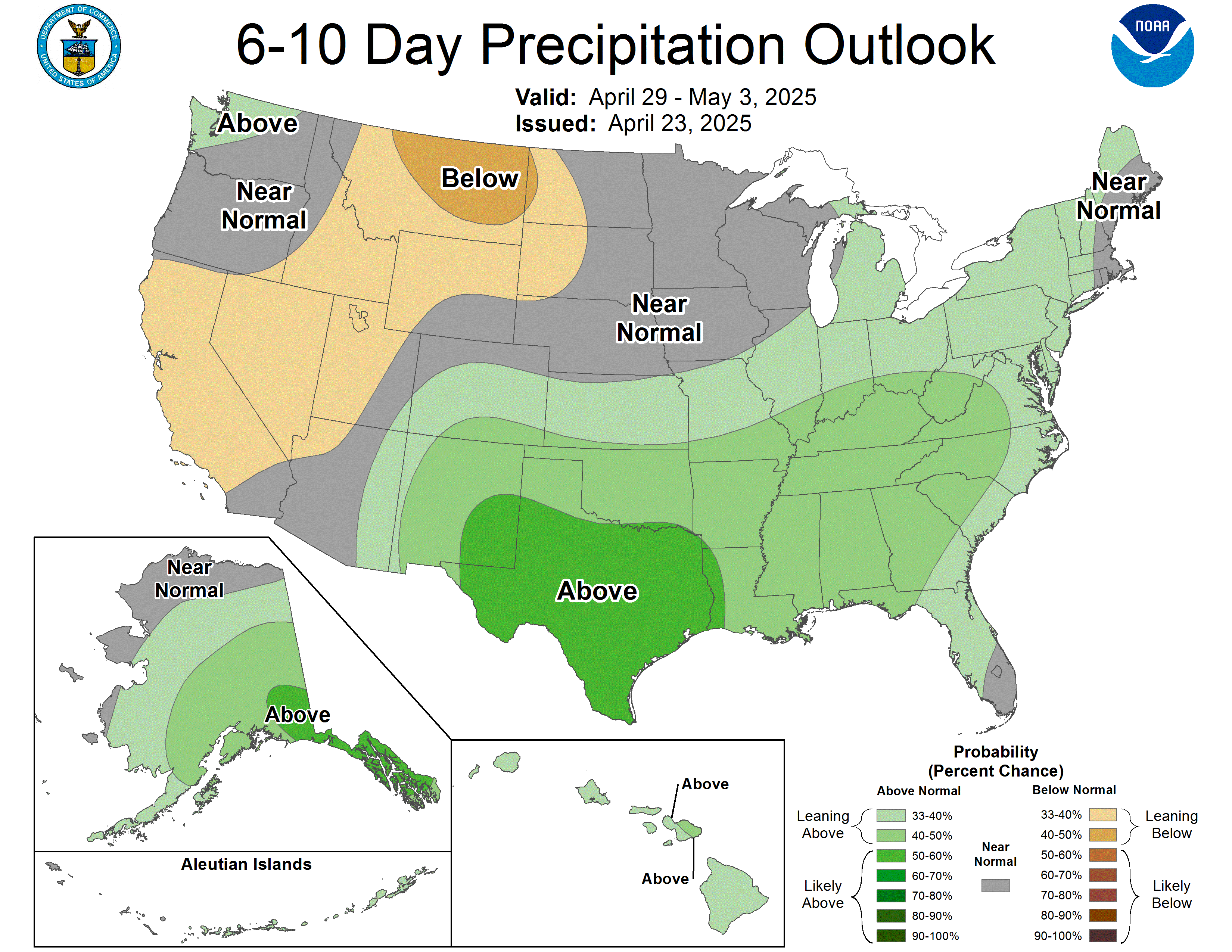
6 – 10 Day Precipitation Outlook Issued Today (Note the NOAA Level of Confidence in the Forecast Released on June 24, 2019 was 4 out of 5)
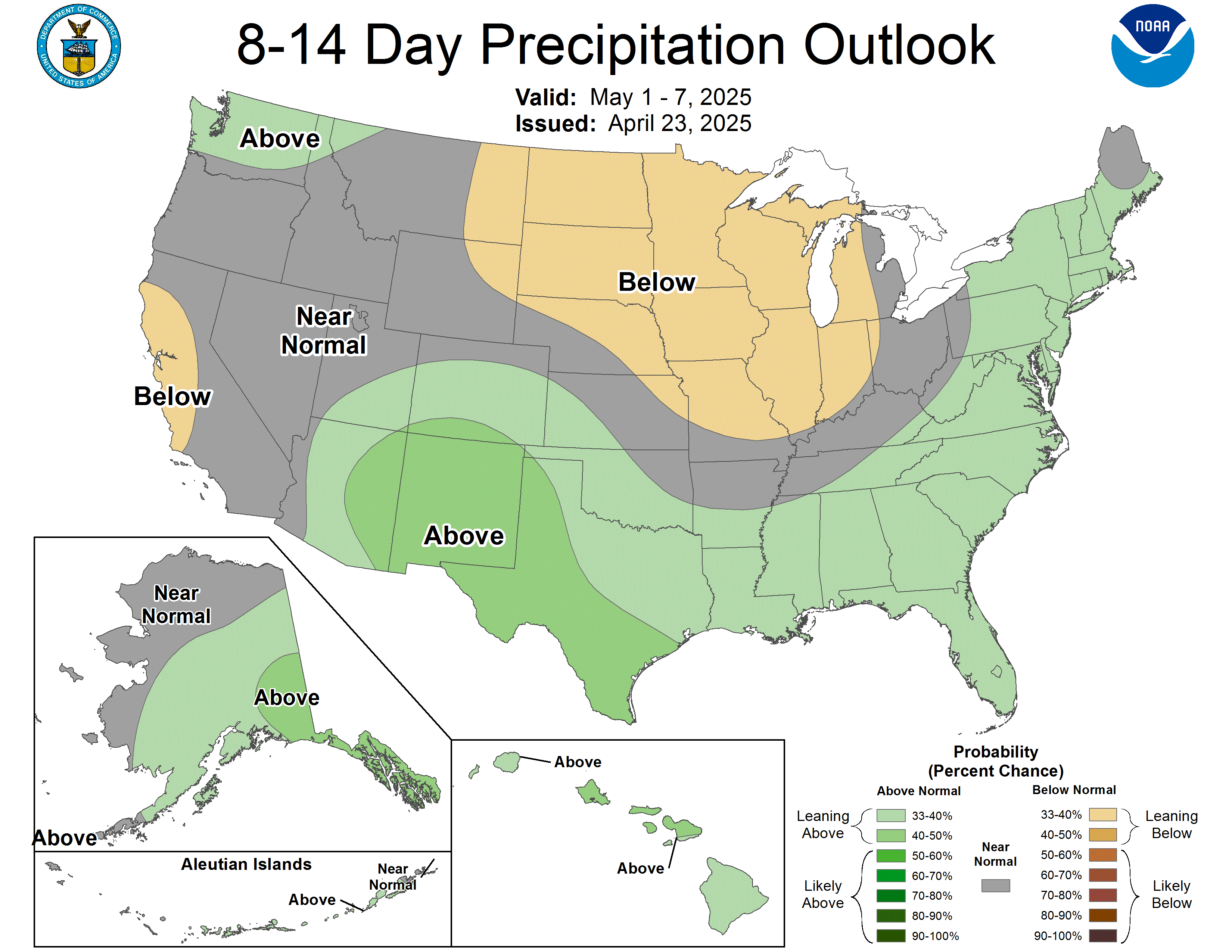
8 – 14 Day Precipitation Outlook Issued Today (Note the NOAA Level of Confidence in the Forecast Released on June 24, 2019 was 3 out of 5)
Looking further out.
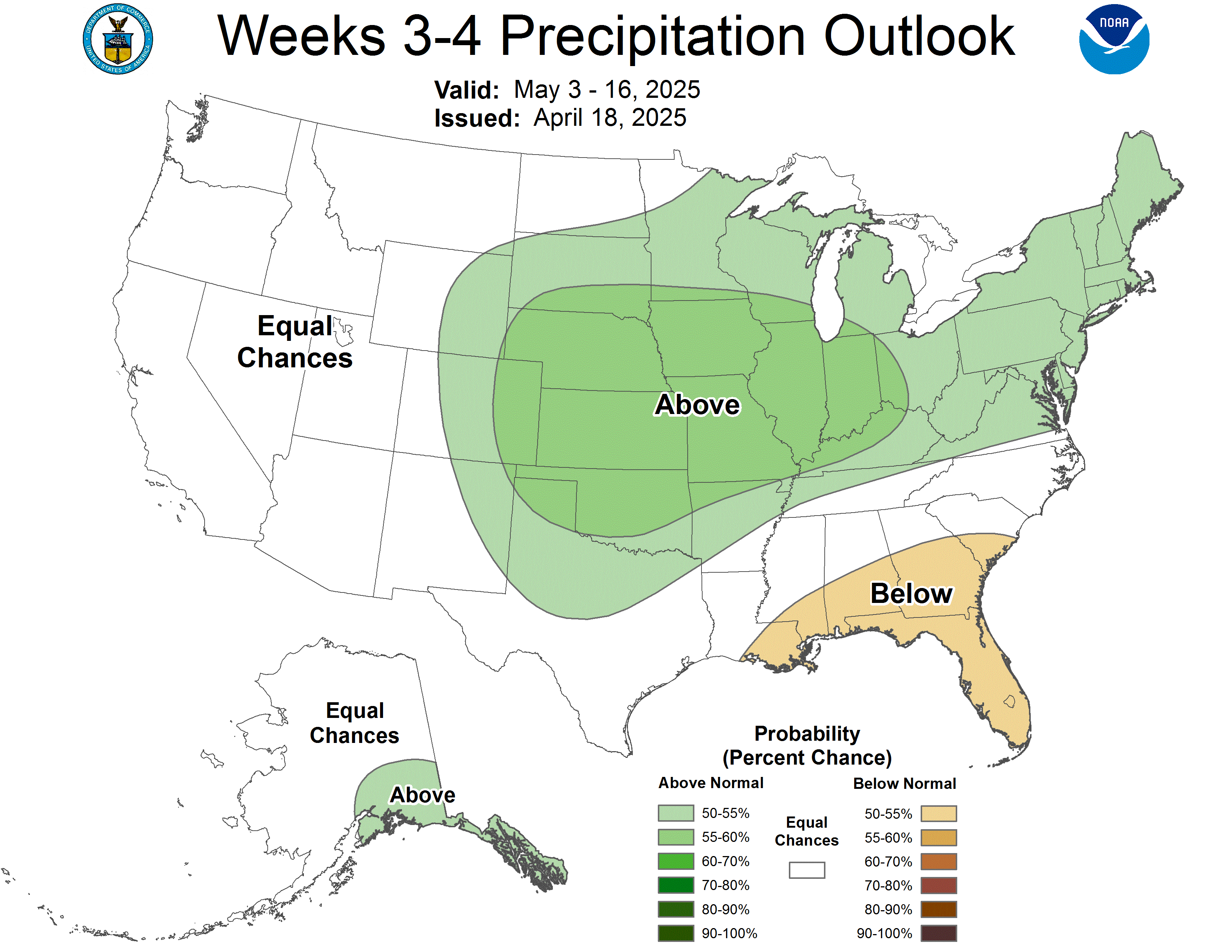
Here is the 6 – 14 Day NOAA discussion released today June 24, 2019
6-10 DAY OUTLOOK FOR JUN 30 – JUL 04, 2019
Model solutions are in good agreement on the predicted circulation pattern over North America during the 6-10 day period. Recent ECMWF, GEFS and Canadian ensemble means each predict ridging over the western Aleutians and troughing over the Bering Sea and parts of western Alaska. All model solutions predict an amplified trough downstream over the North Pacific off of the Pacific coast of North America, ridging over the northern central CONUS, and a trough over the Northeast CONUS and southward off of the Atlantic Coast. The predicted trough over the North Pacific is more amplified in the GEFS ensemble mean, while the ridge over the northern central CONUS is more amplified in the ECMWF. The official manual 500-hPa blend weights the ECMWF model the highest, due to recent greater anomaly correlation skill scores. The manual 500-hPa blend indicates positive 500-hPa height anomalies over the Aleutians and across the Gulf of Alaska into the Alaska Panhandle and negative 500-hPa height anomalies over the Bering Sea and northern Alaska. The manual blend indicates weak positive 500-hPa height anomalies over much of the CONUS with the exceptions of parts of the California coast and New England. Stronger positive 500-hPa height anomalies are indicated over the northern Central CONUS.
Above normal temperatures are likely over most of the CONUS under predicted weak positive 500-hPa height anomalies. Probabilities of above normal temperatures are greatest for the northern central CONUS with a predicted ridge over the region. Near normal temperatures are more likely for the Northeast under a predicted trough. Near to below normal temperatures are favored over parts of northern and central California into Nevada, ahead of a predicted trough over the North Pacific, and over parts of eastern Texas and the Southern Plains, due to the moderation of temperatures by an above normal precipitation forecast. Above normal temperatures are probable for the Aleutians and Alaska Panhandle, under predicted positive 500-hPa height anomalies, and along the west coast of Alaska due to above normal sea surface temperatures near the region. Below normal temperatures are more likely for parts of the central Alaska mainland, under negative 500-hPa height anomalies.
Probabilities of above normal precipitation are enhanced for the Aleutians, along an expected storm track, and for most of the Alaska mainland ahead of a predicted trough over the Bering Sea, while below normal precipitation is more likely for the Alaska Panhandle. Near or below normal precipitation is expected for much of the western CONUS, much of which is climatologically dry and indicated as near normal. Above normal precipitation is more likely from eastern Texas northeastward into the Central Mississippi Valley and the Tennessee and Ohio Valleys, as moisture is predicted to be drawn northward from the Gulf of Mexico by low-level southerly flow. Above normal precipitation is also predicted to be likely east of the Rockies from eastern Montana, Wyoming and Colorado into the Northern Plains and Great Lakes region, with a potential for storm systems to develop and propagate over the expected ridge. Near to below normal precipitation is likely for much of the Eastern Seaboard, ahead of the predicted ridge, with a small area of likely above normal precipitation indicated for Maine, under a predicted trough.
FORECAST CONFIDENCE FOR THE 6-10 DAY PERIOD: Above average, 4 out of 5, due to good agreement among the model 500-hPa circulation forecasts and among the temperature and precipitation forecast tools.
8-14 DAY OUTLOOK FOR JUL 02 – 08 2019
Ensemble means from the ECMWF, GEFS and Canadian model forecasts are in fair agreement on the predicted week 2 500-hPa circulation pattern, with some differences in the evolution of the pattern among models. The ECMWF ensemble mean indicates slightly positive 500-hPa height anomalies over much of the CONUS in week 2, in comparison to the recent GEFS ensemble means that indicate slightly negative 500-hPa height anomalies over the entire eastern CONUS. and a more amplified trough over the North Pacific. The official manual 500-hPa blend weights the ECMWF model the most, due to recent greater anomaly correlation skill scores. The manual blend of 500-hPa heights for week 2 is similar to the circulation pattern forecast for the 6-10 day period indicating weak positive 500-hPa height anomalies over most of the CONUS. Weak positive 500-hPa height anomalies are predicted over the Northeast, under a weakening trough, and greater positive 500-hPa height anomalies are indicated over the northwest CONUS and Northern Plains, as the ridge is predicted to increase in amplitude over this region.
The temperature forecast for the week 2 period indicates increased probabilities of above normal temperatures for the Pacific Northwest, under predicted increasing 500-hPa heights, and lower probabilities of above normal temperatures for the northern central CONUS as a ridge over the region in the 6-10 day period forecast is expected to shift westward in week 2. Enhanced probabilities of below normal precipitation expand in parts of Colorado and Arizona as well as for much of the Southern Plains into the Central Mississippi Valley, related to an enhanced probability of above normal precipitation for these regions. The temperature forecast for Alaska is similar in week 2 to the 6-10 day forecast, with above normal temperatures most likely along the coasts and near to below normal temperatures more likely in the Alaska interior.
Overall the predicted precipitation pattern for week 2 is similar to the forecast for the 6-10 day period. Probabilities of above normal precipitation are enhanced from eastern Texas into the Central Mississippi Valley and the Tennessee and Ohio Valleys, as moisture continues to be expected to be drawn northward from the Gulf of Mexico at low levels. Probabilities of above normal precipitation are slightly enhanced for much of the central CONUS with the potential development of storm systems across the region east of the Rockies. Near to below normal precipitation continues to be likely west of the Rockies in week 2, with some potential for small precipitation amounts, ahead of a trough over the Pacific Ocean, as indicated by some of the tools. Probabilities of above normal precipitation continue to be enhanced for Alaska outside of the Alaska Panhandle, ahead of a predicted trough over the Bering Sea and with nearby above normal sea surface temperatures.
FORECAST CONFIDENCE FOR THE 8-14 DAY PERIOD: About average, 3 out of 5, due to fair agreement among the model circulation forecasts and among the temperature and precipitation tools, offset by increasing uncertainty with longer lead times.
The next set of long-lead monthly and seasonal outlooks will be released on July 18.
Analogs to the NOAA 6 – 14 Day Outlook.
Now let us take a detailed look at the “Analogs”.
NOAA normally provides two sets of Analogs.
A. Analogs related to the 5 day period centered on 3 days ago and the 7 day period centered on 4 days ago. “Analog” means that the weather pattern then resembles the recent weather pattern and the recent pattern is used to initialize the models to predict the 6 – 14 day Outlook.
B. There is a second set of analogs associated with the Outlook. It compares the forecast (rather than the prior period) to past weather patterns. I have not been regularly analyzing this second set of information. The first set applies to the 5 and 7 day observed pattern prior to today. The second set relates to the correlation of the forecasted outlook 6 – 10 days out and 8 – 14 days out with similar patterns that have occurred in the past during a longer period that includes the dates covered by the 6 – 10 Day and 8 – 14 Day Outlook. The second set of analogs also has useful information as it indicates that the forecast is feasible in the sense that something like it has happened before. I am not very impressed with that approach. But in some ways both Approach A and B are somewhat similar. I conclude that if the Ocean Condition now is different then the analogs and if the state of ENSO now is different than the analogs that is a reason to have increased lack of confidence in the forecasts and vice versa.
They put the first set of analogs in the discussion with the second set available by a link so I am assuming that the first set of analogs is the most meaningful and I find it so. But NOAA prefers the first set (A) as it helps them (or at least they think it does) assess the quality of the forecast.
Here are today’s analogs in chronological order although this information is also available with the analog dates listed by the level of correlation. I find the chronological order easier for me to work with. It also helps the reader see the impact of the phases of the PDO and AMO which are shown. The first set (A) which is what I am using today applies to the 5 and 7-day observed pattern prior to today.
| Date | ENSO Phase | PDO* | AMO* | Other Comments |
| Jun 29, 1956 | La Nina | – | – | |
| Jun 15, 1962 | Neutral | – | – (t) | |
| Jun 18, 1975 | La Nina | – | – | |
| Jun 19, 1975 | La Nina | – | – | |
| Jun 26, 1989 | La Nina | + | – | |
| Jun 27, 1989 | La Nina | + | – | |
| Jun 26, 1998 | El Nino | + (t) | + | Tailend MegaNino |
| Jun 27, 1998 | El Nino | + (t) | + | Tail- end MegaNino |
| Jul 8, 2000 | El Nino | – | + | Tail end La Nina |
| Jun 14, 2008 | La Nina | – | + | Tail end |
* I assign values that are consistent with the trend so I am doing some subjective smoothing with respect to the Phases of the AMO and PDO shown in this table. (t) = a month where the Ocean Cycle Index has just changed from a consistent pattern or does change the following month to a consistent pattern.
The spread among the analogs from June 14 to July 8 is 24 days which is tighter than last week.. I have not calculated the centroid of this distribution which would be the better way to look at things but the midpoint, which is a lot easier to calculate, and fairly accurate if the dates are reasonably evenly distributed, is about June 26, 2019. These analogs are describing historical weather that was centered on 3 days and 4 days ago (June 20 or June 21). So the analogs could be considered to be out of sync with respect to weather that we would normally be getting right now and instead are about close to a week early i.e. the ananlogs are associated with weather we would normally experience about a week later than now. .
For more information on Analogs see discussion in the GEI Weather Page Glossary. For sure it is a rough measure as there are so many historical patterns but not enough to be a perfect match with current conditions. I use it mainly to see how our current conditions match against somewhat similar patterns and the ocean phases that prevailed during those prior patterns. If everything lines up I have my own measure of confidence in the NOAA forecast. Similar initial conditions should lead to similar weather. I am a mathematician so that is how I think about models.
Including duplicates, there are three El Nino Analogs, one Neutral analog, and six La Nina Analogs. This suggests that El Nino may not currently be having a major impact on the weather pattern for CONUS and Alaska. The pre-forecast analogs this week are indeterminate but one might conclude there is a slight bias towards PDO+ and AMO-. The AMO tends to have more impact on summer weather than does the PDO.
The following graphic may shed some light on the impact of the AMO in the summer.

More detail can be found in my article on the subject
Climate of the Southwest
Written by Sig Silber
As Presented at the Fourth Santa Fe Conference on Global and Regional Climate Change February 5-10, 2017 Santa Fe, New Mexico
include(“/home4/aleta/public_html/pages/weather/modules/McCabe_background_information.htm”); ?>
Historical Anomaly Analysis
When I see the same dates showing up often I find it interesting to consult this list.
A Useful Read
Some might find this analysis which you need to click to read interesting as the organization which prepares it focuses on the Pacific Ocean and looks at things from a very detailed perspective and their analysis provides a lot of information on the history and evolution of ENSO events.
Some Indices of Possible Interest: We should always remember that the forecast is driven by many factors some of which are conflicting in terms of their impacts. Please pay more attention to the graphics than my commentary which does not update on a regular basis once the article is published. The indices will continue to update. I provide these indices as they are important guidelines to the weather. It is in a way looking at the factors that are impacting the weather. There were developed because weather forecasters found them to be useful.
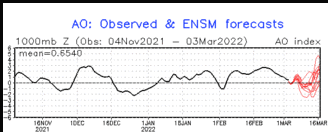
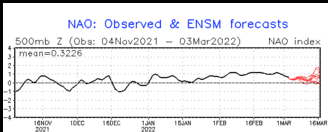
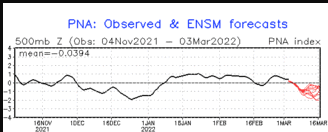

Here is another way of integrating all forecasts into a single graphic. These forecasts extend out further into the future than the forecasts presented earlier. But they do not show the recent history. Also, the set of four does not include the AO but instead the WPO so it is not the same but may be useful.

Madden Julian Oscillation (MJO)
The MJO is an area of convective activity along the Equator which circles the globe generally in 30 to 60 days. The location of the convective activity not only impacts the Equator but also the middle latitudes. Most people are not familiar with the MJO but at certain times it plays an important role Worldwide re weather and for CONUS.
This is the Summary from the weekly NOAA analysis of the MJO.

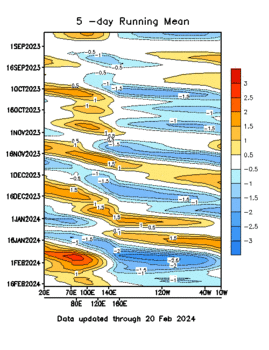
It is sometimes useful to look at the recent history of the MJO.
The MJO Index (more information can be found here) indicates where the MJO has been and this Hovmoeller Graphic shows this. The Index is shown for the parts of the Equator where the MJO is most usually found.
Forecast Models.
There are a lot of models and I try to read the results from all of them. For access to a variety of models, I refer readers here. This weekly report summarizes things. Here is another useful source of information.
Now the first of the two graphics we typically present which shows where the MJO is now and how it got there.

This shows the recent history. MJO is now in Phase 6. What next?
And then a forecast. On this GFS graphic, the light gray shading shows the tracks which fit with 90% of the forecasts and the dark gray shading shows a smaller area that fits with 50% of the forecasts The large dot is the current location.


Here is a larger version of the graphic on the left above.

B. Beyond Alaska and CONUS Let’s Look at the World which of course also includes Alaska and CONUS
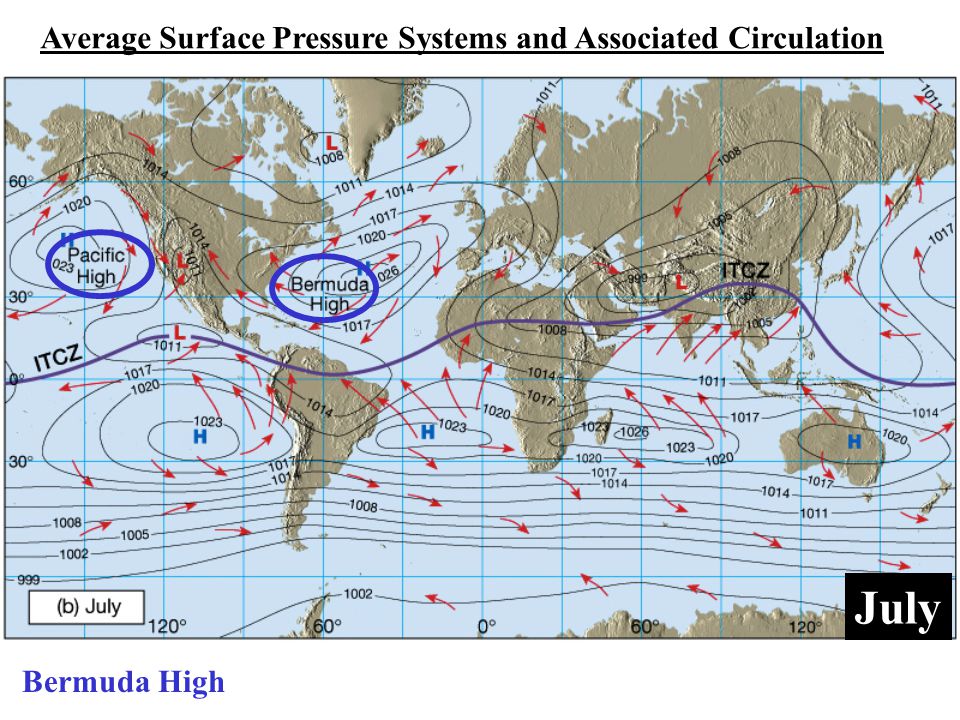
It is Useful to Understand the Semipermanent Patterns that Control our Weather and Consider how These Change from Winter to Summer. These two graphics (click on each one to enlarge) are from a much larger set available from the Weather Channel. They highlight the position of the Bermuda High which they are calling the Azores High in the January graphic and is often called NASH and it has a very big impact on CONUS Southeast weather and also the Southwest. You also see the north/south migration of the Pacific High which also has many names and which is extremely important for CONUS weather and it also shows the change of location of the ITCZ which I think is key to understanding the Indian Monsoon. A lot of things become much clearer when you understand these semi-permanent features some of which have cycles within the year, longer period cycles and may be impacted by Global Warming. We are now moving into Late June/Early July. We should now be into the Summer Pattern. For CONUS, the seasonal repositioning of the Bermuda High and the Pacific High are very significant.
 |  |
World Forecasts
1. Today (Source: University of Maine)
2. Short-term set for day six but can be adjusted (BOM – Australia)
3. 8 – 14 Day (NOAA/Canada/Mexico Experimental NAEFS))
4 Tropical Activity
1. Forecast for Today (you can click on the maps to enlarge them)

And now precipitation

Additional Maps showing different weather variables can be found here.
2. Forecast for Day 6 (Currently Set for Day 6 but the reader can change that)
World Weather Forecast produced by the Australian Bureau of Meteorology. Unfortunately, I do not know how to extract the control panel and embed it into my report so that you could use the tool within my report. But if you visit it Click Here and you will be able to use the tool to view temperature or many other things for THE WORLD. It can forecast out for a week. Pretty cool. Return to this report by using the “Back Arrow” usually found top left corner of your screen to the left of the URL Box. It may require hitting it a few times depending on how deep you are into the BOM tool. Below are the current worldwide precipitation and temperature forecasts for six days out. They will auto-update and be current for Day 6 whenever you view them. If you want the forecast for a different day Click Here

Again, please remember this graphic updates every six hours so the diurnal pattern can confuse the reader.
Now Precipitation

3. And now we have experimental 8 – 14 Day World forecasts from the NAEFS Model.
First Temperature

Then Precipitation

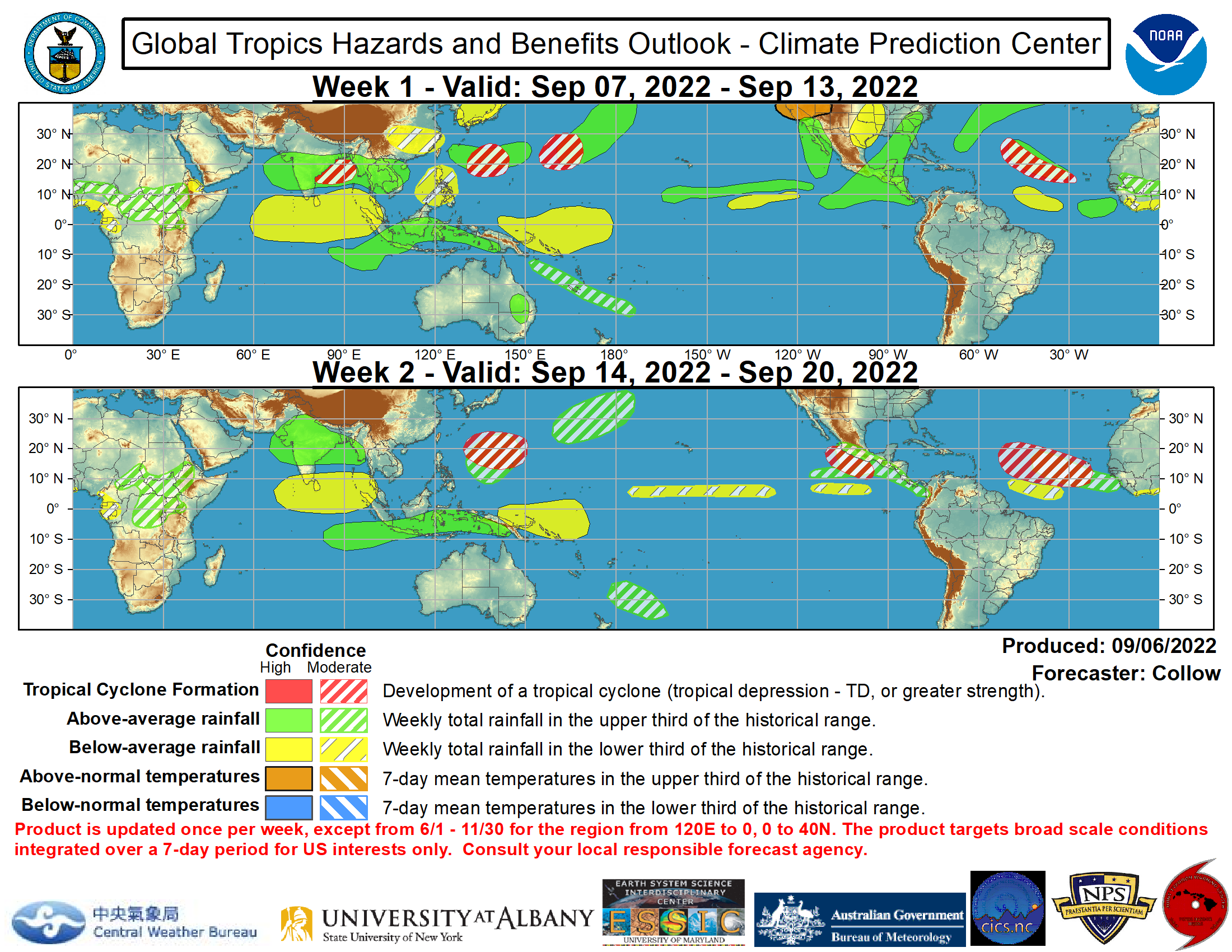
4. Tropical Hazards.
C. ENSO SUMMARY of Current Status.
This section is organized into three parts.
1. Current Sea Surface Temperatures (SST)
2. Current Nino 3.4 Readings
3. The Surface Air Pressure Pattern that confirms the state of ENSO.
1. Current and Recent Sea Surface Temperatures (SST)
A major driver of weather is Surface Ocean Temperatures. Evaporation only occurs from the Surface of Water. So we are very interested in the temperatures of water especially when these temperatures deviate from seasonal norms thus creating an anomaly. The geographical distribution of the anomalies is very important. To a substantial extent, the temperature anomalies along the Equator have a disproportionate impact on the weather so we study them intensely and that is what the ENSO (El Nino – Southern Oscillation) cycle is all about. Subsurface water can be thought of as the future surface temperatures. They may have only indirect impacts on current weather but they have major impacts on future weather by changing the temperature of the water surface. Winds and Convection (evaporation forming clouds) is weather and is a result of the Phases of ENSO and also a feedback loop that perpetuates the current Phase of ENSO or changes it. That is why we monitor winds and convection along or near the Equator especially the Equator in the Eastern Pacific.
My focus here is sea surface temperature anomalies as they are one of the two largest factors determining weather around the World. If we want to have a good feel for future weather, we need to look at the oceans as our weather mostly comes from oceans and we need to look at surface temperature anomalies (weather develops from the ocean surface
It is the ocean surface that interacts with the atmosphere and causes convection and also the warming and cooling of the atmosphere. So we are interested in the actual ocean surface temperatures and the departure from seasonal normal temperatures which is called “departures” or “anomalies”. Since warm water facilitates evaporation which results in cloud convection, the pattern of SST anomalies suggests how the weather pattern east of the anomalies will be different than normal.
Current Sea Surface Temperature (SST) Departures from Normal for this Time of the Year i.e. Anomalies
First the categorization of the current Monthly Average SST anomalies. | ||||
| The Mediterranean, Black Sea and Caspian Sea | Western Pacific | West of North America | North and East of North America | North Atlantic |
The Mediterranean is warm. The Black Sea and Caspian Sea are very warm. | Mostly mixed around Japan | Waters in Bristol Bay and the Chukchi Sea are extremely warm. Gulf of Alaska warm Cool offshore from British Columbia Cool right around Baja | Hudson Bay Cool Great Lakes cool Waters offshore of East Coast cool to the north and mostly warm to the south. | Cool but warm south of Greenland |
| Equator | Central Pacific slightly warm. But far Eastern Pacific cool. | |||
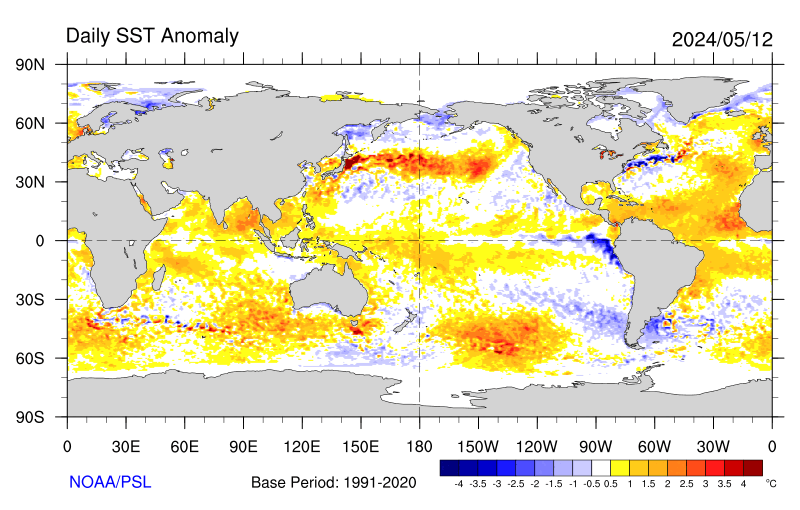 | ||||
| Africa | West of Australia | North, South, and East of Australia | West of South America | East of South America |
Cool Gulf of Guinea Warm south of Africa. Cool off Mozambique extending beyond Madagascar. | Mostly Neutral | Cool to the South | Neutral south of the Equator | Warm 10S extending out to sea Warm 20S to 40S Slightly cool around Cape Horn. |
Then we look at the change in the anomalies. The SST anomaly is sort of like the first derivative and the change in the anomaly is somewhat like a second derivative. It tells us if the anomaly is becoming more or less intense.

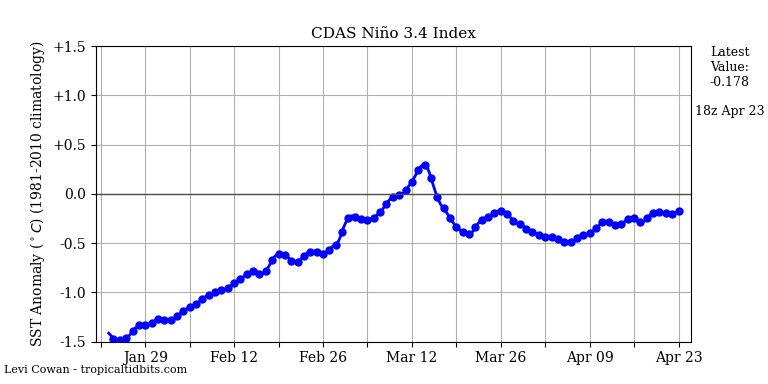
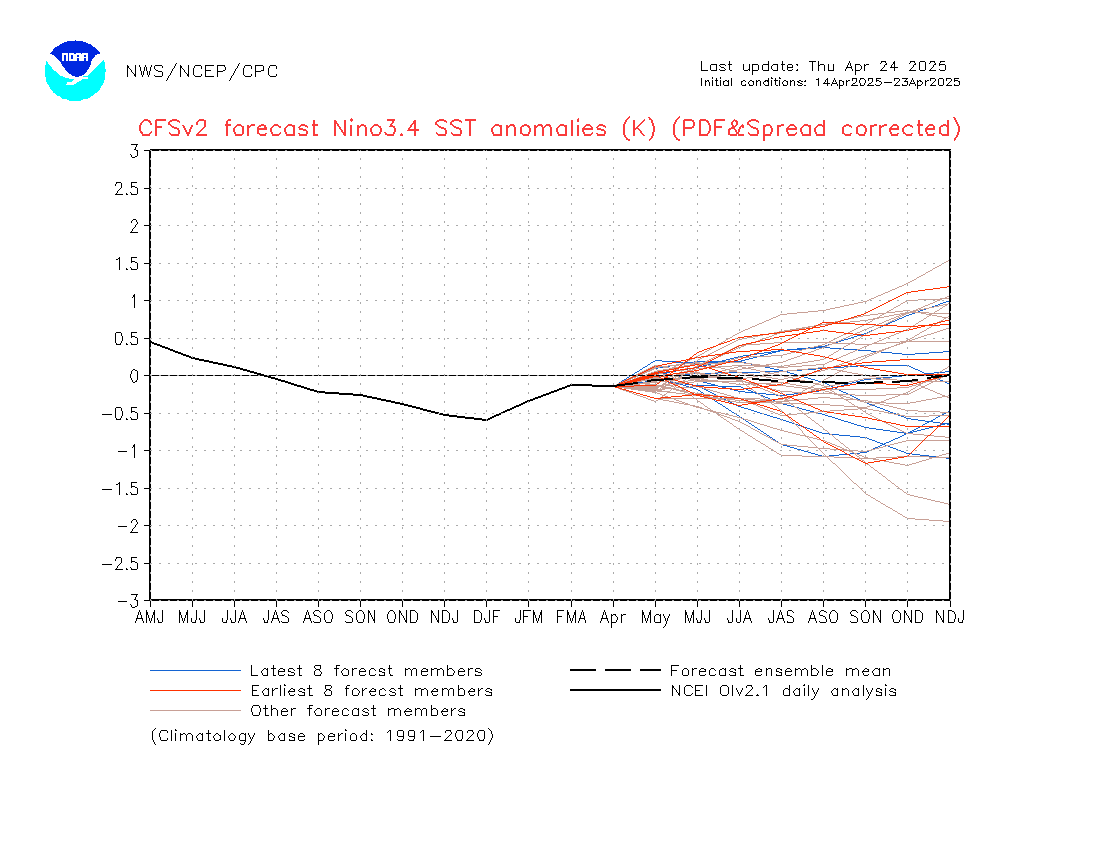
I am only showing the currently issued version of the NINO SST Index Table as the prior values are shown in the small graphics on the right with this graphic. The same data in graphic form but going back a couple of more years can be found here. The full table of values can be found here. NOAA considers Nino 3.4 shown in the graphic as the best indicator of Equatorial Surface Temperature Anomalies associated with different phases of ENSO. There is a duration requirement to be a recorded El Nino or La Nina but to have El Nino Conditions the Nino 3.4 index needs to be +0.5C or warmer and to have La Nina Conditions the Nino 3.4 Index needs to be -0.5C or cooler.

ENSO Considerations
Recent IRI-CDC Analysis

The change in the thinking in a short time is interesting.


This graphic brings the Nino 3.4 up to date and is easy to read.

Here is a daily version
Starting with Surface Conditions.
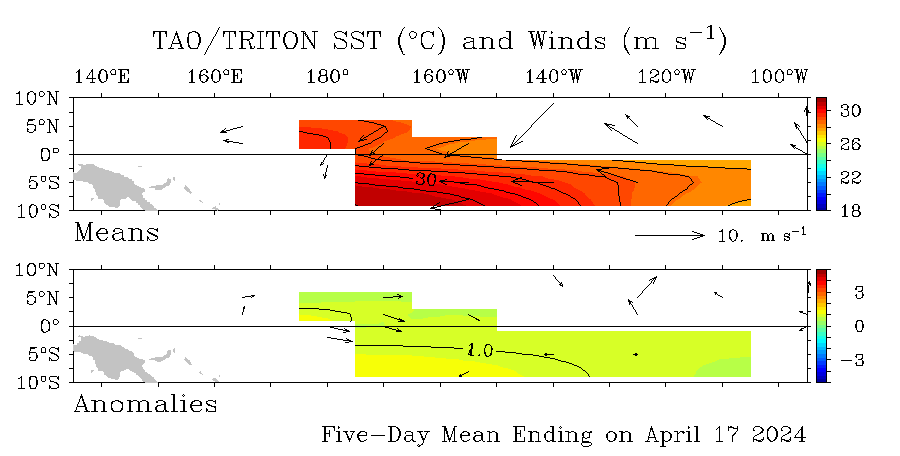
TAO/TRITON GRAPHIC (a good way of viewing data related to the part of the Equator and the waters close to the Equator in the Eastern Pacific where we monitor to determining the current phase of ENSO. It is probably not necessary to follow the discussion below, but here is a link to TAO/TRITON terminology.
And here is the current version of the TAO/TRITON Graphic. The top part shows the actual temperatures, the bottom part shows the anomalies i.e. the deviation from normal.
| ———————————————— | A | B | C | D | E | —————– |

This may help put the above graphics in focus.

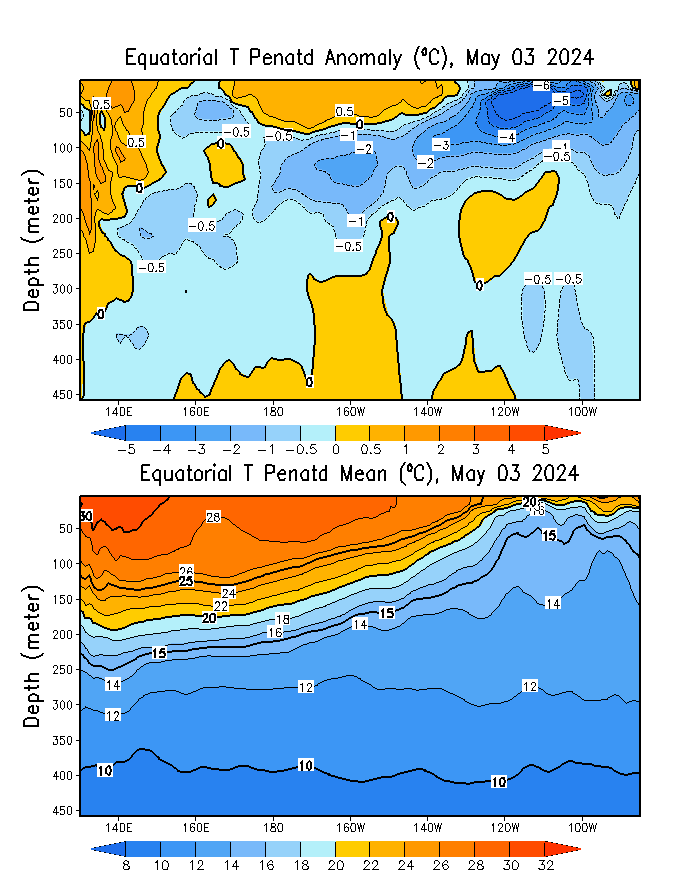
The following graphic is some similar to the above but it updates every five days not once per week. The date shown is the midpoint for the five-day average. It shows a lot more detail than the above graphic. You can see some water at depth that is anomalously warm. But the depth of the warm anomaly is becoming less and there is cool water below it.
3. The Surface Air Pressure that Confirms the Nino 3.4 Index
And of course, Queensland Australia is the official keeper of the SOI measurements.

SOI = 10 X [ Pdiff – Pdiffav ]/ SD(Pdiff) where Pdiff = (average Tahiti MSLP for the month) – (average Darwin MSLP for the month), Pdiffav = long term average of Pdiff for the month in question, and SD(Pdiff) = long term standard deviation of Pdiff for the month in question. So really it is comparing the extent to which Tahiti is more cloudy than Darwin, Australia. During El Nino we expect Darwin Australia to have lower air pressure and more convection than Tahiti (Negative SOI especially lower than -7 correlates with El Nino Conditions). During La Nina we expect the Warm Pool to be further east resulting in Positive SOI values greater than +7).

D. Putting it all Together.
Weak El Nino Modoki Conditions will soon peak and begin to transform to ENSO Neutral.
E. Relevant Recent Articles and Reports
Weather in the News
Nothing to report
Weather Research in the News
Nothing to report
Global Warming in the News
Nothing to report
Useful Reference Information
Understand How the Jet Stream Impacts Weather
include(“/home4/aleta/public_html/pages/weather/modules/Jet_Streak_Four_Quadrant_Analysis.htm”); ?>
include(“/home4/aleta/public_html/pages/weather/modules/MJO_and_ENSO_Interaction_Matrix.htm”); ?>
Standard Pressure Levels
include(“/home4/aleta/public_html/pages/weather/modules/Standard_Pressure_surfaces.htm”); ?> include(“/home4/aleta/public_html/pages/weather/modules/Table_of_Contents_for_Part_II.htm”); ?> include (“/home4/aleta/public_html/pages/weather/modules/AO_NAO_PNA_MJO_Background_Information.htm”); ?>


