


Written by Sig Silber
This article provides continuous updates for a variety of Weather and Weather Related Threats. Please pay attention to all of the smaller maps – these are “Live” and NOAA “Headline” areas are shown when posted. Pay attention to where you live or travel. Click maps for details.
Updated at 11:p.m. EDT May 16, 2019 to reflect the Short-Term Hazards Forecast.
Focus Points This Week: Great Plains Flooding

Please share this article – Go to the very top of the page, right-hand side for social media buttons.
First the Day One and Two CONUS Forecasts: These Maps Update Daily.
Day One CONUS Forecast | Day Two CONUS Forecast |
|
|
These graphics update and can be clicked on to enlarge. You can see where the weather will be | |
 | |


Here are the highlights from Thursday Afternoon’s WPC Short Range Forecast
Short Range Forecast Discussion NWS Weather Prediction Center College Park MD 411 PM EDT Thu May 16 2019 Valid 00Z Fri May 17 2019 – 00Z Sun May 19 2019
…Severe thunderstorms possible from the northern Plains to Ohio Valley tonight…
…Severe thunderstorms likely for much of the Great Plains on Friday…
…Heavy snow over the Sierra Nevada through tonight…
…Heavy rain possible for parts of the northern Rockies through tonight…
…Much cooler than normal conditions for much of the western U.S. and the northern Plains…
Click here for updates to this WPC Discussion
This map showing where “Headlines” have been issued for convection (and an animation of the recent movement of storms) should update and you should be able to click on to get additional details but if it does not update when you click on it, click here. For the Day 2 Outlook click here. For Day 3, click here. For Days 4 – 8 click here. An explanation of the risk codes used can be found here.
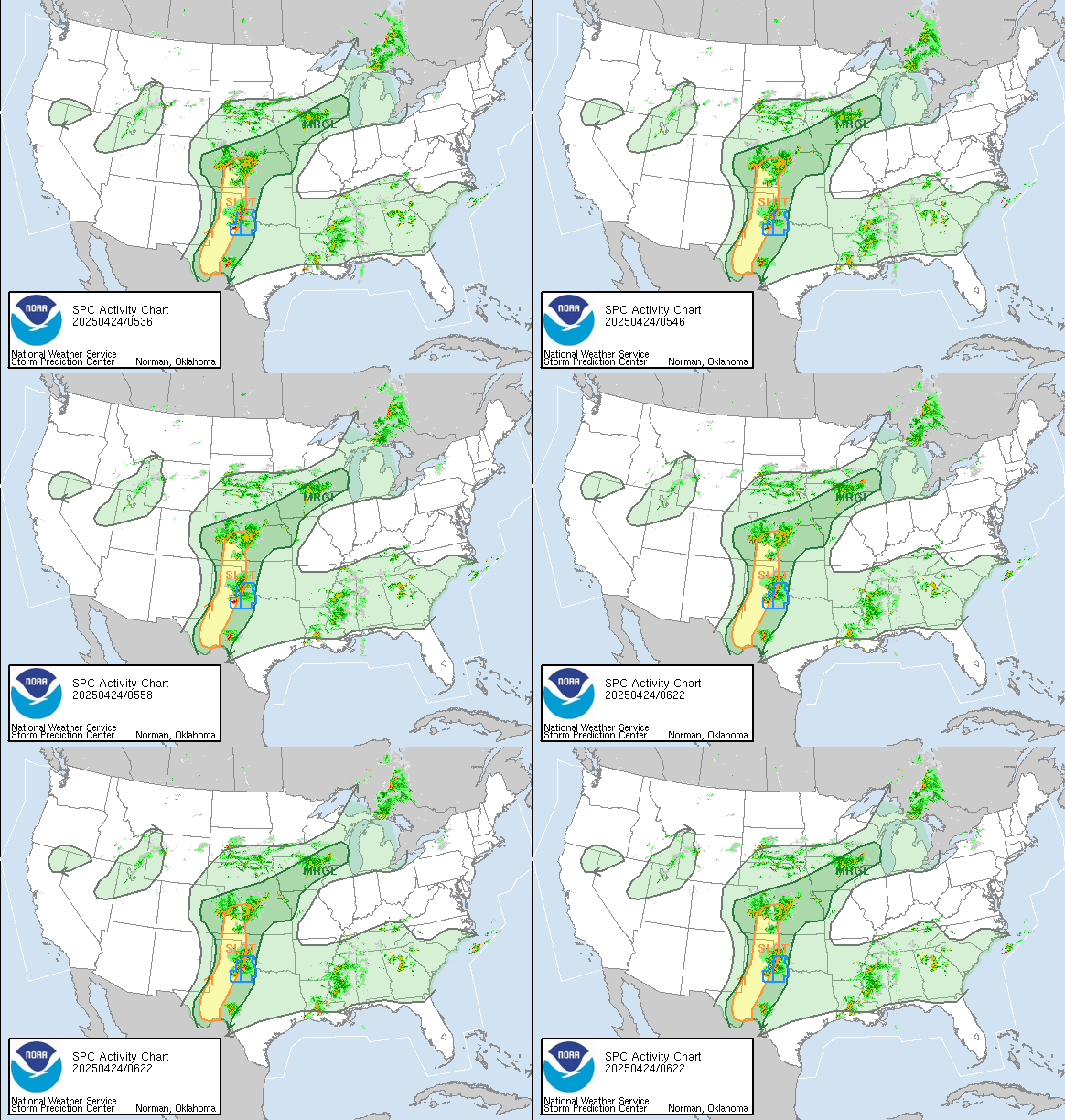
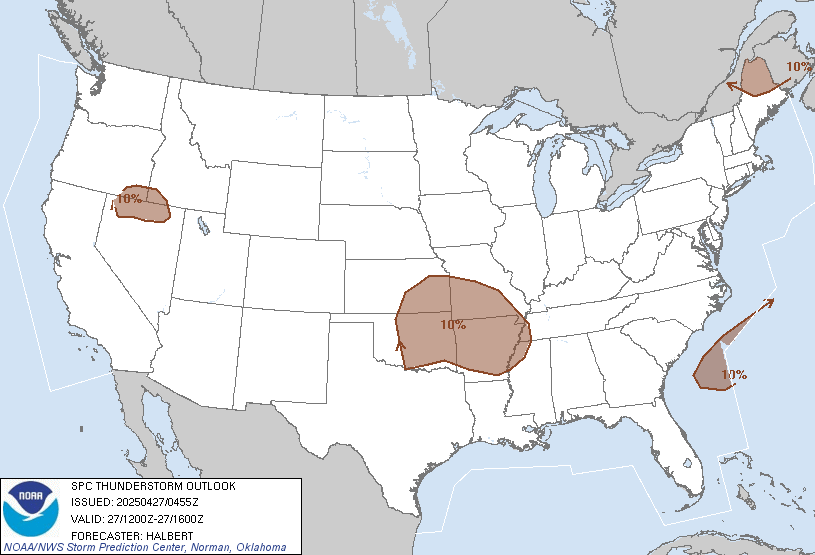
There is a slight difference between convection and thunderstorms. The below map shows where “Headlines” have been issued for Thunderstorms. You should be able to click on the map to get additional details but if it does not update, you can click here.
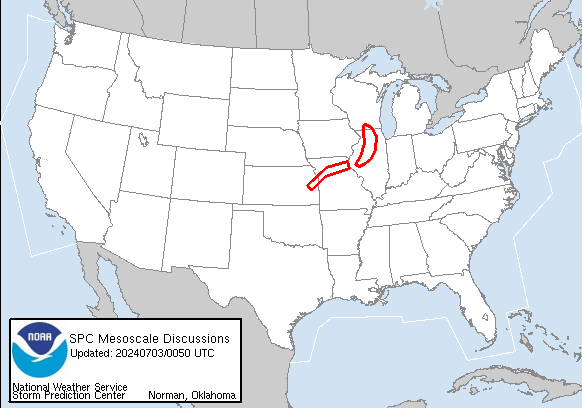
This map shows where mesoscale events are occurring or forecast. If you do not see any areas highlight on this map than there are no mesoscale events taking place or forecast. A mesoscale event is a serious situation for a very small area and detailed information is provided for these events when they occur or are forecast. If a mesoscale event is shown, click on the map and more detail on the event will be shown.
The map below shows the current wildfire risk which becomes more significant as we move into late Spring and Early Summer. When you click on this image it takes you to the SPC Fire Warning Page and you get a set of maps for Days 1, 2, 3 – 8, etc. You can then click on those for more detailed information. The map is a bit blurry as I tried to make it a bit larger than the map provided by NOAA but should be able to see where the current wildfire risks are. But if you click on this map you will get to see three maps that show the risk for different time periods. Or for the Day 2 Fire Oulook click here. For Day 3 – 8 Fire Outlook click here.
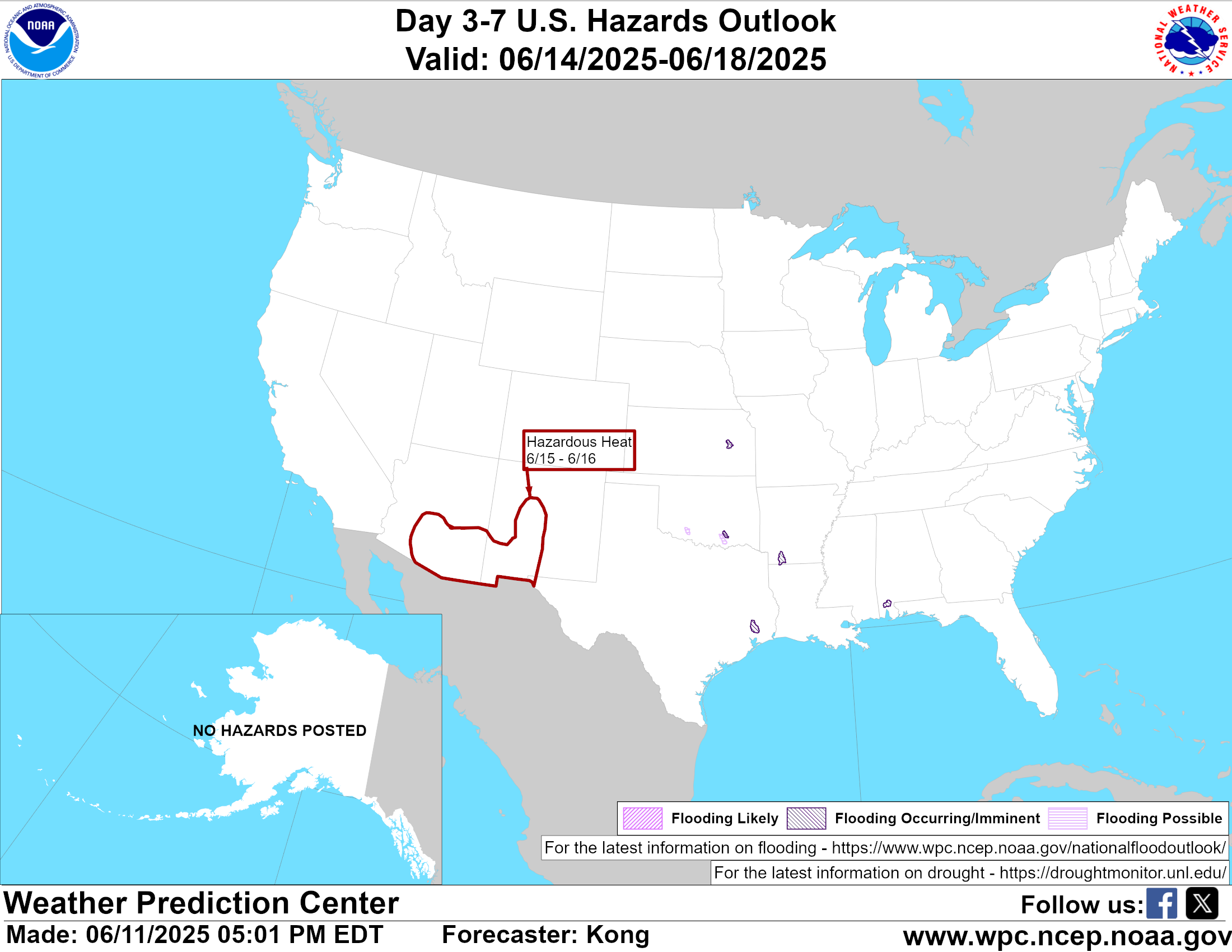
There are a large number of forecasted Day 3 – 7 Hazards.
The following is provided to help the reader relate the maps to how NWS will describe an area of the U.S.
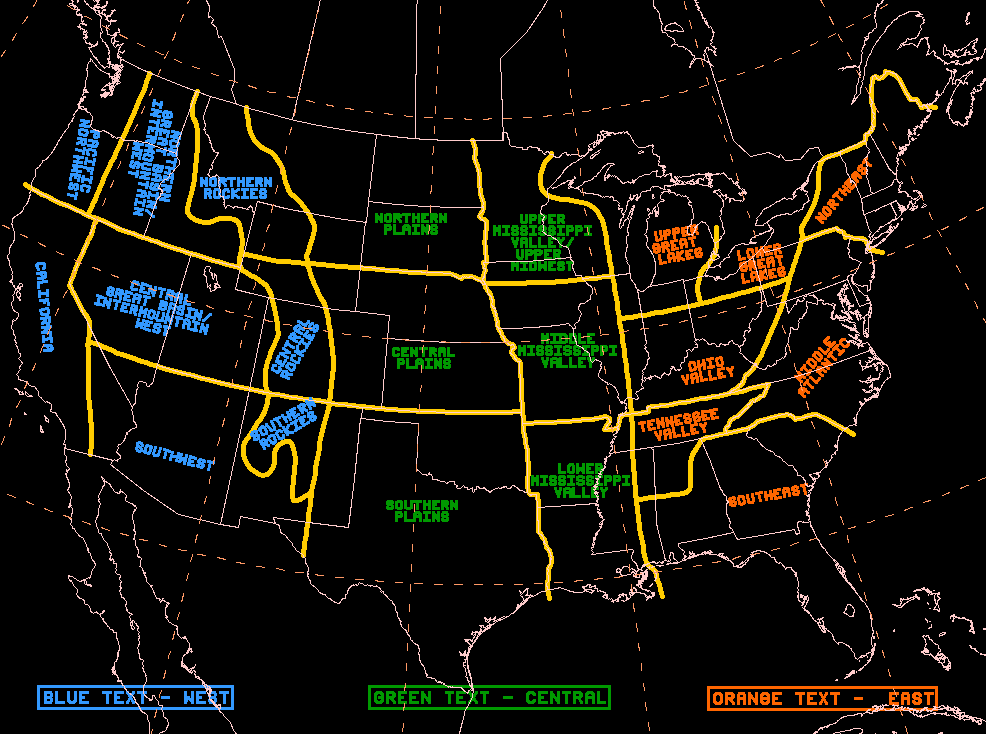
Now to our More Detailed Report
You will see a number of different maps which are updated in real time, making this a “live” report. If a part of one or more of the maps shows an area that is highlighted, you can click on it and get the full current report. By having the reader click on these active situations rather than having GEI do so, you will not miss any events in which you might have an interest and which we had not noticed and the page will not get cluttered with warnings, etc that have since expired.
Our focus here are events that are likely to last in the range of six hours but there can be longer or shorter events that are addressed by the Storm Prediction Center which is the main source of the information in this article. Long-term major events like a Hurricane are more likely to be in a separate article. But that may not always be the case. Since in general, all the links on this page transfer you into the NOAA system, in order to get back into this article you need to either close the tab to which you were transferred or click back on the tab that has this article.
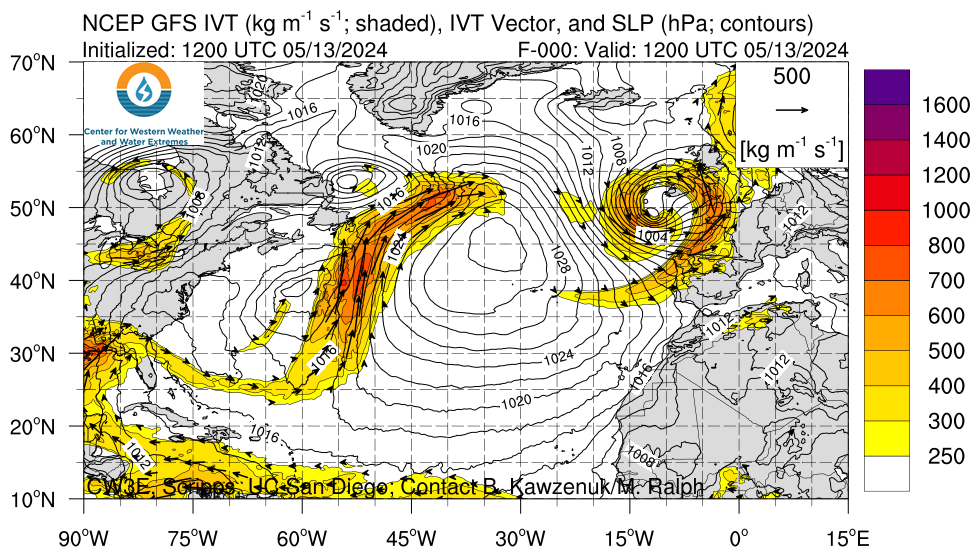
This graphic is about Atmospheric Rivers i.e. thick concentrated movements of water moisture. More explanation on Atmospheric Rivers can be found by clicking here or if you want more theoretical information by clicking here. The idea is that we have now concluded that moisture often moves via narrow but deep channels in the atmosphere (especially when the source of the moisture is over water) rather than being very spread out. This raises the potential for extreme precipitation events.
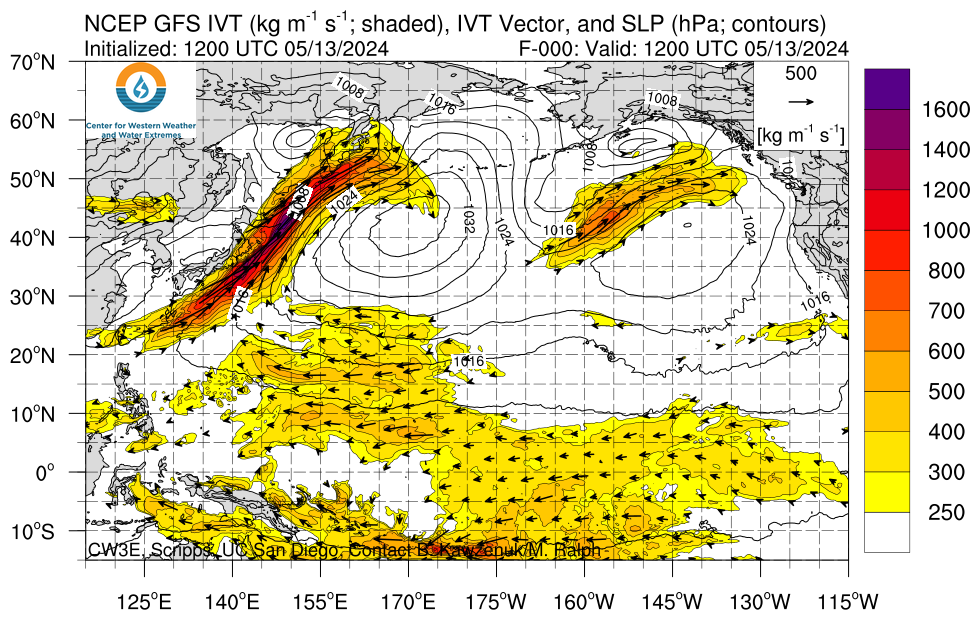
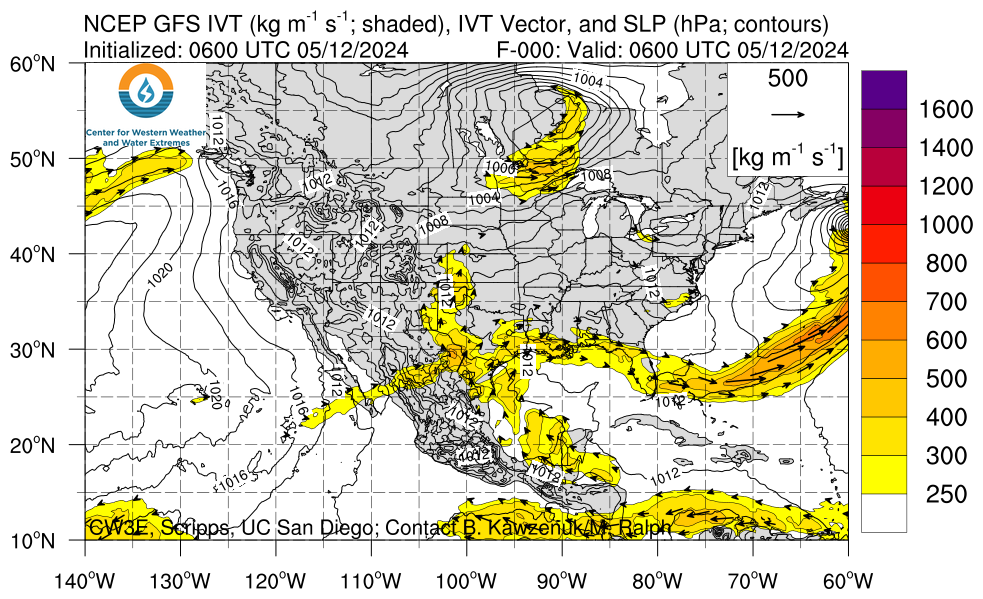
We thought we would show Europe also. This view also provides a better view of the East Coast.
500 MB Mid-Atmosphere View
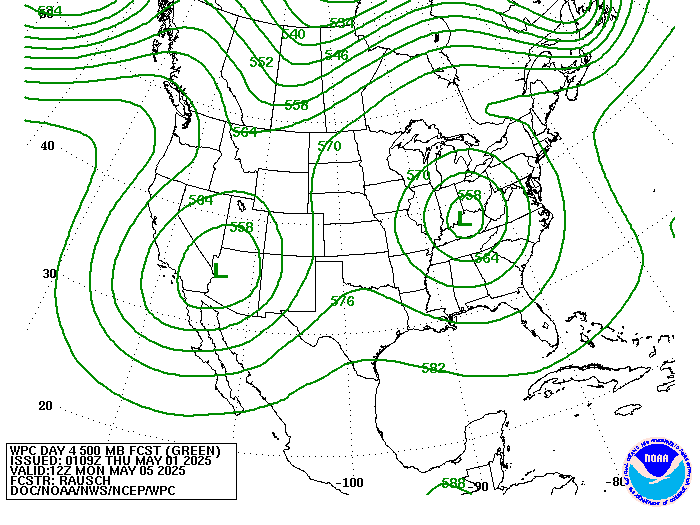
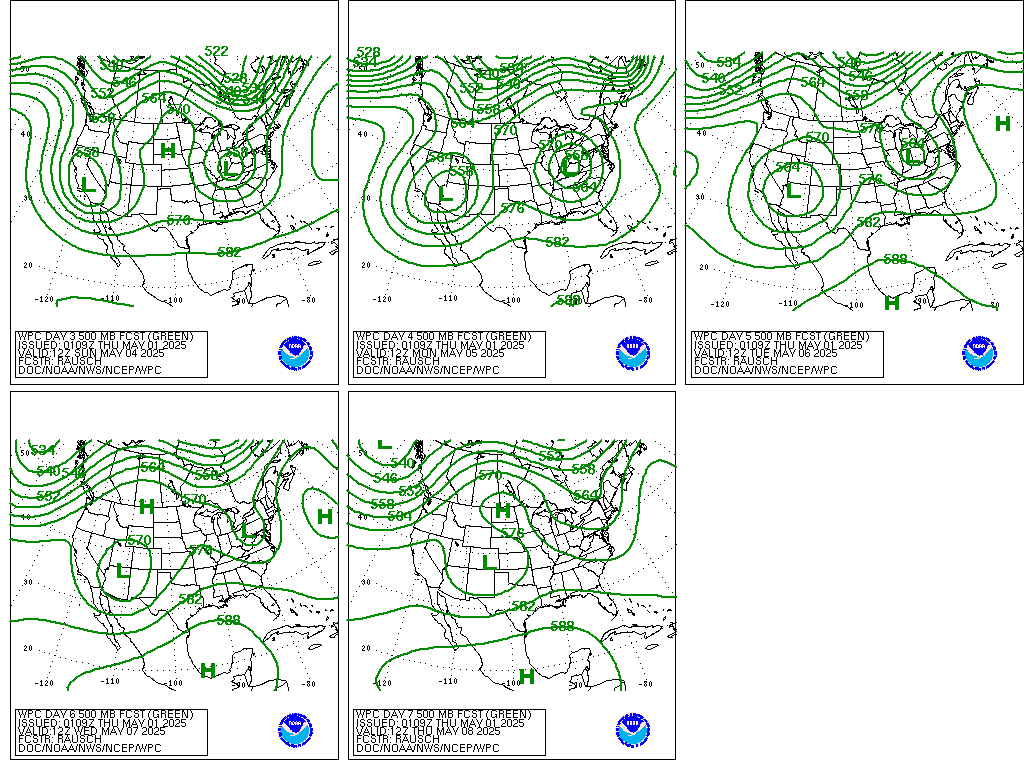
The map below is the mid-atmosphere 3–Day chart rather than the surface highs and lows and weather features. In some cases, it provides a clearer less confusing picture as it shows only the major pressure gradients. This graphic auto-updates so when you look at it you will see NOAA’s latest thinking. The speed at which these troughs and ridges travel across the nation will determine the timing of weather impacts. This graphic auto-updates I think every six hours and it changes a lot. Thinking about clockwise movements around High-Pressure Systems and counterclockwise movements around Low-Pressure Systems provides a lot of information.
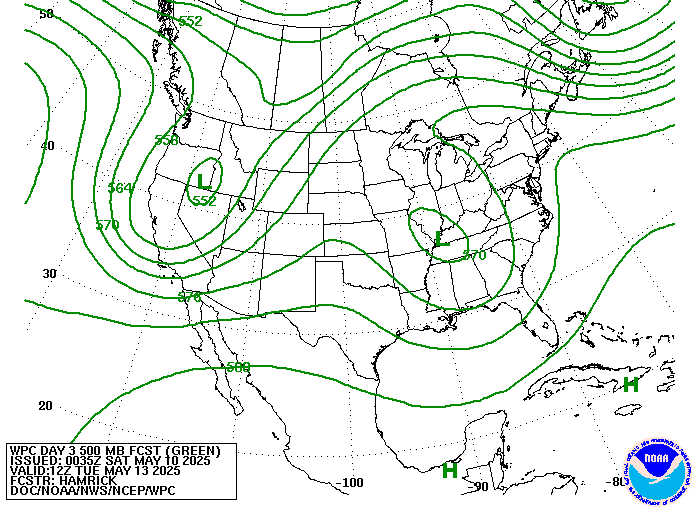
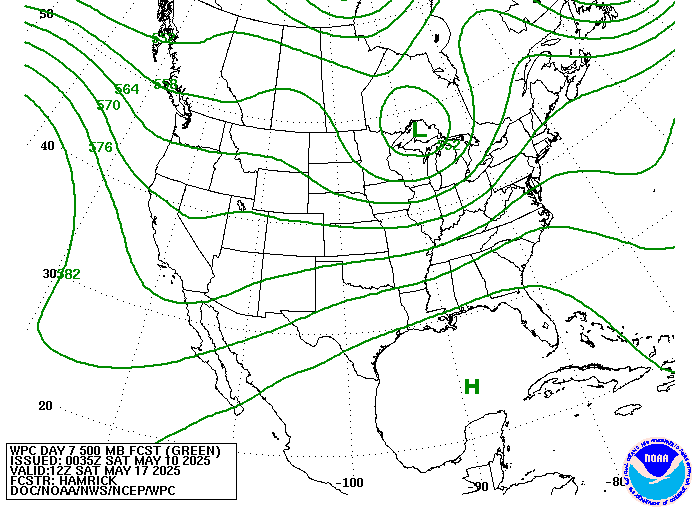
| Day 3 Above, 6 Below | Day 4 Above,7 Below | Day 5 Above. |
|  | 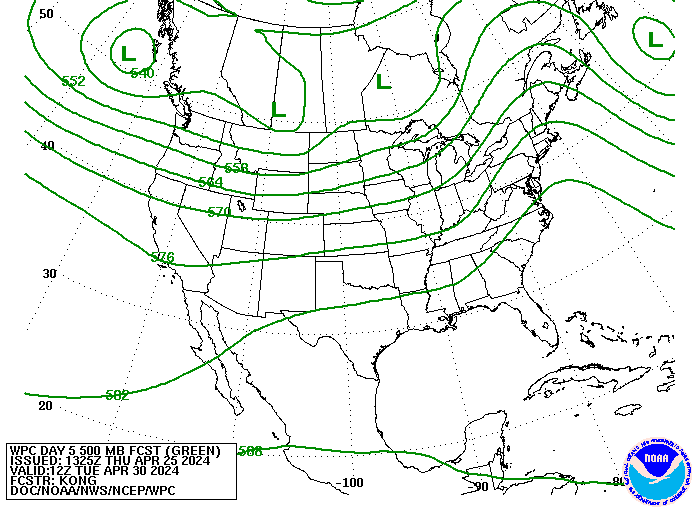 |
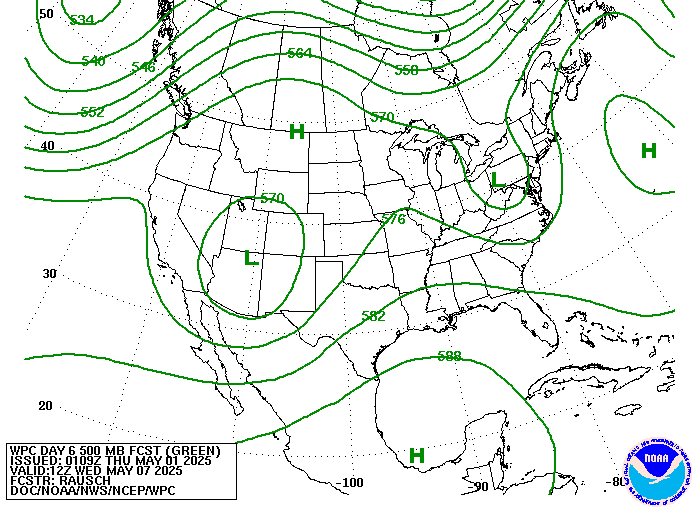 |  |  |
Here are the precipitation forecasts. First the cumulative for Days 1 – 3
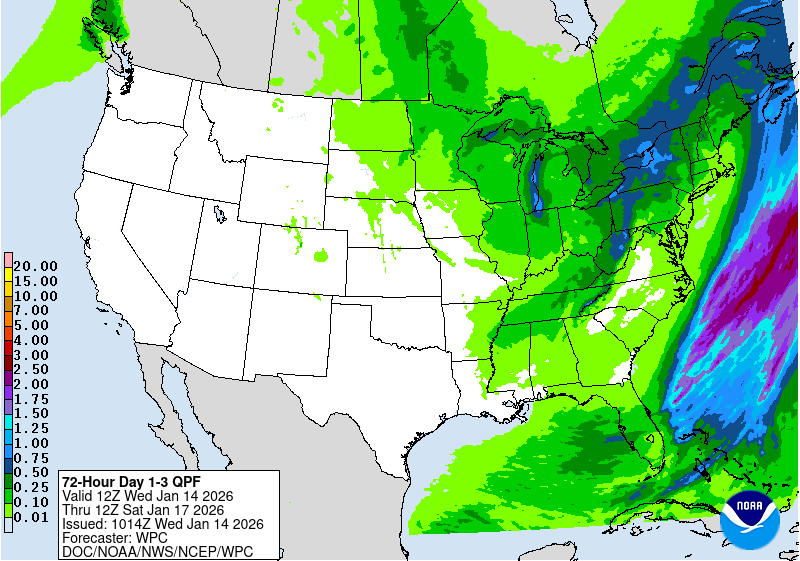
Then cumulative for Days 1 – 5
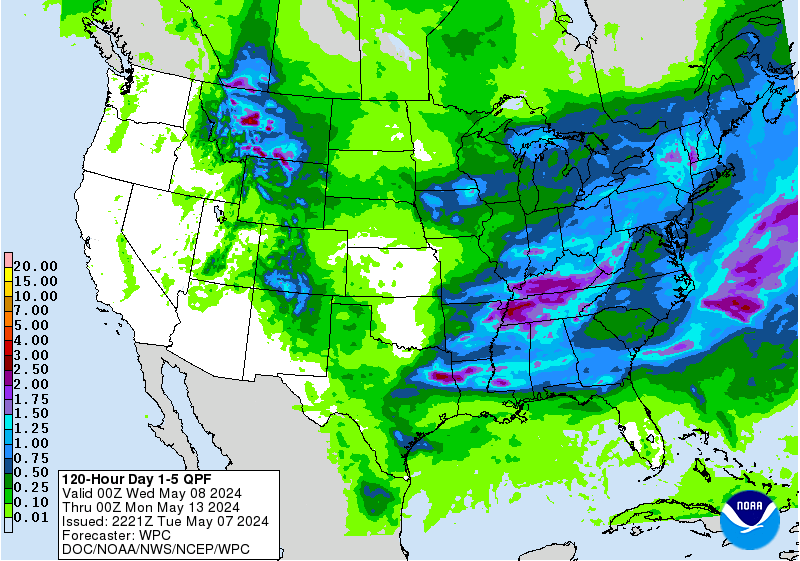
Then cumulative for Days 1 – 7
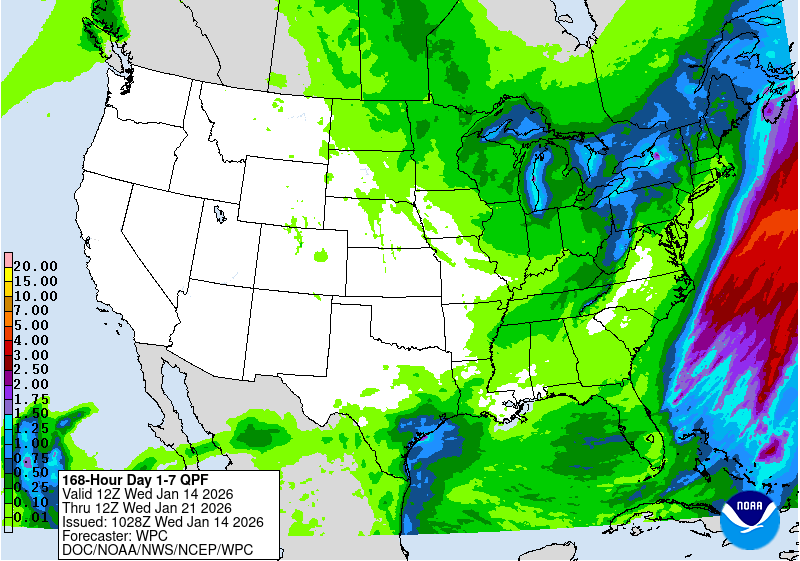
Remember the commentary is as of Sunday Night unless updated which is indicated in the lede paragraph. The graphics autoupdate so the commentary may not be up-to-date beyond the initial publication on Sunday Night.
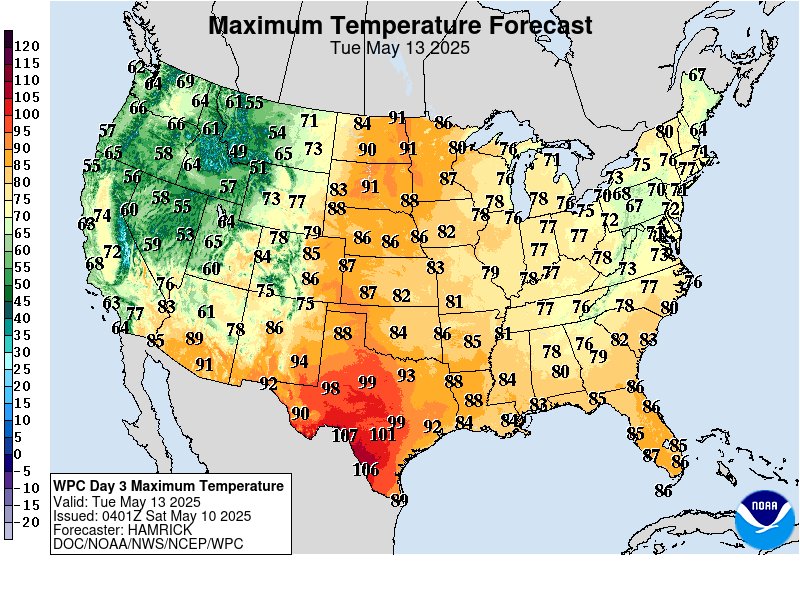
We have to start worrying about heat being a hazard.
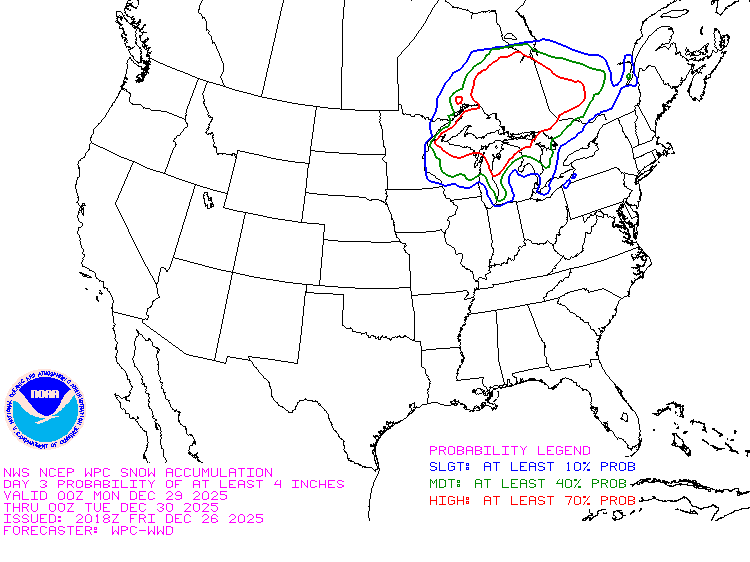
Snow is becoming less of an issue. We show one forecast map for snow. It auto-updates. To get a variety of additional updated maps, click here. We will stop showing this graphic soon.
| Live Warning Maps which If Severe Weather is Shown can be Clicked on to get more detail about these events. If there is a current warning shown on the map, click on the map for additional information related to the event. | These maps are updated as risks are identified. |
| This is the current graphic showing any mesoscale discussions (MD’s) which are in effect over the contiguous United States. Please read the description of the purpose of our MD’s for further information. Details on all valid MD’s may be found on our Current Mesoscale Discussions page. |  |
| Convective Outlooks | |
|---|---|
| This is today’s forecast for organized severe thunderstorms over the contiguous United States. Please read the description of the risk categories for further information. You may find the latest Day 1 Outlook available as well as all Outlooks issued today online. | Today’s Outlook |
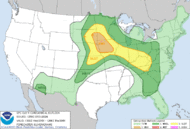 | |
| This is tomorrow’s forecast for organized severe thunderstorms over the contiguous United States. Please read the description of the risk categories for further information. The latest Day 2 Outlook is available as well as all Outlooks that have been issued today. | Tomorrow’s Outlook |
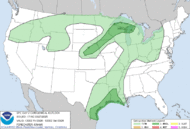 | |
| This is the day after tomorrow’s (day 3) forecast for organized severe thunderstorms over the contiguous United States. Please read the description of the risk categories for further information. The latest Day 3 Outlook is available as well as all Outlooks that have been issued today. | Day 3 Outlook |
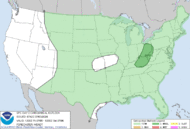 | |
| This is the day 4-8 forecast for organized severe thunderstorms over the contiguous United States. The latest Day 4-8 Outlook is available as well as all Outlooks that have been issued today. Note: A severe weather area depicted in the Day 4-8 period indicates a 30% or higher probability for severe thunderstorms (e.g. a 30% chance that a severe thunderstorm will occur within 25 miles of any point). | Day 4-8 Outlook |
 | |
| The Thunderstorm Outlooks depict the probability of thunderstorm across the contiguous United States in 4 or 8 hour time periods. The probabilistic forecast directly expresses the best estimate of a thunderstorm occurring within 12 miles of a point. The three probabilistic forecast thresholds are 10, 40, and 70 percent. | Thunderstorm Outlook |
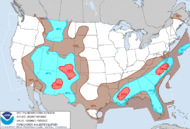 | |
| Fire Weather Outlooks | |
| This is today’s forecast for organized wildfires over the contiguous United States. Please read the description of the risk categories for further information about this product. | Today’s Outlook |
| |
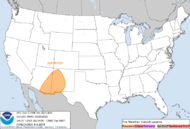
| This is tomorrow’s forecast for organized wildfires over the contiguous United States. Please read the description of the risk categories for further information about this product. | Tomorrow’s Outlook |
 | |
| This is day 3-8 forecast for organized wildfires over the contiguous United States. Please read the description of the risk categories for further information about this product. | Day 3-8 Outlook |
 | |
| Current watches, warnings, and advisories issued by the agencies of the National Weather Service. Hazards should show up in the above maps but the below links will take you to all outstanding watches and warnings in each category which may include some categories not covered in the above maps. So if there is a category of interest, click on the appropriate link below. |
|
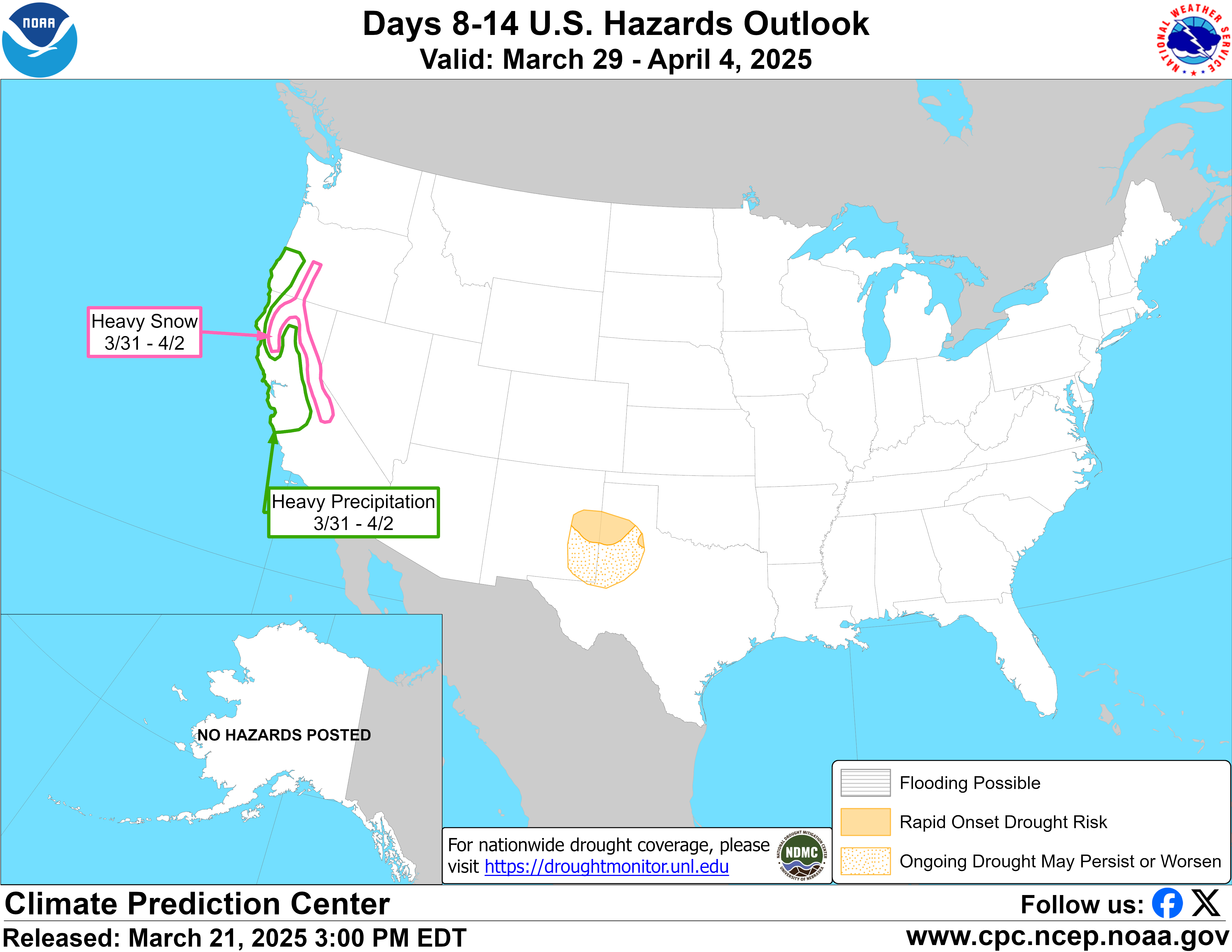
Looking ahead to next week.
.


