


from the Congressional Budget Office (CBO)
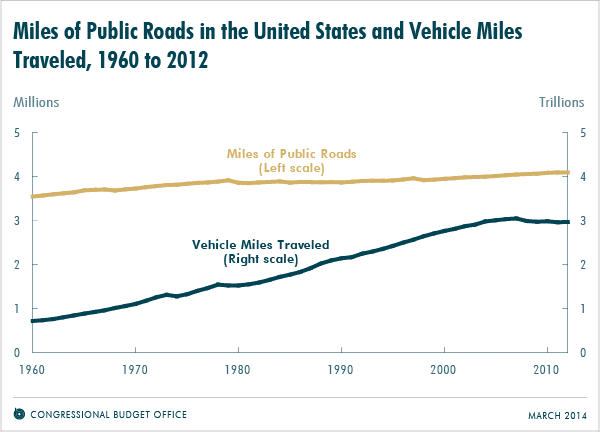
The United States has a network of over 4 million miles of public roads. That system has faced increasing demands over time: The number of vehicle miles traveled (both passenger and commercial) rose from approximately 700 billion in 1960 to just under 3 trillion in 2012 (see the figure below). In 2012, the federal government and state and local governments spent about $155 billion (in 2013 dollars) to build, operate, and maintain roads.

[Editor’s Note: This post is testimony by Joseph Kile, Assistant Director for Microeconomic Studies, before the Panel on Public-Private Partnerships, Committee on Transportation and Infrastructure, U.S. House of Representatives. This testimony adopts the practice of the Federal Highway Administration in using the words “highway” and “road” synonymously.]
Almost all of those infrastructure projects were undertaken using a traditional approach in which a state or local government assumes most of the responsibility for carrying out a project and bears most of its risks, such as the possibility of cost overruns, delays in the construction schedule, and, in the case of toll roads, shortfalls in the road’s revenues.
Some observers assert that an alternative approach, using a public-private partnership, could increase the money available for highway projects and complete the work more quickly or at a lower cost than is possible through the traditional method. Specifically, such a partnership could secure financing for a project through private sources that might require more accountability and could assign greater responsibility to private firms for carrying out the work. For example, a private business might take on the responsibility for specific tasks, such as operations and maintenance, and their accompanying risks.
This testimony addresses the potential role of the private sector in two aspects of carrying out highway projects: the financing of projects and the provision (that is, the design, construction, operation, and maintenance) of highways. In particular, CBO concludes the following:
- Private financing will increase the availability of funds for highway construction only in cases in which states or localities have chosen to restrict their spending by imposing legal constraints or budgetary limits on themselves. The reason is that revenues from the users of roads and from taxpayers are the ultimate source of money for highways, regardless of the financing mechanism chosen.
- The cost of financing a highway project privately is roughly equal to the cost of financing it publicly after factoring in the costs associated with the risk of losses from the project, which taxpayers ultimately bear, and the financial transfers made by the federal government to states and localities. Any remaining difference between the cost of public versus private financing for a project will stem from the effects of incentives and conditions established in the contracts that govern public-private partnerships.
- On the basis of evidence from a small number of -studies, it appears that such partnerships have built highways slightly less expensively and slightly more quickly, compared with the traditional public-sector approach. The relative scarcity of data on public-private partnerships for highway projects, however, and the uncertainty surrounding the results from the available studies make it difficult to apply their -conclusions definitively to other such projects.
[click on image below to read the entire document]

Source: http://www.cbo.gov/sites/default/files/cbofiles/attachments/45157-PublicPrivatePartnerships.pdf


