



Econintersect: The Congressional Budget Office (CBO) lowered the projections of costs for Medicare and Medicaid through 2022. The major reasons include:
- Costs over the last three years under-running previous projections;
- Lower estimated enrollment in Medicaid.
The CBO stated:
In recent years, health care spending has grown much more slowly both nationally and for federal programs than historical rates would have indicated. For example, in 2012, federal spending for Medicare and Medicaid was about 5 percent below the amount that CBO had projected in March 2010.
The CBO statement:
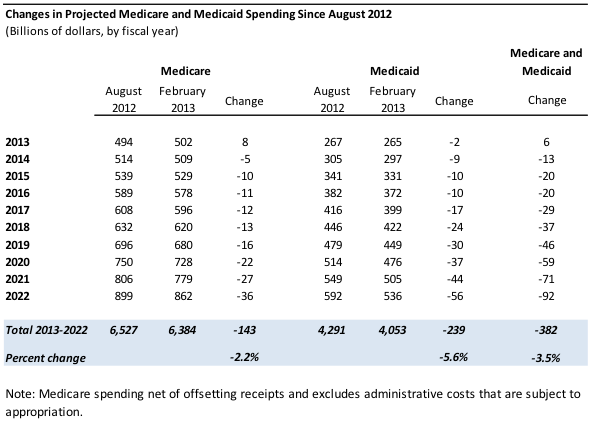
In its most recent baseline projections, CBO reduced its estimates of spending for the Medicare and Medicaid programs compared with its estimates in the August 2012 baseline. For the 2013–2022 period, projected spending for those programs is now $382 billion (or 3½ percent) below the agency’s estimates in August 2012.
CBO makes revisions to its baseline to reflect three kinds of developments—enacted legislation, updates to its economic forecast, and other, technical changes. In the case of Medicare and Medicaid, the downward adjustments since August reflect mostly technical changes—totaling $373 billion; legislative and economic changes accounted for just $9 billion.
CBO’s Projection of Medicaid Spending Over the 2013-2022 Period Has Declined by More Than 5 Percent Since Last August
For the 2013–2022 period, CBO has reduced its estimate of Medicaid spending by $239 billion (or about 5 ½ percent) compared with its estimate in August 2012. Specifically, the revisions reflect both lower anticipated enrollment in Medicaid and lower expected costs per person. CBO now estimates that enrollment in 2022, for example, will be about 84 million, compared with the 85 million it projected last August.
Although CBO has increased its estimate of the number of people who will enroll in Medicaid for the first time because of the Affordable Care Act’s expansion of the program, the agency’s projection of the number of people who would have been covered by Medicaid in the absence of that law has declined by a greater amount. Lower estimated Medicaid enrollment among those other groups is, in part, the result of improvements in CBO’s methods for forecasting the number of people with insurance. More people are now expected to obtain insurance through other sources (primarily employers), resulting in lower projected enrollment in Medicaid. In addition, fewer people are now expected to enroll in the Supplemental Security Income program, and because people who are enrolled in that program automatically qualify for Medicaid, that change in turn reduces the projected number of Medicaid enrollees.
CBO’s current baseline also shows lower spending per person in the Medicaid program than was shown in August, primarily because of adjustments to account for the slowed growth in Medicaid spending. The agency also expects that per-person costs will be lower than it anticipated in August because a larger share of the people who will be covered under the Medicaid program will be children and healthier adults, whose medical costs tend to be lower than those of less healthy adults. Because of those and other factors, CBO now estimates that Medicaid’s spending per person in 2020 will be about 6 percent lower than it projected in August.
CBO’s Projection of Medicare Spending Over the 2013-2022 Period Has Declined by About 2 Percent Since August
CBO has reduced its 10-year projections of outlays for Medicare by $143 billion (or about 2 percent) mostly for technical reasons—in particular because of data on actual spending for 2012, the third consecutive year in which spending was significantly lower than CBO had projected. In past baselines, CBO had begun to reflect the slowing growth in spending for Medicare’s Part A (Hospital Insurance) and Part B (Medical Insurance); the largest downward revision in the current baseline is for spending for Medicare’s Part D (prescription drugs).
The Recent Changes in CBO’s Baseline Reflect Trends That Have Developed Over the Past Few Years
In recent years, health care spending has grown much more slowly both nationally and for federal programs than historical rates would have indicated. For example, in 2012, federal spending for Medicare and Medicaid was about 5 percent below the amount that CBO had projected in March 2010.
In response to that slowdown, over the past several years CBO has made a series of downward adjustments to its projections of spending for Medicaid and Medicare. For example, from the March 2010 baseline to the current baseline, technical revisions—mostly reflecting the slower growth in the programs’ spending in recent years—have lowered CBO’s estimates of federal spending for the two programs in 2020 by about $200 billion—by $126 billion for Medicare and by $78 billion for Medicaid, or by roughly 15 percent for each program.


