


The Fed is being forced to end its bond-buying, cutting off the “free money for financiers” that has sustained a frothy stock market.
by Charles Hugh Smith, Of Two Minds
While the Federal Reserve presents itself as free to do whatever it pleases whenever it pleases, the reality is the Fed’s own policies are constraining its choices. Take the taper of U.S. Treasury bond purchases–the heart of quantitative easing (a.k.a. QE or more accurately free money for financiers).

You probably know how this works: the U.S. government runs a deficit, as it spends more than it collects in tax revenues. This deficit is funded by the sale of Treasury bonds.
The Fed has been creating money out of thin air, a.k.a. printing money, and using this new money to buy Treasury bonds.
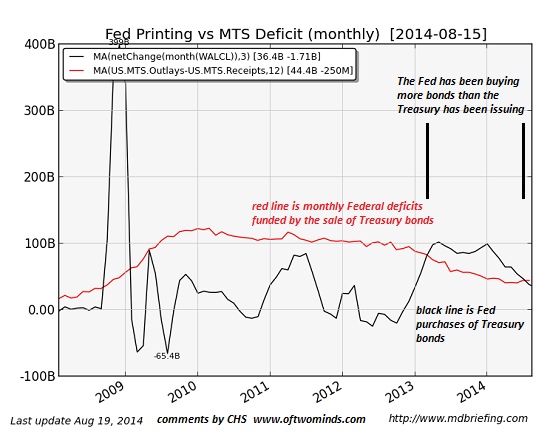
As the Federal deficit shrank, the Fed upped its bond-buying program (QE). As a result, the Fed was buying more bonds than the Treasury was issuing. This graph from from the excellent charting site Market Daily Briefing plots the Fed’s bond-buying (printing) and the Federal deficit (issuance ofnew bonds, which is different from rolling over the existing debt as bonds mature and must be replaced with new bonds).
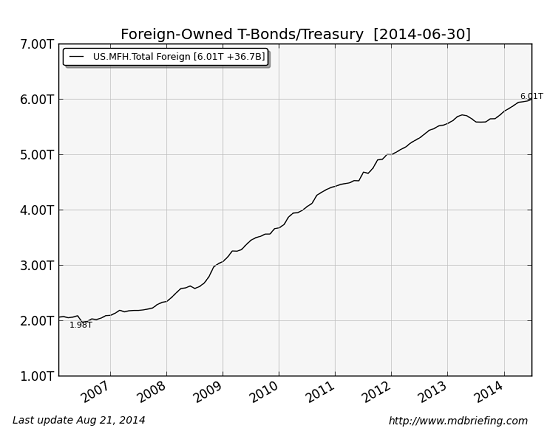
Many seem to believe the Fed was forced into buying bonds because foreign owners have been dumping their Treasury bond holdings. But if we look at a chart of foreign-owned Treasuries, we see a modest dip in mid-2013 that reversed later that year. Foreign ownership has reached a new high of $6 trillion:
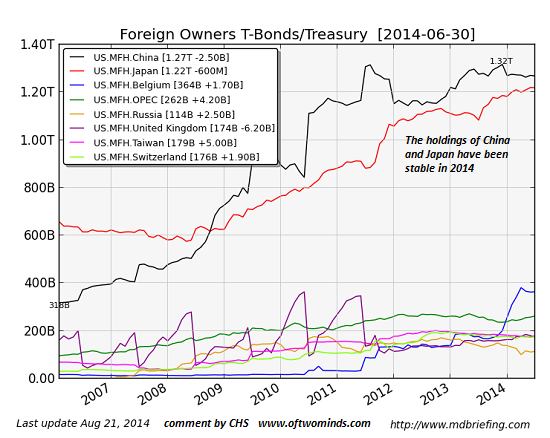
Much has been made of China selling some of its Treasury holdings, but if we look at this breakdown of foreign ownership, we see relatively modest fluctuations in the holdings of both China and Japan.
As I noted in Are Capital Inflows Propping Up U.S. Markets?, foreign central banks buy Treasuries not just for reserves but to lower the value of their currency vis-a-vis the U.S. dollar, the idea being to boost exports to the U.S. by weakening their currency.
These dynamics have created a global competition for Treasuries, pushing yields lower. The Fed is in effect competing with foreign and domestic buyers of Treasuries, a competition that has heated up as Federal deficits have declined.
This can be viewed as one consequence of the Triffin paradox, something I have covered in depth:
What Will Benefit from Global Recession? The U.S. Dollar (October 9, 2012)
Understanding the “Exorbitant Privilege” of the U.S. Dollar (November 19, 2012)
America’s Energy Boom and the Rising U.S. Dollar
As the issuance of new Treasury bonds (and thus U.S. dollars) declines, the demand for dollars will push the dollar higher.
A second side-effect is the Fed is forced to end its bond-buying, cutting off the free money for financiers QE that has sustained a frothy stock market. With the free money for financiers ending, the stock market will actually have to support its lofty valuations on its own merits.
If the market will continue rising without the Fed’s injections of free money for financiers, then why is Wall Street so terrified of “hawkish” murmurings, never mind actually hawkish actions by the Fed?


