


Written by Steven Hansen
US Census says manufacturing new orders declined. Our analysis agrees but one needs to consider that literally the entire growth of new orders the previous month was from a massive spike in civilian aircraft orders – so a decline was expected. Still, excluding civilian aircraft, the data has been soft for two months in a row. Consider that this data is noisy – and the rolling averages (which include transport) continue to accelerate. If this softness of non-transport sectors continues next month, there may be cause for concern.

- The Federal Reserve’s Industrial Production and the US Census agree that August was worse than July.
- The 3 month moving average of unadjusted new orders accelerated.
3 Month Rolling Average – Unadjusted Manufacturing New Orders (blue line), Inflation Adjusted New Orders from the Unadjusted Data (red line)

- The seasonally adjusted manufacturing new orders is down 10.1% (after last month’s rise of 13.0%) month-over-month, and up 4.3% year-to-date.
- Market expected month-over-month growth of -11.0% to -1.2% (consensus -9.3%) versus the reported -10.1%.
- Manufacturing unfilled orders up 0.6% month-over-month, and up 13.0% year-to-date
Econintersect Analysis:
- Unadjusted manufacturing new orders growth decelerated 13.6% month-over-month, but up 2.9% year-over-year
- Unadjusted manufacturing new orders (but inflation adjusted) up 1.5% year-over-year
- Unadjusted manufacturing unfilled orders growth decelerated 0.2% month-over-month, and up 12.1% year-over-year
- As a comparison to the inflation adjusted new orders data, the manufacturing subindex of the Federal Reserves Industrial Production was growth decelerated 0.4% month-over-month, and up 4.0% year-over-year.
Seasonally Adjusted Manufacturing Value of New Orders – All (red line, left axis), All except Defense (green line, left axis), All with Unfilled Orders (orange line, left axis), and all except transport (blue line, right axis)

From the above graphic, one can see that transport was weak compared to last month’s strength – but everything else was soft also. The graph below shows sector growth year-over-year.
Year-over-Year Change Manufacturing New Orders – Unadjusted (blue line) and Inflation Adjusted (red line)

Now look at the manufacturing component of industrial production. While it is true that these are slightly different pulse points (inventory not accounted in shipments) – they should not have different trends for long periods of time. Although the general trend is mixed – but in narrow channels.
Comparing Year-over-Year Change – Manufacturing Industrial Production (blue line) to Inflation Adjusted Manufacturers Shipments (green line)

Using employment to confirm manufacturing growth says this industry is growing year-over-year.
Employment Growth – Manufacturing (Seasonally Adjusted) – Total Employment (blue line) and Year-over-Year Change (red line)

The health of manufacturing is gauged by the growth of unfilled orders. The 3 month rolling average rate of growth is currently strongly accelerating – mostly due to last month’s large orders to Boeing.
Unadjusted Unfilled Orders – Total Current Value (blue line, left axis) and Year-over-Year Change (red line, right axis)
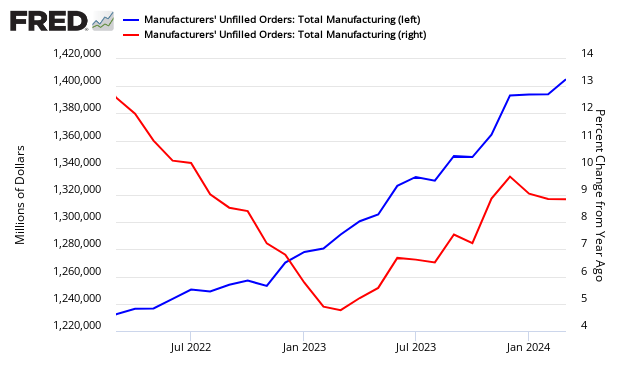
A declining unfilled orders backlog could be a recessionary indication as unfilled orders generally decline in poor economic times. Keep the score on surveys, the following is a comparison of surveys to hard data – this Census data is the orange bars.
Comparing Surveys to Hard Data


/images/z survey1.png
Caveats on the Use of Manufacturing Sales
The data in this index continues to be revised up to 3 months following initial reporting. The revision usually is not significant enough to change the interpretation of each month’s data in real time. Generally there are also annual revisions to this data series. The methodology used by US Census Bureau to seasonally adjust the data is not providing a realistic understanding of the month-to-month movements of the data. One reason is that US Census uses data over multiple years which includes the largest modern recession which likely distorts the analysis. Further, Econintersect believes there has been a fundamental shift in seasonality in the aftermath of the Great Recession of 2007 – the New Normal.Econintersect determines the month-over-month change by subtracting the current month’s year-over-year change from the previous month’s year-over-year change. This is the best of the bad options available to determine month-over-month trends – as the preferred methodology would be to use multi-year data (but the New Normal effects and the Great Depression distort historical data). This series is NOT inflation adjusted –Econintersect uses the PPI – subindex All Manufactured Goods. However, this is a rear view look at the economy. Manufacturing new orders or unfilled orders generally correlates to the economy – but it is not obvious in real time whether a recession is imminent. So in context to economy watchers – manufacturing by itself cannot be used as an economic gauge.
Adjusted Value – New Orders (blue line) and Unfilled Orders (red line)
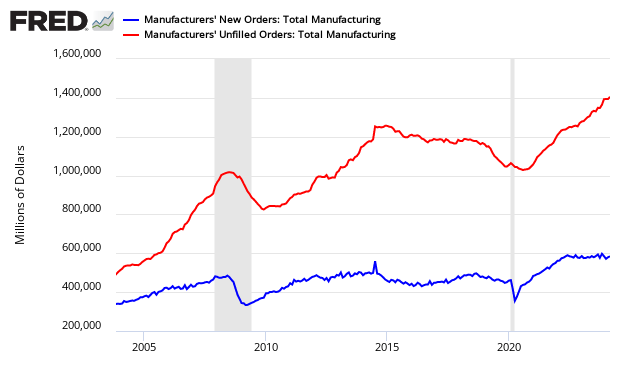
The same issues are also evident if manufacturing backlog is used as a recession gauge.
Related Posts:
Old Analysis Blog | New Analysis Blog |
| All Manufacturing Posts | All Manufacturing Posts |


