


Written by Doug Short and Steven Hansen

The advance estimate of second quarter 2014 Real Gross Domestic Product (GDP) is a positive 4.0%.
- The market expected GDP at +2.3% to 4.0% (consensus 3.1%).
- 1Q2014 GDP was just revised from a negative 2.9% to negative 2.1% – an unusual revision.
- There are significant “buts” relative to this advance GDP estimate (see below).
Before you believe the economy is taking off like a rocket, one must consider:
- This advance estimate released today is based on source data that are incomplete or subject to further revision. (See caveats below.) Please note that historically advance estimates have turned out to be little more than wild guesses.
- Headline GDP is calculated by annualizing one quarter’s data against the previous quarters data (and the previous quarter was terrible in this instance). A better method would be to look at growth compared to the same quarter one year ago. For 2Q2014, the year-over-year growth is 2.4% – up from 1Q2014’s 1.9% year-over-year growth. So one might say that GDP accelerated 0.6% from the first quarter.
- 1.7% (over 40% of GDP growth) was attributable to inventory gain.
Real GDP Expressed As Year-over-Year Change

Real GDP is inflation adjusted and annualized – and Real GDP per capita has made an all time high.
Real GDP per Capita

The table below compares the 1Q2014 third estimate of GDP (Table 1.1.2) with the advance estimate 2Q2014 GDP which shows:
- consumption for goods and services has improved;
- trade balance again worsened;
- there was an inventory growth adding almost 1.7% to GDP;
- fixed investment improved;
- government spending actually added to GDP.
The arrows in the table below highlight significant differences between 1Q2014 and 2Q2014 (green is good influence, and red is a negative influence).
[click on graphic below to enlarge]

What the BEA says about this advance estimate:
Real GDP increased 4.0 percent in the second quarter, after decreasing 2.1 percent in the first. This upturn in the percent change in real GDP primarily reflected upturns in private inventory investment and in exports, an acceleration in PCE, an upturn in state and local government spending, an acceleration in nonresidential fixed investment, and an upturn in residential fixed investment that were partly offset by an acceleration in imports.
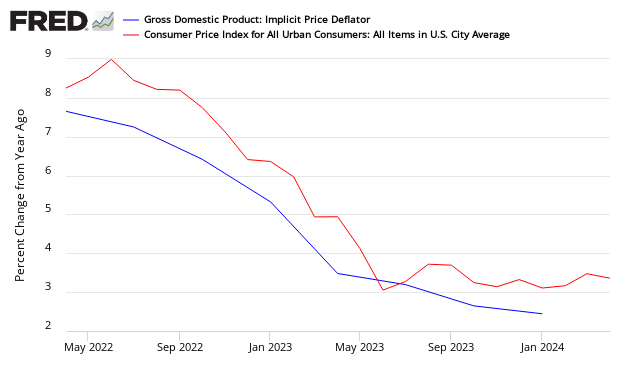
Inflation continues to moderate as the “deflator” which adjusts the current value GDP to a “real” comparable value continues to moderate. The market expected the deflator at 1.5% to 2.6% (consensus 2.0%) versus the reported 1.9%. The following compares the GDP deflator to the Consumer Price Index:
GDP was revised for 1Q2014 – an unusual event:
For the first quarter of 2014, real GDP is now estimated to have declined 2.1 percent; in the previously published estimates, first-quarter GDP was estimated to have declined 2.9 percent. The 0.8- percentage point upward revision to the percent change in first-quarter real GDP primarily reflected upward revisions to private inventory investment, to nonresidential fixed investment, and to PCE.

Overview Analysis:
Here is a look at GDP since Q2 1947 together with the real (inflation-adjusted) S&P Composite. The start date is when the BEA began reporting GDP on a quarterly basis. Prior to 1947, GDP was reported annually. To be more precise, what the lower half of the chart shows is the percent change from the preceding period in Real (inflation-adjusted) Gross Domestic Product. I’ve also included recessions, which are determined by the National Bureau of Economic Research (NBER).

Here is a close-up of GDP alone with a line to illustrate the 3.3 average (arithmetic mean) for the quarterly series since the 1947. I’ve also plotted the 10-year moving average, currently at 1.6 percent, down from 1.7 percent last quarter.
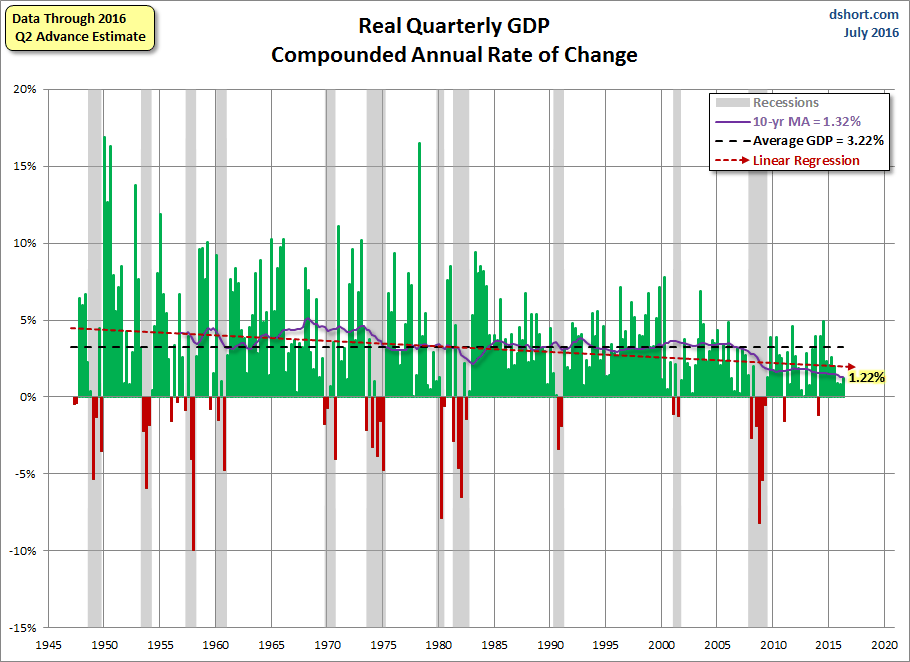
Here is the same chart with a linear regression that illustrates the gradual decline in GDP over this timeframe.
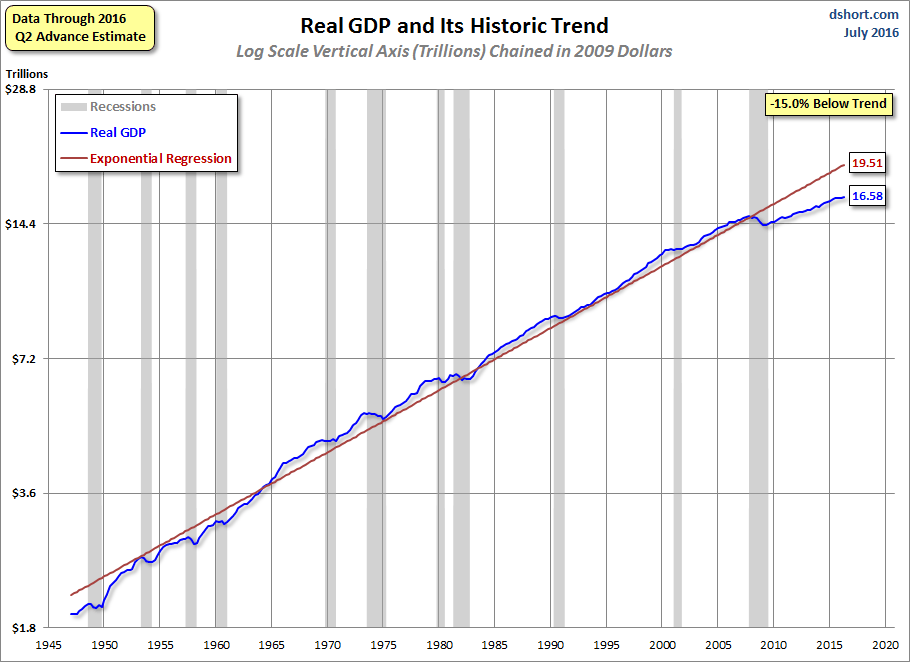
And for a bit of political trivia, here is a look at GDP by party in control of the White House and Congress.

In summary, the Q2 GDP Advance Estimate of 4.0 percent was well above forecasts and supports the mainstream view that the Q1 GDP contraction was a weather-related fluke.
The chart below is a way to visualize real GDP change since 2007. The chart uses a stacked column chart to segment the four major components of GDP with a dashed line overlay to show the sum of the four, which is real GDP itself. As the analysis clear shows, personal consumption is key factor in GDP mathematics.

Caveats on the Use of Gross Domestic Product (GDP)
GDP is market value of all final goods and services produced within the USA where money is used in the transaction – and it is expressed as an annualized number. GDP = private consumption + gross investment + government spending + (exports − imports), or GDP = C + I + G + (X – M). GDP counts monetary expenditures. It is designed to count value added so that goods are not counted over and over as they move through the manufacture – wholesale – retail chain.
The vernacular relating to the different GDP releases:
“Advance” estimates, based on source data that are incomplete or subject to further revision by the source agency, are released near the end of the first month after the end of the quarter; as more detailed and more comprehensive data become available, “second” and “third” estimates are released near the end of the second and third months, respectively. The “latest” estimates reflect the results of both annual and comprehensive revisions.
Consider that GDP includes the costs of suing your neighbor or McDonald’s for hot coffee spilled in your crotch, plastic surgery or cancer treatment, buying a new aircraft carrier for the military, or even the replacement of your house if it burns down – yet little of these activities is real economic growth.
GDP does not include include home costs (other than the new home purchase price even though mortgaged up the kazoo), interest rates, bank charges, or the money spent buying anything used.
It does not measure wealth, disposable income, or employment.
In short, GDP does not measure the change of the economic environment for Joe Sixpack in 1970, and Joe Sixpack’s kid, yet pundits continuously compare GDP across time periods.
Although there always will be some correlation between all economic pulse points, GDP does not measure the economic elements that directly impact the quality of life of its citizens.
Related Articles
Old Analysis Blog | New Analysis Blog |
| Posts on GDP | Posts on GDP |


