


Written by Steven Hansen
New coronavirus cases continue to slowly trend down. At the end of this post is a set of interactive graphs and tables for the world and individual states – as well as today’s headlines which include;
- Protests Pose Particular Risks for COVID-19 Transmission
- Sharp Decline in Emergency Visits Seen in Early Days of Coronavirus Pandemic
- ICUs become a ‘delirium factory’ for Covid-19 patients
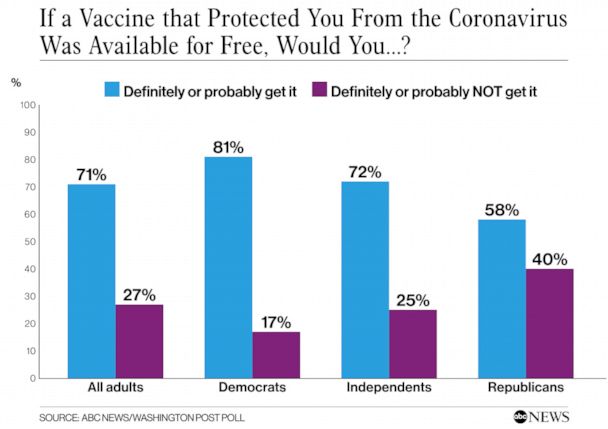
- 27% unlikely to be vaccinated against the coronavirus

The rolling averages for new coronavirus cases in the U.S. continue to SLOWLY trend down.

Coronavirus News You May Have Missed
Protests Pose Particular Risks for COVID-19 Transmission – MedPage Today
Thousands of protesters have been depicted not social distancing from one another, and some not wearing masks in public. Experts told MedPage Today that viral transmission risks at these events go far beyond these non-pharmaceutical interventions. (See a separate MedPage Today report on concerns over a potential COVID-19 surge in Minneapolis related to protests there.)
… Adalja, who is at Johns Hopkins University in Baltimore, compared the close contact, as well as yelling and screaming, at the protests to a choir rehearsal, where the CDC documented a high COVID-19 attack rate in part due to singing, which also produces more droplets than ordinary speaking.
And the methods used for breaking up protests may carry transmission risks of their own. “Nobody’s done a study where we’ve exposed people to smoke or tear gas and then infected them with COVID,” said another IDSA spokesperson, Gregory Poland, MD, of the Mayo Clinic in Rochester, Minnesota, but based on extrapolating known information, “anything that irritates the respiratory tract is likely to increase risk of infection.”
Adalja noted that tear gas makes people cough, and thus can promote transmission
Federal Reserve Board announces an expansion in the number and type of entities eligible to directly use its Municipal Liquidity Facility – Federal Reserve
The Federal Reserve Board on Wednesday announced an expansion in the number and type of entities eligible to directly use its Municipal Liquidity Facility (MLF). Under the new terms, all U.S. states will be able to have at least two cities or counties eligible to directly issue notes to the MLF regardless of population. Governors of each state will also be able to designate two issuers in their jurisdictions whose revenues are generally derived from operating government activities (such as public transit, airports, toll facilities, and utilities) to be eligible to directly use the facility.
In addition to the expanded terms outlined above, the MLF continues to be directly open to U.S. states, the District of Columbia, U.S. cities with a population of at least 250,000 residents, U.S. counties with a population of at least 500,000 residents, and certain multistate entities.
The MLF was established under Section 13(3) of the Federal Reserve Act, with approval of the Treasury Secretary. It will offer up to $500 billion in lending to states and municipalities to help manage cash flow stresses caused by the coronavirus pandemic.
Appendix A: Federal Reserve Municipal Liquidity Facility Limit per State (PDF)
Important scientific questions have been raised about data reported in the paper by Mandeep Mehra et al—Hydroxychloroquine or chloroquine with or without a macrolide for treatment of COVID-19: a multinational registry analysis —published in The Lancet on May 22, 2020. Although an independent audit of the provenance and validity of the data has been commissioned by the authors not affiliated with Surgisphere and is ongoing, with results expected very shortly, we are issuing an Expression of Concern to alert readers to the fact that serious scientific questions have been brought to our attention. We will update this notice as soon as we have further information.
The World Health Organization is resuming its trial of hydroxychloroquine … after temporarily halting research over safety concerns.
The Data Safety Monitoring Board decided there was no reason to discontinue the international trial after reviewing available data on the drug, WHO Director-General Tedros Adhanom Ghebreyesus said during a press conference Wednesday at the agency’s Geneva headquarters.
“The executive group received this recommendation and endorsed the continuation of all arms of solidarity trial including hydroxychloroquine,” he said.
On May 25, WHO announced it had temporarily suspended its trial of the drug over safety concerns. The announcement came days after a study published in medical journal The Lancet found that hospitalized Covid-19 patients treated with hydroxychloroquine had a higher risk of death than those who didn’t take it. That study is now being reexamined.
Sharp Decline in Emergency Visits Seen in Early Days of Coronavirus Pandemic: U.S. Study – US News
EMERGENCY department visits fell 42% across the United States during the early days of the coronavirus pandemic compared to the same period last year, according to a study by the U.S. Centers for Disease Control and Prevention (CDC).
The steepest declines in emergency department visits, from the start of 2020 through May 30, were seen in children younger than 14 and women, and in the northeast region that includes New York and New Jersey, the epicenter of the U.S. outbreak.
The proportion of infectious disease-related visits, including for general symptoms, pneumonia not caused by tuberculosis and for respiratory failure, was four times higher during the early pandemic period.
But the number of visits for chest pain, heart attacks and other medical issues not related to the virus fell sharply, suggesting people were delaying care for conditions that might be fatal if left untreated, researchers said in the CDC’s Morbidity and Mortality Weekly report.
Face Masks & Physical Distancing Reduce COVID-19 Risk – Statista
A new study published in The Lancet medical journal has found that measures such as physical distancing and wearing face masks are effective at reducing COVID-19 transmission. The systematic review and meta-analysis of 172 observational studies found that there is a 12.8 percent chance of contracting COVID-19 with physical distancing measures of less than 1 meter but this falls to just 2.6 percent with a distance of 1 meter or more.
Masks have become a hugely controversial topic but they are being credited with helping halt the spread of the disease in many countries across Asia as well as some in Europe such as the Czech Republic. According to The Lancet, the chance of transmission without masks and respirators is 17.4 percent and this falls to just 3.1 percent when they are worn. Eye protection can also reduce the chance of infection from 16 percent to 5.5 percent. The authors of the study caution that even when all these measures are combined, they fail to offer complete protection and that others are necessary, especially hand washing/good hand hygiene.
You will find more infographics at Statista

China rejects report that it delayed COVID-19 information sharing with WHO – Reuters
China said on Wednesday a news report that said it delayed sharing COVID-19 information with the World Health Organization (WHO) is totally untrue.
Foreign ministry spokesman Zhao Lijian made the remarks during a daily briefing in response to a question about the report by the Associated Press, which said the WHO was frustrated by significant delays in information sharing by Beijing as the coronavirus outbreak took hold in China in January.
Man behind Sweden’s controversial Covid-19 strategy admits mistakes – Hindustan Times
Sweden’s top epidemiologist says more should have been done in his country to tackle Covid-19 at the start of the outbreak, in order to keep the death rate down.
“If we were to encounter the same illness with the same knowledge that we have today, I think our response would land somewhere in between what Sweden did and what the rest of the world has done,” Anders Tegnell said in an interview with Swedish Radio.
Tegnell is the brains behind Sweden’s controversial approach to fighting the virus, and the government of Stefan Lofven has deferred to the epidemiologist in its official response to the pandemic. Gatherings of more than 50 people continue to be banned, but throughout the crisis Swedes have been able to visit restaurants, go shopping, attend gyms and send children under 16 to school.
… At 43 deaths per 100,000, Sweden’s death rate is among the highest globally and far exceeds that of neighboring Denmark and Norway, which imposed much tougher lockdowns at the outset of the pandemic.
ICUs become a ‘delirium factory’ for Covid-19 patients – CNN
Doctors are fighting not only to save lives from Covid-19, but also to protect patients’ brains.
Although Covid-19 is best known for damaging the lungs, it also increases the risk of life-threatening brain injuries — from mental confusion to hallucinations, seizures, coma, stroke and paralysis. The virus may invade the brain, and it can starve the brain of oxygen by damaging the lungs. To fight the infection, the immune system sometimes overreacts, battering the brain and other organs it normally protects.
Yet the pandemic has severely limited the ability of doctors and nurses to prevent and treat neurological complications. The severity of the disease and the heightened risk of infection have forced medical teams to abandon many of the practices that help them protect patients from delirium, a common side effect of mechanical ventilators and intensive care.
… A study from Wuhan, China — where the first Covid-19 cases were detected — found 36% of patients had neurological symptoms, including headaches, changes in consciousness, strokes and lack of muscle coordination.
A smaller, French study observed such symptoms in 84% of patients, many of which persisted after people left the hospital.
WHO says coronavirus has not meaningfully mutated to a more lethal or contagious form – CNBC
- The coronavirus has not mutated in any way that would meaningfully change how quickly it spreads or how severely it can harm humans, World Health Organization officials said Wednesday.
- The WHO and its network of scientists and virologists continue to track the genetic sequence of the virus in countries across the world to monitor for mutations, the WHO said.
- Dr. Maria Van Kerkhove, head of WHO’s emerging diseases and zoonosis unit, said scientists have observed “normal changes” in the virus, which were expected.
27% unlikely to be vaccinated against the coronavirus; Republicans, conservatives especially: POLL – ABC News
Unpersuaded by more than 100,000 pandemic deaths in the United States, 45% of strong conservatives, four in 10 Republicans and nearly as many evangelical Christians say they’d be unlikely to get vaccinated against the coronavirus, even for free.
Overall, 27% of adults in an ABC News/Washington Post poll say they definitely (15%) or probably (12%) would not get the vaccine. Among them, half say they don’t trust vaccines in general, while nearly a quarter don’t think it’s needed in this case.
Fauci: Moderna COVID-19 Phase III Trial to Begin in July with 30,000 Patients – BioSpace
Cambridge, Massachusetts-based Moderna is largely ahead of the game in the U.S. for developing a vaccine against COVID-19. On May 20, the company released positive interim Phase I data from its clinical trial of mRNA-1273. Yesterday, Anthony Fauci, director of the U.S. National Institute of Allergy and Infectious Diseases (NIAID), which is collaborating on the vaccine with Moderna, told the editor of the technical journal JAMA that the vaccine’s Phase III trial is expected to launch in July. It will evaluate 30,000 patients ranging in age as 18 years and include the elderly.
Moderna’s vaccine uses unproven technology, mRNA. No therapy or vaccine has been approved based on the technology yet. Messenger RNA (mRNA) delivers the genetic code to the ribosomes where the protein is manufactured. In the Moderna vaccine, which is similar to a gene therapy, the mRNA codes for the virus’s Spike (S) protein. The patient’s cells then manufacture the S protein, which triggers the body’s immune system to recognize the virus itself.
The following are foreign headlines with hyperlinks to the posts
Singapore Was A Shining Star In COVID-19 Control — Until It Wasn’t
How Iceland Beat the Coronavirus
Brazil will be first country outside UK to test vaccine developed by Oxford University
Coronavirus Cases in Europe Drop to Fewest Since March; India Sees Surge
Venezuela’s Maduro joins hands with Guaido in fight against virus
The following are national and state headlines with hyperlinks to the posts
USDA announces first case of dog testing positive for coronavirus in US
Restaurants in 7 regions across New York can reopen outdoor seating tomorrow
Coronavirus Statistics For 03 June 2020 |
| U.S. Only | Global | U.S Percentage of Total | ||||
| Today | Cumulative | Today | Cumulative | Today | Cumulative | |
| New Cases | 20,544 | 1,830,000 | 103,262 | 6,350,000 | 19.9% | 28.8% |
| Deaths | 1,034 | 106,181 | 4,383 | 380,810 | 23.6% | 27.9% |
| Mortality Rate | 3.6% | 5.8% | 3.4% | 6.0% | ||
| total COVID-19 Tests per 1,000 people | 1.30* | 51.17* | ||||
* as of 31 May 2020
Today’s Posts On Econintersect Showing Impact Of The Pandemic With Hyperlinks
April 2020 Headline Manufacturing New Orders Continue In Coronavirus Decline
May 2020 ISM and Markit Services Surveys Improve But Remain In Recession Territory
May 2020 ADP Employment Declines 2,760,000
Have The Fed Swap Lines Reduced Dollar Funding Strains During The COVID-19 Outbreak?
Infographic Of The Day: Layoffs At Prominent Startups Triggered By COVID-19
Health Crisis: Different Economic Animal From Financial Crisis
How We’ll Surf – And Trade – The Looming Bankruptcy “Tidal Wave”
COVID-19 How Far Away Are We From Herd Immunity?
Lockdown: We Need To Experiment With Reopenings Now To Prevent A Second Wave
CFNAI Economic Indicator Crashes Most On Record
How The First Modern Pandemic Made Key Workers Its Early Victims
Coronavirus INTERACTIVE Charts
include($_SERVER[‘DOCUMENT_ROOT’].’/pages/coronavirus.htm’); ?>
Analyst Opinion of Coronavirus Data
There are several takeaways that need to be understood when viewing coronavirus statistical data:
- The global counts are suspect for a variety of reasons including political. Even the U.S. count has issues as it is possible that as much as half the population has had coronavirus and was asymptomatic. It would be a far better metric using a random sampling of the population weekly. In short, we do not understand the size of the error in the tracking numbers.
- Just because some of the methodology used in aggregating the data in the U.S. is flawed – as long as the flaw is uniformly applied – you establish a baseline. This is why it is dangerous to compare two countries as they likely use different methodologies to determine who has (and who died) from coronavirus.
- COVID-19 and the flu are different but can have similar symptoms. For sure, COVID-19 so far is much more deadly than the flu. [click here to compare symptoms]
- From an industrial engineering point of view, one can argue that it is best to flatten the curve only to the point that the health care system is barely able to cope. This solution only works if-and-only-if one can catch this coronavirus once and develops immunity. In the case of COVID-19, herd immunity may need to be in the 80% to 85% range. WHO warns that few have developed antibodies to COVID-19. At this point, herd immunity does not look like an option.
- Older population countries will have a higher death rate.
- There are at least 8 strains of the coronavirus. New York may have a deadlier strain imported from Europe, compared to less deadly viruses elsewhere in the United States.
- Each publication uses different cutoff times for its coronavirus statistics. Our data uses 11:00 am London time. Also, there is an unexplained variation in the total numbers both globally and in the U.S.
- The real question remains if the U.S. is over-reacting to this virus. The following graphic from the CDC puts the annual flu burden in perspective [click on image to enlarge].
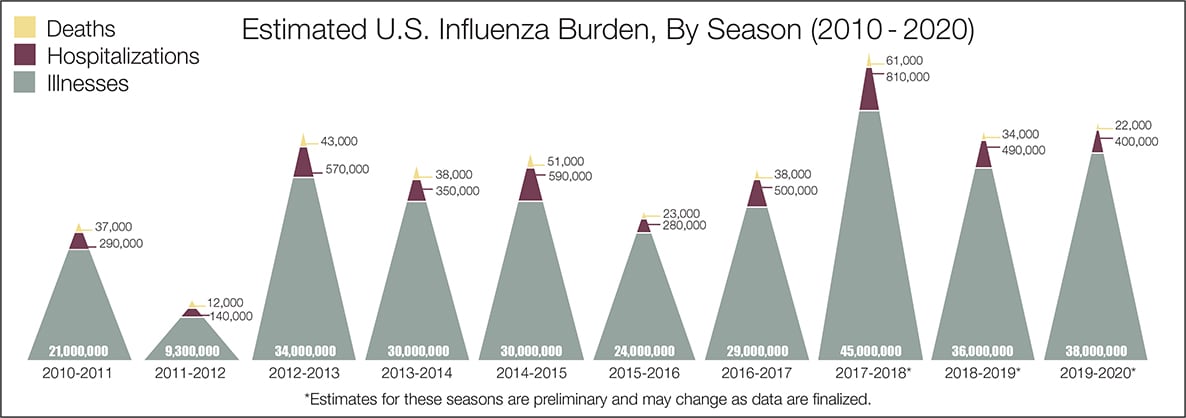
What we do not know about the coronavirus [actually there is little scientifically proven information]. Most of our knowledge is anecdotal, from studies with limited subjects, or from studies without peer review.
- How many people have been infected?
- Can the US really scale up coronavirus testing and tracing?
- What forms of social distancing work best?
- Can children widely spread coronavirus?
- Why have some places avoided big coronavirus outbreaks?
- What effect will the weather have?
- Can we reopen parks and beaches? [we will find out soon as many beaches and parks have reopened]
- Do we develop lasting immunity to the coronavirus?
- Can the world really push out a vaccine in 12 to 18 months?
- Will we get other medical treatments for Covid-19?
- Do we need all these ventilators?
The bottom line is that COVID-19 so far has been shown to be much more deadly than the data on the flu. Using CDC data, the flu has a mortality rate between 0.06 % and 0.11 % Vs. the coronavirus which to date has a mortality rate of over 5 % – which makes it between 45 and 80 times more deadly. The reason for ranges:
Because influenza surveillance does not capture all cases of flu that occur in the U.S., CDC provides these estimated ranges to better reflect the larger burden of influenza.
There will be a commission set up after this pandemic ends to find fault [it is easy to find fault when a once-in-a-lifetime event occurs] and to produce recommendations for the next time a pandemic happens. Those that hate President Trump will conclude the virus is his fault. The most important issue will be an analysis of whether the federal government took a strong enough lead in dealing with the pandemic – and that includes every single politician!
include(“/home/aleta/public_html/files/ad_openx.htm”); ?>


