



Of the four Federal Reserve districts which have released their May manufacturing surveys. A complete summary follows.
Analyst Opinion of Dallas Fed Manufacturing Survey
This survey remains in positive territory year-over-year with subindices new orders decreasing (and in expansion) and unfilled orders declined and marginally in contraction. This should be considered a worse report than last month.
The expectations from Econoday was +5.0 to +10.0 (consensus +7.0) [no expectations this month] for the general activity index, and the reported value was 6.3. From the Dallas Fed:
Texas factory activity continued to expand in May, albeit at a slower pace, according to business executives responding to the Texas Manufacturing Outlook Survey. The production index, a key measure of state manufacturing conditions, fell six points to 6.3, indicating output growth decelerated from April.
Most other measures of manufacturing activity also suggested slower expansion in May. The survey’s demand indicators fell but remained positive: The new orders index slipped seven points to 2.4, and the growth rate of orders index moved down from 5.2 to 1.1. The capacity utilization index fell to 7.7 from a seven-month high of 15.6 in April. Meanwhile, the shipments index edged up to 7.6.
Perceptions of broader business conditions exhibited some weakness in May. The general business activity index turned negative and reached a year-to-date low of -5.3. The company outlook index dipped into negative territory for the first time this year, coming in at -1.7. The index measuring uncertainty regarding companies’ outlooks jumped nine points to 16.1, its highest reading since last September. More than a quarter of firms said uncertainty increased this month.
Labor market measures suggested stronger employment growth and longer workweeks in May. The employment index rebounded from its April dip, rising seven points to 11.6. Twenty-one percent of firms noted net hiring, while 9 percent noted net layoffs. The hours worked index remained positive but inched down to 6.4.
Slight upward pressure on input costs continued in May, while pressure on selling prices abated. The raw materials prices index held steady at 7.4, a three-year low. Meanwhile, the finished goods prices index retreated from 6.0 to 0.7, with the near-zero May reading suggesting virtually no growth in selling prices. The wages and benefits index remained elevated and largely unchanged at 27.6.
Expectations regarding future business conditions remained positive in May, although the indexes moved down from April readings. The index of future general business activity fell nine points to 9.1. Similarly, the index of future company outlook fell nine points to 11.5. Most other indexes of future manufacturing activity declined this month but stayed in positive territory.
Dallas Fed (hyperlink to reports):

z dallas_man.PNG
Source: Dallas Fed
Summary of all Federal Reserve Districts Manufacturing:
Richmond Fed (hyperlink to reports):

z richmond_man.PNG
Kansas Fed (hyperlink to reports):

z kansas_man.PNG
Philly Fed (hyperlink to reports):

z philly fed1.PNG
New York Fed (hyperlink to reports):

z empire1.PNG
Federal Reserve Industrial Production – Actual Data (hyperlink to report):
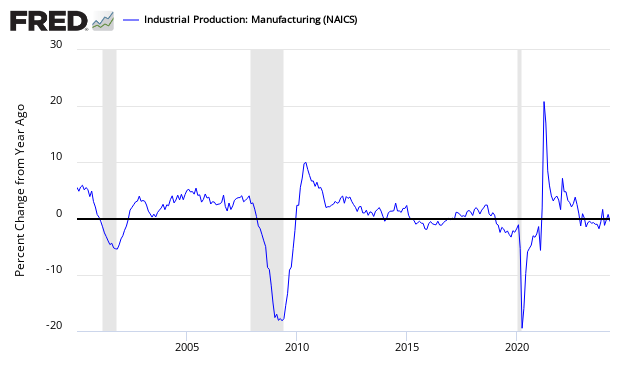
Holding this and other survey’s Econintersect follows accountable for their predictions, the following graph compares the hard data from Industrial Products manufacturing subindex (dark blue bar) and US Census manufacturing shipments (lighter blue bar) to the Dallas Fed survey (light blue bar).
Comparing Surveys to Hard Data:

z survey1.png
In the above graphic, hard data is the long bars, and surveys are the short bars. The arrows on the left side are the key to growth or contraction.
include(“/home/aleta/public_html/files/ad_openx.htm”); ?>


