


from The Conversation
— this post authored by Mary Elizabeth Collins, Boston University and Sarah B. Garlington, Ohio University
The health and economic impacts of the coronavirus pandemic are not equally felt. From the United States to Brazil and the United Kingdom, low-wage workers are suffering more than others and communities of color are most vulnerable to the virus.

Please share this article – Go to very top of page, right hand side, for social media buttons.
Despite the disparities, countries are reopening without a plan to redress these unequal harms and protect the broader community going forward. Our ethics research examines the potential for using virtues as a guide for a more moral coronavirus response.
Virtues are applied morals – actions that promote individual and collective well-being. Examples include generosity, compassion, honesty, solidarity, fortitude, justice and patience. While often embedded in religion, virtues are ultimately a secular concept. Because of their broad, longstanding relevance to human societies, these values tend to be held across cultures.
We propose three core virtues to guide policymakers in easing out of coronavirus crisis mode in ways that achieve a better new normal: compassion, solidarity and justice.
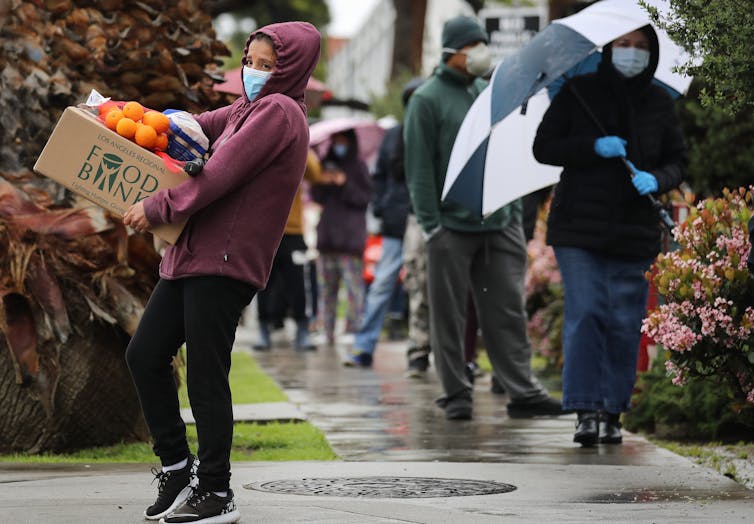
The coronavirus crisis isn’t hitting all communities equally hard, calling for not just aid like this California food bank but also justice-oriented policies to redress harms. Mario Tama/Getty Images
1. Compassion
Compassion is a core virtue of all the world’s major religions and a bedrock moral principle in professions like health care and social work. The distinguishing characteristic of compassion is “shared suffering:” Compassionate people and policies recognize suffering and take actions to alleviate it.
As the French philosopher André Comte-Sponville said, compassion “means that one refuses to regard any suffering as a matter of indifference or any living being as a thing.”
Individual acts of compassion abound in the coronavirus crisis, like frontline health care professionals and neighbors who deliver food, among other examples.

Compassion and solidarity on display at New York’s Elmhurst Hospital, during the April peak of the city’s coronavirus outbreak. Noam Galai/Getty Images
Some pandemic-era policies also reflect compassion, such as regulations preventing evictions and expanding unemployment benefits and giving food aid to poor familes.
A compassion-guided reopening aimed at preventing or reducing human suffering would require governments to continually monitor and alleviate the pain of their people. That includes addressing new forms of suffering that arise as circumstances change.
2. Solidarity
In a global pandemic, the actions people do or don’t take affect the health of others worldwide. Such shared emergencies require solidarity, which recognizes both the inherent dignity of each individual person and the interdependence of all people. As United Nations officials have emphasized, “we are all in this together.”
Public health measures like stay-at-home orders, social distancing and wearing masks reflect solidarity. While compliance in the United States has not been universal, data indicate broad approval for these measures. A new study found that 80% of Americans nationwide support staying home and social distancing and 74% support using face coverings in public.
To achieve these acts of solidarity, the leaders most praised in their countries and abroad – from U.S. National Institutes of Health director Dr. Anthony Fauci to New Zealand prime minister Jacinda Ardern – have relied primarily on moral persuasion, not threats of punishment.
By delivering clear information, giving simple and repeated behavioral guidance, and setting a good example, they’ve helped convince millions to take personal responsibility for protecting their community.

Face masks signal that wearers care about protecting others around them. Islam Dogru/Anadolu Agency via Getty Images
3. Justice
Justice focuses on the fair distribution of resources and the social structures that enable what the Dutch philosopher Patrick Loobuyck has called a “condition of equality.”
Justice-oriented policies are necessary for a moral reopening because of the pandemic’s disproportionate health and economic impacts. The evidence clearly shows that communities of color, low-income populations, people in nursing homes and those on the margins of society, such as homeless people and undocumented immigrants, are hardest hit.
Justice-oriented policies would aim for equitable balancing of necessary pandemic resources. That means directing testing and health equipment toward vulnerable communities – as identified by COVID-19 tracking data and risk factors like housing density and poverty – and ensuring free, widespread vaccine distribution when it becomes available.
In the U.S., economic justice will also require aggressively investing in minority-run businesses and poorer areas to guard against further harm to owners, employees and neighborhoods.
Similarly, all American school children have lost critical classroom hours, but lower-income children have been disproportionately damaged by remote learning in part due to the digital divide and loss of free lunch programs. Justice would demand channeling additional resources to the students and schools that need them most.
A moral reopening
Using virtues to guide social policies is an old idea. It dates back at least to the Greek thinker Aristotle.

Social distance stickers to prepare Nepal’s empty Tribhuwan International Airport for reopening. Narayan Maharjan/NurPhoto via Getty Images
New Zealand is a good example of virtuous pandemic policymaking, even considering its advantages in having wealth, low density and no land borders. Its coronavirus response included not only aggressive public health measures but also a well articulated message of being united in the COVID-19 fight and recurring government payments so workers did not have to risk their health for their job.
Note that it isn’t enough to apply just one virtue in a crisis of this magnitude. Policies built on compassion, solidarity and justice should be deployed in combination.
A compassionate post-pandemic response that does not address underlying inequalities, for example, ignores certain communities’ specific needs. Meanwhile, tackling specific injustices without engaging everyone in efforts like mask-wearing endangers the public health.
Bolstered by scientific evidence, virtue ethics can help nations reopen not just economically but morally, too.
[Get the best of The Conversation, every weekend. Sign up for our weekly newsletter.]
Mary Elizabeth Collins, Professor of Social Welfare Policy, Boston University and Sarah B. Garlington, Assistant Professor, Social Work, Ohio University
This article is republished from The Conversation under a Creative Commons license. Read the original article.


