


from The Conversation
— this post authored by Richard Bowen and Alan Rudolph, Colorado State University
Nobody yet knows for sure the definitive origins of the newly recognized coronavirus now known as 2019-nCoV that’s currently spreading across the globe as a human respiratory pathogen. Early reports indicate that the source of the virus was the Huanan seafood market in Wuhan, China, where an eclectic mix of animals including rodents, rabbits, bats and other wild animals and seafood are all on display for consumption and in contact with human shoppers.

Please share this article – Go to very top of page, right hand side, for social media buttons.
Over the past two decades, the world has seen the emergence of multiple pandemic threats, including bird flu (H5N1 avian influenza), SARS, Ebola, Middle East Respiratory Syndrome, chikungunya, Zika and now the new coronavirus from Wuhan. The viruses that cause these diseases, and indeed roughly two-thirds of all recent emergent viruses, originate in animals before they jump to humans.
Each of these events underscores that multiple parts of an ecosystem are at play during an outbreak. For instance, wild bats and rodents harbor numerous viruses that have the potential to infect humans and animals. When these wild animals are extracted from their natural habitat and come into close contact with people, very rare transmission events become much more likely.
These pathogen jumps are complex. They can occur via direct contact, consumption of bushmeat or transmission by insect vectors that carry the germs among a variety of species. And a range of environmental conditions – such as temperature, humidity, sunlight and even seasonal rain and soil conditions – can affect transmission.
Despite the complexity of the natural world, the research approach to understanding how potentially pandemic pathogens and their animal and human hosts interact has been relatively simple. Scientists typically focus on a single species at a time, studied under conditions of constant temperature, humidity and airflow. This strategy has clearly helped researchers understand infectious disease processes.
But as biologists, we believe that more explicitly acknowledging the complexity of the natural world will provide a more robust understanding of emerging infectious diseases. We’ve set up what we call “artificial ecosystems” in the lab to mimic the complicated conditions out in the real world. They’re helping us gather new insights into how viruses and other pathogens actually emerge to become global threats.
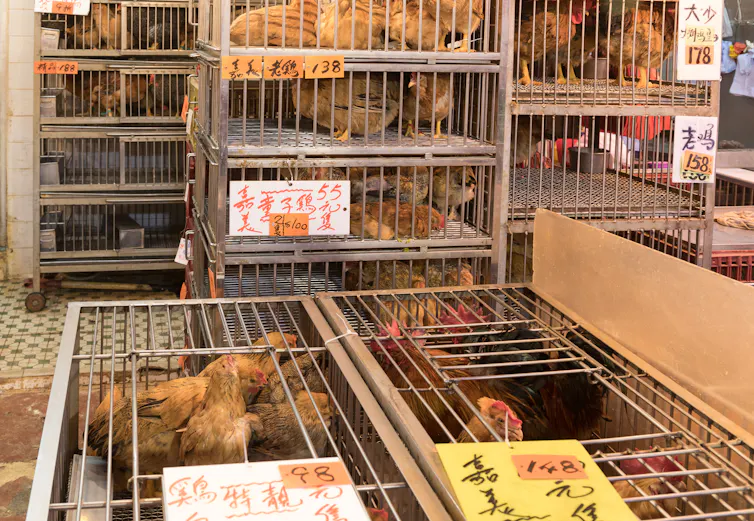
Places where lots of animals come into contact can help pathogens move from species to species. Baloncici/iStock via Getty Images Plus
Reconstructing live-animal markets and barnyards
It’s undoubtedly rare for pathogens to jump directly from animals in nature into people. But within markets like the one in Wuhan, there are abundant opportunities for the type of interactions that promote pathogen transmission among species.
To mimic these scenarios, we’ve established artificial ecosystems in our lab. That way, we can study the transmission and spread of pathogens, such as influenza viruses, among diverse groups of birds and mammals all housed together and interacting freely.
Because the pathogens we’re studying are potentially deadly and contagious, we need to be very careful they can’t escape from the lab. We establish our ecosystems under strict biocontainment conditions: All exhaust air is filtered and personnel use respirators, wear facility apparel and shower before exiting.
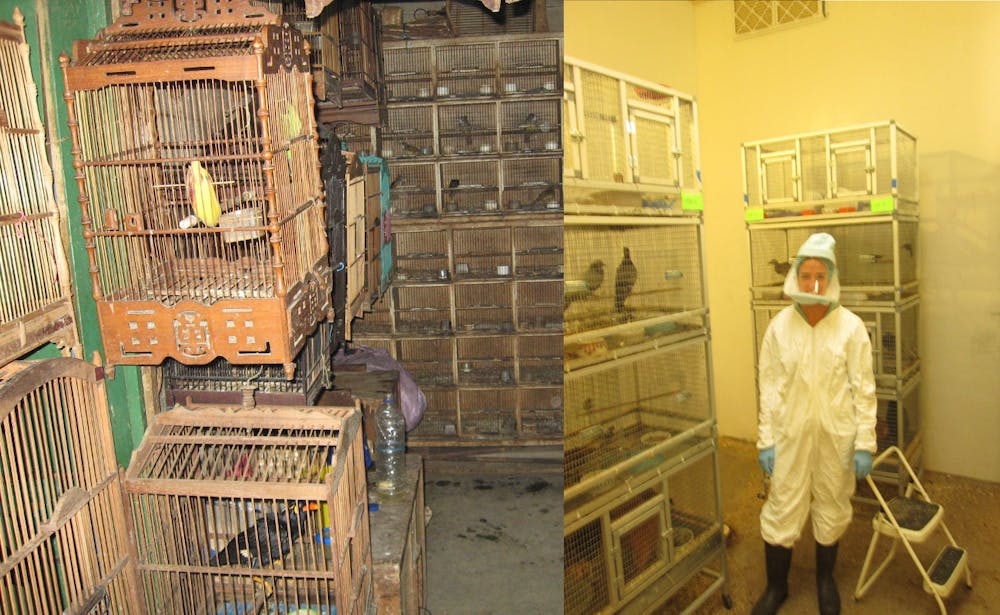
A live-animal market in Indonesia (left) and an artificial market established to study interspecies transmission of avian influenza viruses as viewed through the window of a biosafety containment level 3 room. Richard Bowen, CC BY-ND
For our studies with bird flu, we created artificial barnyards that housed ducks, chickens, pigeons, blackbirds and rats all together. They freely interacted with one another, sharing access to common feed and water. As occurs in real barnyards, the rats were never seen outside of their enclosed nests during daylight hours, though video recordings showed them cavorting around the room, bathing in the water pool and harassing the ducks in the dark. We then introduced a small number of infected ducks into the room and watched to see how infection spread.
In a different setup, we investigated transmission of another avian influenza virus among chickens, quail, pheasants and rabbits caged as in a live-animal market. Additionally, sparrows and pigeons were loose in the room and able to interact with the caged animals. As anticipated, birds housed beneath those inoculated with virus were more likely be become infected, as waste runs downhill. Quail were the most susceptible to infection.
Key discoveries have emerged from our artificial ecosystem approach. For example, we were able to show that avian influenza viruses pass among diverse birds and mammals interacting freely with one another in an artificial barnyard or artificial live-animal market. We found that there’s massive accumulation of virus in shared water sources.
More recently, we’ve created even more sophisticated artificial ecosystems that allow us to modulate temperature and humidity. We can even impose rain and wind onto an ecosystem, allowing us to evaluate environmental conditions that facilitate virus transmission.
Artificial ecosystems complement other research approaches that identify viruses and their properties. xia yuan/Moment via Getty Images
Lessons from inside the artificial ecosystems
Despite the known complexity of these sorts of interactions in the real world, it’s more typical to study emerging pathogens by focusing on infection in a single species at a time. This is partly due to the regulatory processes by which diagnostics or vaccines are approved. They require definitive demonstration of safety and efficacy in individual animal models.
We hope this new approach could foster a more realistic understanding of how pathogens are transmitted among species, including jumping into human populations, and will facilitate development of new diagnostic tests, vaccines or therapeutics.
Our ecosystem method fits in with what’s called the One Health approach to public health. One Health is based on the concept that human health is inextricably tied to the health of animals and the environment. Understanding infection in natural hosts in mixed ecosystems that mimic real-world scenarios of transmission is crucial for developing disease control methods.
[Deep knowledge, daily. Sign up for The Conversation’s newsletter.]
Richard Bowen, Professor of Biomedical Sciences, Colorado State University and Alan Rudolph, Professor of Biomedical Sciences and Vice President for Research, Colorado State University
This article is republished from The Conversation under a Creative Commons license. Read the original article.


