


from The Conversation
— this post authored by Robert E Gutsche Jr, Lancaster University
If anyone is surprised by the portrait of president Donald Trump in investigative journalist Bob Woodward’s new book, Fear: Trump in the White House, they’ve been living under a log. The way Trump treats women, immigrants, children, and the press is clearly beyond the pale, but it’s also well-established. So it pays to ask what yet another long tale of Trump’s transgressions can do for society – and for journalism.

Please share this article – Go to very top of page, right hand side, for social media buttons.
Do we really need to hear more about Donald Trump’s behaviour? What is there that we don’t already know? And what has anyone, including the media, done with this knowledge anyway?
The much-anticipated release of this tell-all by Woodward, who together with Carl Bernstein broke the Watergate story, has predictably sent the press and everyone across the US political spectrum into tremors of excitement. This latest work of political insiderdom has provided the mainstream media with “scoops” – that is, offered up a clutch of juicy quotes to journalists who’ve read select excerpts from the nearly 450-page book.
The Huffington Post’s list of outré comments allegedly made by the president, deftly titled “The Wildest Things About Trump From Bob Woodward’s New Book“, includes illuminating snippets such as Trump’s alleged mocking of attorney general Jeff Sessions’ accent:
“This guy is mentally retarded. He’s this dumb Southerner … He couldn’t even be a one-person country lawyer down in Alabama.”
Other accounts excerpted by HuffPo touch on more serious topics. Following Trump’s statement that “both sides” were responsible for the violence at an August 2017 white supremacist rally in Charlottesville, Woodward reports that “advisers urged him to make another speech condemning white supremacists and neo-Nazis”. According to Woodward, after Trump made the speech “he almost immediately told aides, ‘That was the biggest fucking mistake I’ve made’ and the ‘worst speech I’ve ever given’”.
These sorts of remarks are clearly unedifying to say the least. But the matter of whether or not people love or hate them – and, more importantly, the ideas behind them – is not changed or challenged by journalism that merely “covers” them. This is no substitute for journalism that examines the influence of such comments and actions on social change. Instead, the media too often sticks to its habit of idle voyeurism, poring over the details of what someone might have said.
A way with secrets
Woodward’s book is advertised by his employer, The Washington Post, as being
“drawn from hundreds of hours of interviews with firsthand participants and witnesses that were conducted on ‘deep background’, meaning the information could be used but he would not reveal who provided it.”
But the book comes on the heels of more than a dozen related titles by journalists this year alone. And they all tackle the same topics: misogyny, xenophobia, racial hatred, corporate greed. They are all based on personal experiences and stories of those whose names should not be mentioned. They all pretty much tell us the same thing: that Trump is a cruel, inept and unfit president. What more is there to know about him, and do we really want or need to know?
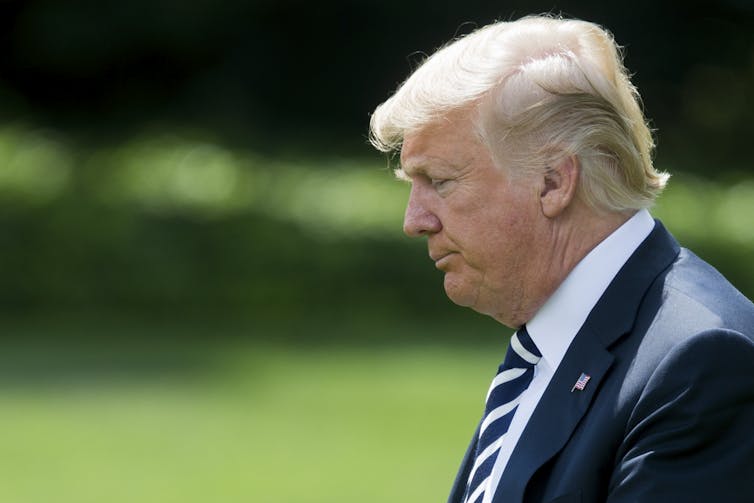
Exposed at last? Hardly. EPA/Michael Reynolds
Covering the lives of politicians and of the political press itself has been a longstanding function of US journalism. How well journalists have followed through with critical assessments of policy action, inaction and injustice, however, is left to critique. Woodward has been at the centre of covering US presidents and policy, making a career out of persuading insiders to sit down for interviews and obtaining exclusive access to documents.
The implications of Woodward’s “deep background” methodology are often glossed over by journalists and journalism scholars. Instead of being interrogated on the ethical issues deep background work presents regarding the identity of sources and how Woodward got to them, it is simply accepted as the price that must be paid for juicy detail.
These types of journalistic tactics aren’t much criticised by the mainstream press, and it’s even given a pass to use them by the political sources it uses. It’s simply part of doing business. In fact, such sources apparently like being on background not only to protect their identities, but because having secrets to leak is a mark of their power in Washington.
Toothless insiderism
This style of journalism has worked for Woodward, who became one of the world’s most celebrated reporters off the back of the Watergate investigation conducted with colleague Carl Bernstein, although a handful of people have questioned the some of the techniques they deployed.
Deep background became even more influential in the emotional telling of how president George W Bush handled (or didn’t) the 9/11 terrorist attacks. Woodward’s 2004 Plan of Attack, in which he detailed the ineptitude and calculations of the Bush Administration before and following the attacks, is a mix of unsourced quotes dishing out both great praise for the president and to-be-expected criticism.
That book, however, wasn’t as bad as Woodward’s 2002 Bush at War, which was also based on unnamed sources and lengthy private conversations with Bush himself. In the end, Woodward looked, in the words of one critic, like “pretty Pooh Bear in the end, a cuddly old muddler slopping around in a honey pot of sources“.
Journalism has been under attack for misunderstanding the influence of Trump and his supporters. In my opinion, it should also be under scrutiny for celebrating the very kind of salacious “insider journalism” that Woodward’s latest work exemplifies.
Having now read shelves upon shelves of Trump-bashing texts (and admittedly writing some myself), it’s time to change tack. What’s needed is journalism that joins the dots of bad language, misfires, and intentional wrongdoing to larger systems of power and to individuals who can be held accountable. As a reviewer of Woodward’s Bush love story put it in 2002: “Why am I being told all this? What does it mean? It isn’t investigation, just cross-referenced compilation. If you want to hit gold, do your own digging.”
Robert E Gutsche Jr, Senior Lecturer in Critical Digital Media Practice, Lancaster University
This article is republished from The Conversation under a Creative Commons license. Read the original article.


