


by Charles Hugh Smith, Of Two Minds
The idea that food is globally incredibly cheap right now doesn’t compute in the mainstream narrative.

In the consensus view, agriculture is only profitable on a mega-farm corporate scale, and tool-making has been offshored because it’s unprofitable to manufacture stuff in the U.S. But what if both of these “obvious” consensus opinions are flat-out wrong? What if small-scale farming and toolmaking are both potentially profitable?
Perhaps we should be asking: what if the highest future profits will belong to small-scale agriculture and manufacturing, not Wall Street or Silicon Valley? This idea is so far out of the mainstream that it is widely considered “impossible:” nothing could be more profitable than politically sacrosanct “too big to fail” Wall Street banks or quasi-monopoly tech giants.
As for agriculture–nothing could be more profitable than large-scale corporate production, all watched over by machines of loving grace (as per Richard Brautigan and Adam Curtis).
All of these presumed “truths” may be melting into air if small-scale machine tools and software technologies enable highly efficient and productive small-scale agriculture:
Drew Sample and I discuss these nascent but potentially revolutionary trends in a new podcast, Small Scale Farming, Small Scale Manufacturing (1:08 hrs).
Critics will quickly point out that large-scale production of grains such as corn and wheat and crops such as soy beans cannot be profitably grown in small plots. While that’s currently a financial reality, that does not imply it’s a permanent truth: large-scale agriculture consumes vast quantities of fossil fuels (currently cheap, but maybe not cheap forever) and huge quantities of minerals such as potash that are non-renewable.
Should essential non-renewables skyrocket in price, large-scale agriculture becomes a lot more costly to operate.
There’s also the question of sustainability. Typical large-scale practices such as tilling cause soil loss that cannot be “fixed” with conventional methods. Then there’s the decline of water tables as aquifers are drained by conventional agricultural practices.
In typical Wall Street fashion, the perspective on what’s sustainable currently extends about one quarter (three months). Few observers ask what will be sustainable in 20 years.
The idea that food is globally incredibly cheap right now also doesn’t compute in the mainstream narrative. The idea that basic foods could double, triple or quadruple in price as large-scale crop failures become more common and input costs soar is rejected as “impossible.” But this mainstream faith that food will remain cheap forever ignores the vulnerabilities in global stores and supply chains and the potential for catastrophic crop failures as global rainfall and climate patterns shift or become erratic.
The idea that tomorrow’s hotshots will not be attorneys or coders or bankers but makers and growers appears improbable in the current era of glorifying financiers and techies. But if these centralized, largely abstract profit centers have reached the apex of the S-Curve, then their days of dominance are numbered regardless of what analysts project.
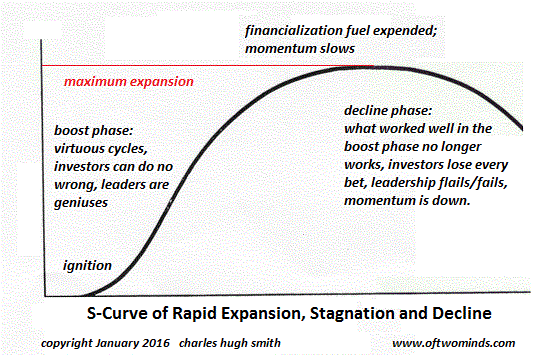
Right now such a decline in the dominance of centralized corporate farming, banking and technology is viewed as “impossible.” Maybe the wiser view is that such a decline in both inevitable and healthy for the nation, though not for Wall Street.
New podcast: Small Scale Farming, Small Scale Manufacturing (1:08 hrs)


