


from the Atlanta Fed
— this post authored by John Robertson
The Atlanta Fed’s Wage Growth Tracker has shown an uptick during the past several months. The 12-month average reached 3.7 percent in June, up from 3.2 percent last year. But in 2016, it depicted acceleration that eventually reversed course. So is this recent increase real or illusory?

Although using a 12-month average quiets much of the noise in the monthly data, it is possible that the smoothed series still may exhibit some unwanted variation due to the way the Wage Growth Tracker is constructed. For example, how the monthly Current Population Survey reports individual earnings might be a factor introducing unwanted noise into the Tracker. Specifically, some people directly report their hourly rate of pay, and some report their earnings in terms of an amount per week, per month, or per year.
Relative to those paid an hourly rate, there are at least a couple of reasons why using the earnings of nonhourly workers might introduce additional variability into the Wage Growth Tracker’s overall estimate of wage growth. First, reported nonhourly earnings include base pay as well as any overtime pay, tips, and commissions earned, and hence can vary over time even if the base rate of pay didn’t change. For a worker paid at an hourly rate, reported earnings exclude overtime pay, tips, and commissions and so are not subject to this source of variation. Second, the method we use to convert nonhourly earnings to an hourly rate is likely subject to some margin of error since it involves using the person’s recollection of how many hours they usually work. These two factors suggest that the earnings of workers paid at an hourly rate might be a somewhat cleaner measure of hourly earnings.
To investigate whether this distinction actually matters in practice, we created the following chart comparing the 12-month average Wage Growth Tracker since 2015 (depicted in the green line) with a version that uses only the earnings of those paid at an hourly rate (blue line).
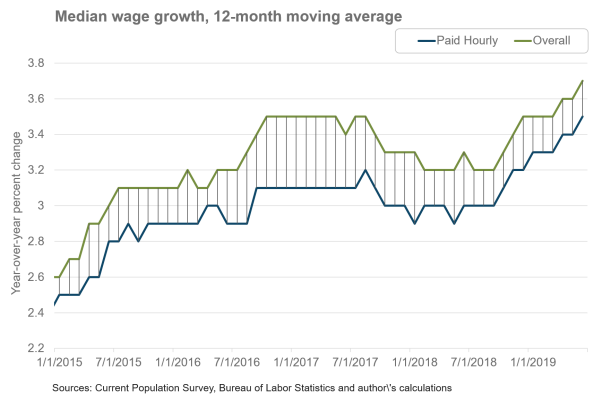
As the chart shows, the 12-month average of median wage growth for hourly workers generally tracks the overall series – both series are about a percentage point higher than at the beginning of 2015. However, the hourly series is a bit less variable, making the recent uptick in wage growth more noticeable in the hourly series than in the overall series. This observation suggests that as we monitor shifts in wage pressure, the hourly series could complement the overall series nicely. Versions of the Wage Growth Tracker series for both hourly and nonhourly workers are now available on the Wage Growth Tracker page of the Atlanta Fed’s website.
If you would like to use the Wage Growth Tracker’s underlying microdata to create your own versions (or to conduct other analysis), follow this link to explore the data on the Atlanta Fed’s website. See this macroblog post, “Making Analysis of the Current Population Survey Easier,” from my colleague Ellyn Terry to learn more about using this dataset.
Source
About the Author
 John Robertson, a senior policy adviser in the Atlanta Fed’s research department


